Leptaena
Leptaena is a genus of extinct brachiopods, commonly referred to as lamp shells. These marine invertebrates are frequently discovered as fossils within…
What is Leptaena?
Leptaena is a genus of extinct brachiopods, commonly referred to as lamp shells. These marine invertebrates are frequently discovered as fossils within sedimentary rocks dating from the Ordovician to the Lower Carboniferous periods, spanning approximately 488 million to 318 million years ago.1
The shell of Leptaena is highly distinctive, recognized primarily by its wrinkled ornamentation and fine linear markings. Like other members of the phylum Brachiopoda, these animals were sedentary, unsegmented creatures enclosed within a bivalve shell.12
What are the main differences between brachiopods and bivalve mollusks?
While brachiopods and bivalve mollusks both possess two-part shells and live in aquatic environments, they are biologically distinct groups that are not closely related. Their primary differences lie in their body symmetry, feeding mechanisms, and internal anatomy.5
Symmetry and Shell Orientation
- Bivalves: The two valves of a bivalve are typically mirror images of each other (left and right), with the plane of symmetry passing between the two valves.6
- Brachiopods: The two valves are unequal in size and shape (dorsal and ventral), but each individual valve is symmetrical along its own midline. The plane of symmetry passes through the center of each valve.7
Feeding Mechanisms
- Bivalves: Most modern bivalves are suspension feeders that use modified gills called ctenidia to filter food particles from the water.68
- Brachiopods: These animals use a specialized, horseshoe-shaped organ called a lophophore, which is covered in ciliated filaments that create water currents to trap food particles.97
Internal Anatomy
- Digestive System: Bivalves have a complete digestive tract that includes an anus. In contrast, many articulate brachiopods have a blind intestine, meaning they lack an anus and must excrete waste through the mouth.697
- Musculature: Bivalves use adductor muscles to close their shells, and many species are capable of movement or even swimming. Brachiopods use a more complex set of muscles to open and close their valves, and they are generally sedentary, often attaching to surfaces via a fleshy stalk called a pedicle.6897
How do fossils help scientists understand ancient marine environments?
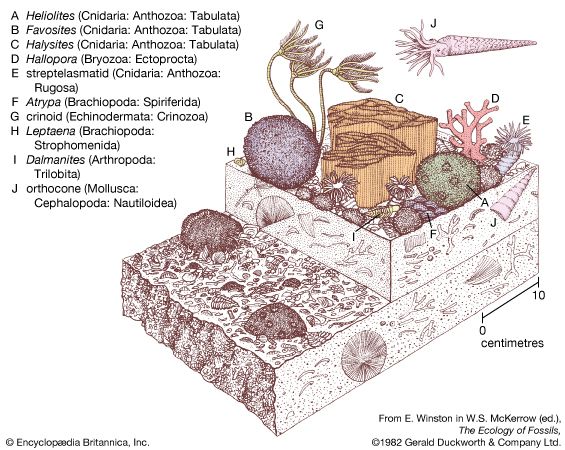
Fossils serve as essential indicators of ancient marine environments, allowing scientists to reconstruct the conditions of the past through the field of paleoecology. By analyzing the remains of organisms preserved in sedimentary rock, researchers can determine the physical and biological constraints of the sites where these creatures lived.131415
Specialists known as paleoecologists examine fossil assemblages to answer critical questions about ancient ecosystems, such as:1416
- Environmental Conditions: Certain species, such as specific types of coral, require warm, shallow water to survive. Finding such fossils in regions that are now polar suggests that the Earth’s crust has shifted over time.1315
- Ecological Niches: Scientists study the food chain and community structure of fossilized organisms to understand their roles within their habitat.14
- Sedimentation and Behavior: Evidence of burrowing or trace fossils provides insight into how organisms interacted with the seafloor and adapted to predation pressures.1715
Furthermore, index fossils help geologists correlate strata across vast distances, providing a framework for understanding the history of marine life and the evolution of Earth.181419
What is a lophophore and how do brachiopods use it to feed?
A lophophore is a specialized, circular or horseshoe-shaped organ found in certain aquatic invertebrate animals, including lamp shells (brachiopods), bryozoans, and phoronid worms. It is characterized by a fan of ciliated tentacles that function primarily in food-gathering and respiration.21228
Brachiopods use the lophophore to feed through a process of filter feeding:
- Water Currents: By opening their shells, brachiopods expose the lophophore. The rhythmic lashing of the cilia—tiny, hairlike structures on the lophophore’s filaments—creates water currents that draw food-bearing water toward the animal.23
- Particle Capture: As water flows over the lophophore, minute organisms and organic particles are trapped, often within mucus secreted by the organ.23
- Transport: Cilia located in grooves along the lophophore then transport these trapped particles directly to the mouth.23
Some species utilize specialized shell structures to separate incoming food-bearing currents from outgoing waste-bearing currents, ensuring efficient feeding.23
Sources
- Leptaena — Encyclopædia Britannica
- Brachiopoda — Merriam-Webster
- Strophomena — Encyclopædia Britannica
- Stropheodonta — Encyclopædia Britannica
- bivalve - Internal features — Encyclopædia Britannica
- bivalve - Evolution and paleontology — Encyclopædia Britannica
- bivalve - Ecology and habitats — Encyclopædia Britannica
- lamp shells - Behaviour and ecology — Encyclopædia Britannica
- lamp shells - Size range and diversity of structure — Encyclopædia Britannica
- lamp shells - Form and function — Encyclopædia Britannica
- skeleton - Calcareous structures — Encyclopædia Britannica
- Circulatory system - Brachiopoda — Encyclopædia Britannica
- index fossil — Encyclopædia Britannica
- fossil record — Encyclopædia Britannica
- Jurassic Period - Protists and invertebrates — Encyclopædia Britannica
- paleoecology — Merriam-Webster
- geology - Paleontology — Encyclopædia Britannica
- paleontology — Encyclopædia Britannica
- paleoecologist — Merriam-Webster
- fossil — Encyclopædia Britannica
- lophophorate — Encyclopædia Britannica
- lophophore — Merriam-Webster
- lophophore hypothesis — Encyclopædia Britannica
Published on · 3 min read