Dielasma
Dielasma is a genus of extinct brachiopods, commonly known as lamp shells, that lived between 359 million and 251 million years ago during the Carboniferous…
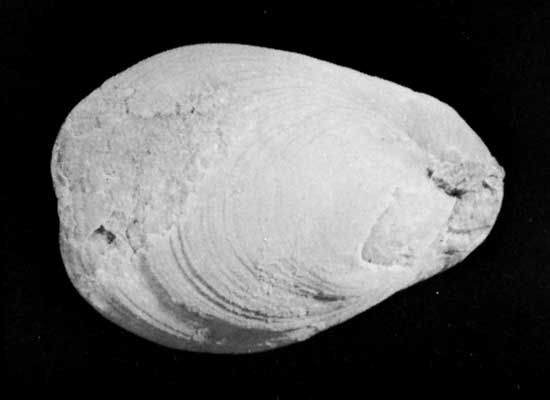
What is Dielasma?
Dielasma is a genus of extinct brachiopods, commonly known as lamp shells, that lived between 359 million and 251 million years ago during the Carboniferous to Permian periods.1
These organisms are found as fossils in ancient marine rock deposits. Their shells consist of two small, relatively smooth valves that are slightly convex in profile. A distinguishing feature is that the pedicle (or foot) valve is significantly larger than the brachial (or upper) valve, and the shells typically exhibit visible growth lines. In terms of their habitat and geological time range, Dielasma shares similarities with another brachiopod genus, Composita.1
What are brachiopods and how do they live?
Brachiopods, commonly known as lamp shells, are bottom-dwelling marine invertebrates belonging to the phylum Brachiopoda. They are characterized by two valves (shells) of unequal size that cover the dorsal and ventral sides of the animal. While they superficially resemble mollusks, they are not related.34
How They Live
Brachiopods are filter feeders that inhabit all oceans, ranging from shallow tidal zones to the deep abyss. Their lifestyle includes:35
- Feeding: They use a horseshoe-shaped organ called a lophophore, which is covered in cilia (hairlike structures). By lashing these cilia, they create water currents that filter minute organisms and organic particles from the seawater.56
- Attachment: Most modern species anchor themselves to hard objects like pebbles or stones using a stalklike organ called a pedicle. Some specialized forms cement themselves to the substrate, while others lie loose on the sea floor.57
- Environment: They generally prefer quiet, protected surroundings. For example, the genus Lingula lives in burrows within mud or sand, using its contractile pedicle to extend or retract its shell.57
- Reproduction: Most species have separate sexes. Fertilization typically occurs externally in the water, though some species develop their young in brood pouches.8
What characterizes the Carboniferous and Permian periods?
The Carboniferous Period (roughly 359 to 299 million years ago) and the Permian Period (299 to 252 million years ago) represent a transformative era in Earth’s history, marked by significant geological and biological shifts.
The Carboniferous Period
This period was characterized by highly variable environments, including shallow marine settings and vast continental coal swamps, particularly during the Pennsylvanian subperiod.13
- Life: Marine communities were dominated by crinoids, bryozoans, and brachiopods), and brachiopods. On land, insects diversified rapidly, with high atmospheric oxygen levels potentially enabling some, such as early dragonflies, to reach massive sizes. The first reptiles also appeared during this time.161413
- Geology: Extensive mountain-building events occurred across the globe, and the Southern Hemisphere experienced widespread glaciation.13
The Permian Period
The Permian was defined by the assembly of the supercontinent Pangea, which profoundly influenced global climate and life.1516
- Climate: The period began with widespread glaciation, but shifted toward global warming and arid conditions as Pangea formed. By the Late Permian, hot, dry climates and widespread deserts were common.1517
- Life and Extinction: Terrestrial plants and reptiles continued to diversify. However, the period ended with the largest mass extinction in Earth’s history, likely triggered by extreme climate shifts, volcanic activity (such as the Siberian Traps), and ocean oxygen depletion.151718
How do scientists use fossils to learn about ancient marine environments?
Scientists use fossils to reconstruct ancient marine environments through the field of paleoecology, which examines the relationships between ancient organisms and their surroundings. By analyzing the types of fossils present in sedimentary strata, researchers can determine the ecological niches, food chains, and biological communities that existed in past oceans.192021
Key methods include:
- Environmental Indicators: Certain organisms have specific habitat requirements. For example, the presence of specific coral species indicates that the environment was once warm and shallow. If such fossils are found in regions that are now polar, it suggests that the Earth’s crust has shifted position over time.21
- Isotopic Analysis: Scientists study the ratio of oxygen isotopes (16^{16}O and 18^{18}O) in the calcium carbonate shells of microfossils. Because these ratios are influenced by water temperature and the volume of global ice, they provide a continuous record of past glaciations and climate cycles.22
- Stratigraphic Correlation: Index fossils—which are abundant, widespread, and existed for a short time—help geologists date and correlate marine strata across different regions, allowing for a broader understanding of ancient environmental changes.2320
Sources
- Dielasma — Encyclopædia Britannica
- terebratulid — Merriam-Webster
- lamp shells — Encyclopædia Britannica
- branchiopod - Evolution and paleontology — Encyclopædia Britannica
- branchiopod - Distinguishing taxonomic features — Encyclopædia Britannica
- lamp shells - Size range and diversity of structure — Encyclopædia Britannica
- lamp shells - Reproduction — Encyclopædia Britannica
- lamp shells - Behaviour and ecology — Encyclopædia Britannica
- lamp shells - Form and function — Encyclopædia Britannica
- branchiopod - Distribution and abundance — Encyclopædia Britannica
- lamp shells - Distinguishing taxonomic features — Encyclopædia Britannica
- Circulatory system - Brachiopoda — Encyclopædia Britannica
- A Journey Through Time Since the Precambrian - Permian Period: 298.9 million to 252.2 million years ago — Encyclopædia Britannica
- Permian Period - The Permian environment — Encyclopædia Britannica
- Permian Period - Paleoclimate — Encyclopædia Britannica
- Carboniferous Period - Distinctive features — Encyclopædia Britannica
- Permian Period - Temperature crises — Encyclopædia Britannica
- Carboniferous Period - Invertebrates — Encyclopædia Britannica
- index fossil — Encyclopædia Britannica
- fossil record — Encyclopædia Britannica
- Pleistocene Epoch - Marine oxygen isotope record — Encyclopædia Britannica
- Jurassic Period - Protists and invertebrates — Encyclopædia Britannica
- Precambrian - Development of the ocean — Encyclopædia Britannica
- paleoecology — Merriam-Webster
- geology - Paleontology — Encyclopædia Britannica
Published on · 3 min read