Atrypa
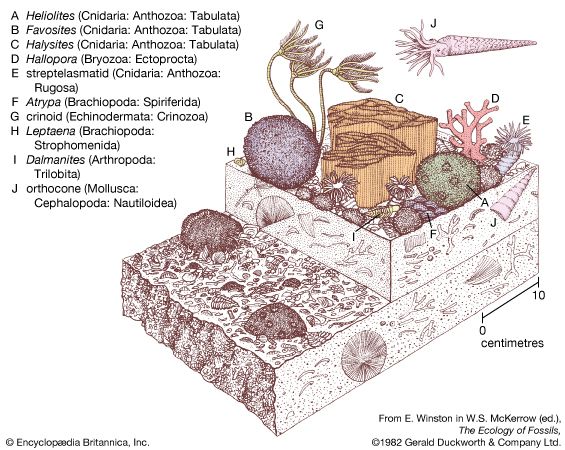
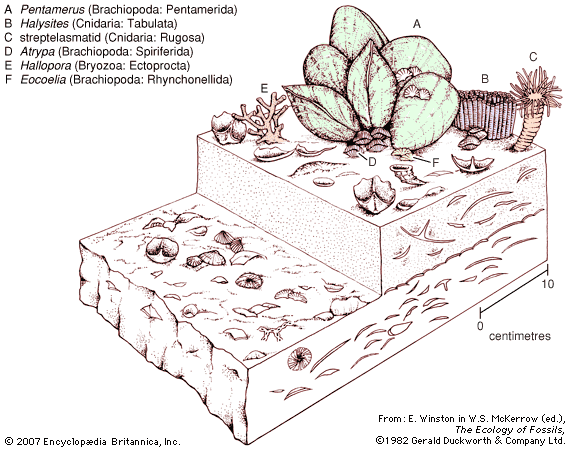
Atrypa is a genus of extinct brachiopods, commonly known as lamp shells, that lived from the Silurian through the Early Carboniferous periods, approximately…
What is Atrypa?
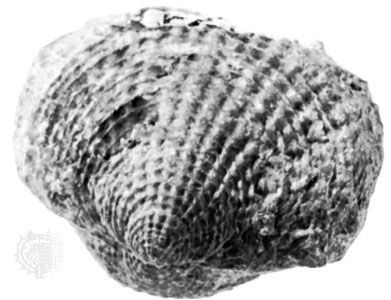
Atrypa is a genus of extinct brachiopods, commonly known as lamp shells, that lived from the Silurian through the Early Carboniferous periods, approximately 444 million to 318 million years ago.12
These marine invertebrates are characterized by their distinctive concentric growth lines and unique shell outgrowths. Anatomically, they are defined by a brachidium—an internal support structure for the feeding organ—with plates that form spirally rolled processes. Fossils of Atrypa are abundant in marine rock formations, though researchers have noted that in some Devonian-era sites, only the pedicle (bottom) valves are found, likely due to selective sorting by ancient ocean currents.13
Because of their widespread occurrence during specific geological intervals, they serve as useful indicators for dating rock layers.2
What are the main differences between brachiopods and mollusks?
Although brachiopods (lamp shells) and mollusks (specifically bivalves) may superficially resemble one another due to their two-shelled appearance, they are distinct groups of animals with fundamental biological differences.35
Key Differences
- Symmetry: Brachiopod shells are bilaterally symmetrical across the valves; that is, the left and right sides of a single valve are mirror images of each other. In contrast, most bivalve mollusks exhibit symmetry between the two valves themselves, though some species (like oysters and scallops) have evolved irregular or radial shapes.367
- Anatomy: Brachiopods are characterized by a lophophore—a specialized feeding organ—and a body divided into a posterior visceral cavity and an anterior mantle cavity. Bivalves utilize gills (ctenidia) for both respiration and filter feeding, and they possess a muscular foot used for movement or attachment.867
- Valve Orientation: In brachiopods, the two valves are positioned dorsally (top) and ventrally (bottom). Bivalve mollusks typically have valves positioned on the left and right sides of the body.367
- Evolutionary Relationship: Despite their similar appearance, these two phyla are not closely related.5
How do scientists use fossils to date geological time periods?
Scientists use fossils to determine the relative age of rock layers through the principle of faunal succession, which observes that different intervals of Earth’s history are characterized by unique assemblages of animal life. By identifying these specific fossil sequences, geologists can correlate rock layers found in different geographic locations, establishing that they were formed during the same time period.1011
The primary tool for this process is the index fossil. To be effective, an index fossil must meet several criteria:1011
- Short temporal range: The species existed for a relatively brief span of geologic time.1210
- Wide distribution: It was geographically widespread, allowing for global correlation.1210
- Distinctiveness: It is easily recognizable, preventing misidentification.1210
- Abundance: It is common enough to be discovered frequently in the rock record.1210
While fossils provide a reliable relative timeline, they are often calibrated using absolute dating techniques, such as radiometric measurements of volcanic minerals found in adjacent rock units. This integration of biostratigraphy and isotopic dating allows scientists to construct a precise and consistent geologic time scale.101113
What was the environment like during the Silurian and Devonian periods?
The Silurian and Devonian periods were times of significant environmental change, marked by shifting sea levels, the formation of new landmasses, and the colonization of terrestrial habitats.
The Silurian Period (443.4 to 419.2 million years ago)
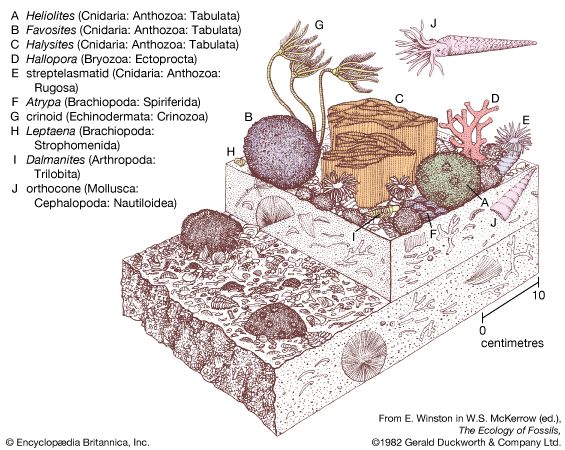
The Silurian was characterized by generally low continental elevations and a high global sea level, which rose significantly as Late Ordovician glaciers melted. This flooding created vast shallow seas across continental platforms, fostering the growth of widespread coral mound reefs. While marine life, including jawless and early jawed fishes, thrived in these environments, terrestrial life was limited; vascular plants began to colonize coastal lowlands, but continental interiors remained largely barren.1516
The Devonian Period (419.2 to 359 million years ago)
Often called the “Age of Fishes,” the Devonian saw the union of North America, Greenland, and Europe into the supercontinent Laurussia (or Euramerica).1718
- Terrestrial Expansion: This period featured the first extensive colonization of land by plants, leading to the development of the earliest known forests by the Middle Devonian. Vertebrates also moved onto land, with the first four-legged amphibians appearing late in the period.192017
- Marine Environment: Approximately 85 percent of the globe was covered by oceans. However, these seas frequently experienced episodes of low oxygen (anoxia), which are linked to several major extinction events that decimated marine groups like corals, brachiopods, and trilobites.172118
- Climate: The climate was generally warm and equitable, though the period also saw fluctuations in sea level and evidence of cooling, potentially associated with glacial development in the Late Devonian.1721
Sources
- Atrypa — Encyclopædia Britannica
- Atrypa — Merriam-Webster
- lamp shells — Encyclopædia Britannica
- atrypoid — Merriam-Webster
- lamp shells - Size range and diversity of structure — Encyclopædia Britannica
- bivalve - Internal features — Encyclopædia Britannica
- lamp shells - Form and function — Encyclopædia Britannica
- What’s the difference between clams, mussels, and oysters? — Encyclopædia Britannica
- Circulatory system - Brachiopoda — Encyclopædia Britannica
- index fossil — Encyclopædia Britannica
- dating - Principles and techniques — Encyclopædia Britannica
- dating - Distinctions between relative-age and absolute-age measurements — Encyclopædia Britannica
- Tertiary Period - Correlation of Tertiary strata — Encyclopædia Britannica
- geochronology - Accumulational processes — Encyclopædia Britannica
- A Journey Through Time Since the Precambrian - Devonian Period: 419.2 million to about 359 million years ago — Encyclopædia Britannica
- Devonian Period - Extinction events — Encyclopædia Britannica
- Devonian Period - Significant geologic events — Encyclopædia Britannica
- Silurian Period - Paleogeography — Encyclopædia Britannica
- Devonian Period - Devonian life — Encyclopædia Britannica
- Silurian Period - Silurian sea level — Encyclopædia Britannica
- Devonian Period - Plants — Encyclopædia Britannica
- A Journey Through Time Since the Precambrian - Silurian Period: 443.4 million to 419.2 million years ago — Encyclopædia Britannica
Published on · 4 min read