Indian Paint Brush
The term "Indian paint brush" refers to any plant belonging to the genus Castilleja. These herbaceous plants, which include about 200 species, are notable…
What is Indian paint brush?
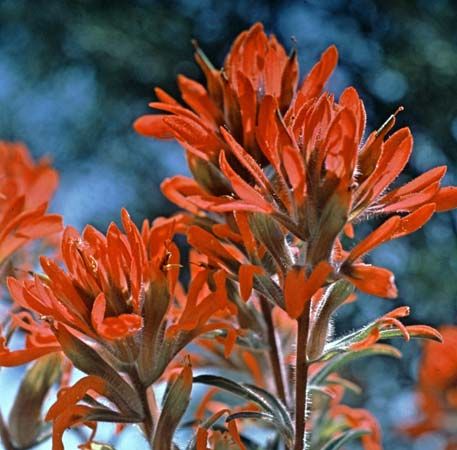
The term “Indian paint brush” refers to any plant belonging to the genus Castilleja. These herbaceous plants, which include about 200 species, are notable for being partially or wholly parasitic, as they derive nourishment from the roots of other plants.12
The plant is characterized by small, irregular, tubular flowers surrounded by brightly colored bracts—often red, orange, yellow, pink, or white—which give the appearance of having been dipped in paint. Due to their parasitic nature, they are rarely cultivated successfully in home gardens. The Indian paintbrush is also recognized as the official state flower of Wyoming.123
How do parasitic plants steal nutrients from their hosts?
Parasitic plants obtain nutrients and water from their hosts through a specialized organ called a haustorium. This structure serves as the defining feature of parasitic plants, acting as a bridge that penetrates the host’s tissues to establish a vascular union between the two plants.45
Once this connection is formed, the haustorium allows the parasite to redirect the host’s resources for its own survival. The process varies depending on the type of parasite:
- Hemiparasites: These plants possess the ability to photosynthesize but rely on the host primarily for water and mineral nutrients.5
- Holoparasites: These are nonphotosynthetic and depend entirely on the host for all their nutritional needs, often lacking chlorophyll and functional root systems.5
The haustorium may develop from either the roots or stems of the parasite, depending on the species. While some parasites remain largely external to the host, others grow endophytically, meaning their vegetative growth occurs entirely within the host, emerging only to produce flowers.5
Why is the Indian paintbrush the state flower of Wyoming?
The Indian paintbrush (Castilleja linariifolia) was officially designated as the state flower of Wyoming by the state legislature on January 31, 1917.
The selection was driven by the plant’s status as a native wildflower that thrives across the state’s diverse landscapes, from high mountain meadows to arid plains. Its vibrant, brush-like appearance—which earned it its common name—made it a recognizable and iconic symbol of the Wyoming wilderness. By adopting the Indian paintbrush, the state sought to honor its unique natural heritage and the rugged beauty of its native flora.3
What are bracts and how do they differ from flower petals?
A bract is a modified, typically small, leaflike structure positioned beneath a flower or an inflorescence. While they are botanically distinct from petals, they are frequently mistaken for them because they can be large and brightly colored to attract pollinators or provide protection to the developing flower cluster.67
The primary differences include:
- Origin: Bracts are modified leaves that arise from the axil of a flower or floral axis, whereas petals are specialized floral organs that form part of the flower’s reproductive structure.68
- Function: While petals are primarily involved in attracting pollinators through color and scent, bracts often serve a protective role, such as the woody, boat-shaped bracts found in many palms.7
- Appearance: In many species, such as poinsettias or dogwoods, the showy, colorful parts that appear to be petals are actually modified bracts.67
Sources
- Indian paint brush — Encyclopædia Britannica
- Indian paintbrush — Merriam-Webster
- Wyoming: Country Facts — Encyclopædia Britannica
- haustorium — Encyclopædia Britannica
- parasitic plant — Encyclopædia Britannica
- bract — Encyclopædia Britannica
- angiosperm - The receptacle — Encyclopædia Britannica
- bract — Merriam-Webster
Published on · 2 min read