Inselberg
An inselberg (from the German Insel, meaning "island," and Berg, meaning "mountain") is an isolated hill or mountain that rises abruptly above a surrounding…
What is inselberg?
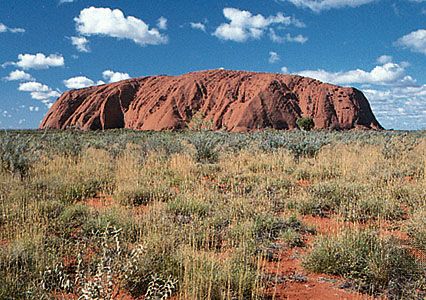
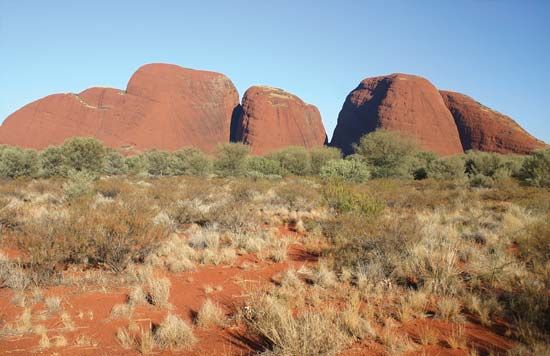
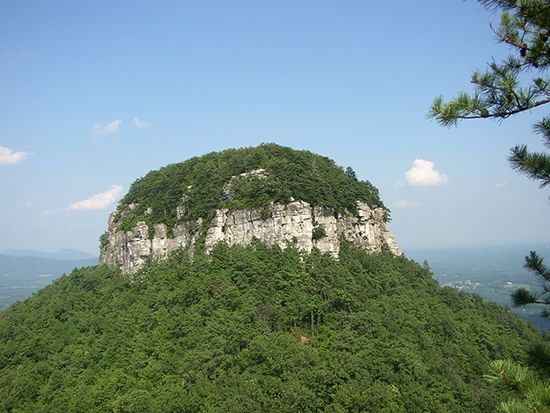
An inselberg (from the German Insel, meaning “island,” and Berg, meaning “mountain”) is an isolated hill or mountain that rises abruptly above a surrounding plain. These landforms were named by early German explorers in southern Africa who observed that the domed or castle-like peaks resembled islands rising from the sea.12
Geologically, inselbergs are relict features that have maintained their elevation while the adjacent landscape was lowered by erosion. They are often composed of hard rock that has resisted weathering, allowing them to survive for tens of millions of years. Notable examples include Uluru/Ayers Rock and the Olga Rocks in central Australia. In some contexts, the term “monadnock” is used as a synonym for these structures.12
How does subsurface weathering create these landforms?
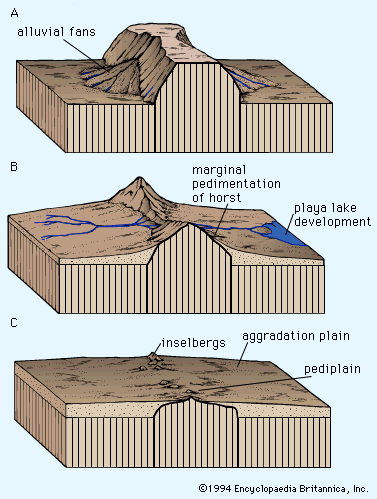
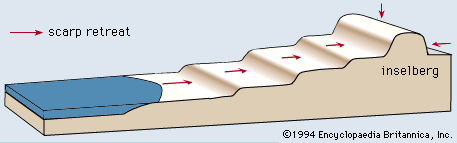
Subsurface weathering plays a critical role in the formation of granitic inselbergs, a process notably demonstrated by the geomorphologist C.R. Twidale.1
This mechanism is closely linked to the concept of etchplanation, where deep weathering creates a sharp contrast between a thick layer of weak, decomposed rock (regolith) and the underlying zone of intact, resistant rock.5
The process generally follows these steps:
- Deep Weathering: Over long periods, chemical weathering penetrates the bedrock, often following fractures or joints, to create a deep, uneven subsurface landscape.5
- Etching: This creates a “weathering front” that defines the boundary between the weathered material and the solid rock core.5
- Stripping: When subsequent erosional processes remove the overlying weathered regolith, the previously hidden, resistant rock compartments are exposed at the surface.15
Because the surrounding landscape is lowered while these resistant cores remain, the exposed rock stands out as an isolated, prominent hill—the inselberg. These features are considered relict landforms, often surviving with minimal modification for tens of millions of years.1
What is the difference between an inselberg and a mountain?
An inselberg is a specific type of isolated hill or mountain that rises abruptly above a surrounding plain, resembling an island in the sea. While the term “mountain” is a broad, general category for any significant landform that rises prominently above its surroundings, an inselberg is defined by its specific geological history and appearance.41
The primary differences include:
- Formation: Unlike many mountains formed by tectonic uplift or volcanic activity, an inselberg is a relict feature. It remains standing because its hard, resistant rock has withstood the erosion that lowered the surrounding landscape over millions of years.41
- Context: Mountains often exist as part of larger ranges or chains. In contrast, an inselberg is characterized by its isolation, standing as a solitary feature amidst a well-developed plain.41
- Terminology: Because of their distinct appearance, inselbergs are sometimes referred to as monadnocks, a term derived from Mount Monadnock in New Hampshire.4
Why are inselbergs considered paleoforms?
Inselbergs are classified as paleoforms because they are relict landforms that have persisted with minimal modification for tens of millions of years. As residual features, they represent remnants of an ancient landscape that escaped destruction while the surrounding terrain was lowered by erosional processes.16
Their status as paleoforms is defined by several key characteristics:
- Longevity: These structures can survive for vast geological timescales, often spanning the Paleogene and Neogene periods.17
- Relict Nature: They are inherited elements of the landscape, often reflecting environmental conditions from past climates rather than modern erosional regimes.18
- Stability: While the surrounding plains have undergone significant degradation, the inselbergs have maintained their relief due to the high resistance of their rock cores.1
Because they remain as “islands” of ancient topography amidst modern landscapes, they serve as vital evidence for understanding long-term geomorphic evolution and the profound climatic changes that have shaped the Earth’s surface over millions of years.18
Sources
- inselberg — Encyclopædia Britannica
- inselberg — Merriam-Webster
- inselbergs — Merriam-Webster
- inselberg — Merriam-Webster
- planation surface — Encyclopædia Britannica
- residual landform — Encyclopædia Britannica
- duricrust - Effects of climate and time — Encyclopædia Britannica
- valley - Role of climatic change — Encyclopædia Britannica
Published on · 3 min read