Monadnock
A monadnock is an isolated hill or mountain of bedrock that rises conspicuously above the surrounding landscape. These features are classified as residual…
What is monadnock?
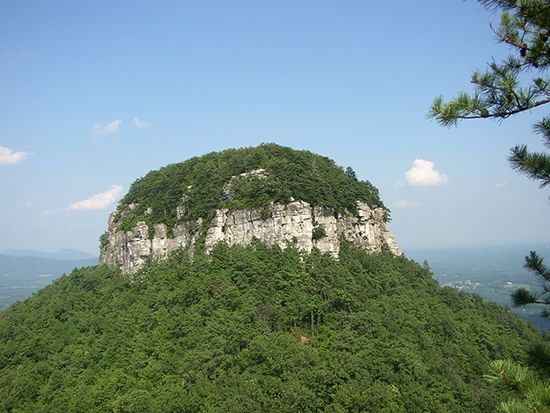
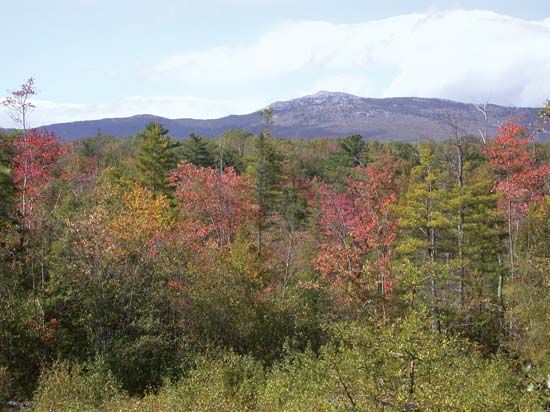
A monadnock is an isolated hill or mountain of bedrock that rises conspicuously above the surrounding landscape. These features are classified as residual landforms, meaning they have survived the erosion that leveled the terrain around them.12
This resistance to weathering is typically due to the composition of the rock, which often consists of durable materials like quartzite or massive, less-jointed volcanic rock. While monadnocks are similar to inselbergs—a term often used synonymously—the term monadnock is specifically applied to such formations in humid, temperate regions.134
The name is derived from Mount Monadnock in New Hampshire, U.S., which serves as the classic example of the feature. Another well-known instance is Stone Mountain in Georgia.15
How does erosion shape the landscape over time?
Erosion is the process by which Earth’s surface is worn down and molded through the removal and transportation of soil and rock debris. This process, often following the disintegration of rock via weathering, is driven by natural agents such as water, ice, and wind.7
Primary Agents of Erosion
- Water: As the most significant erosional agent, moving water scours riverbanks and coastlines. In rivers, sediment load acts as an abrasive tool, carving the landscape, while wave action creates features like sea cliffs, sea arches, and wave-cut platforms.7
- Glaciers: Glaciers reshape the land by grinding over surfaces and plucking rock from the bed. They transform narrow, V-shaped stream valleys into broad, U-shaped valleys and carve out cirques, arêtes, and horns.89
- Wind: In arid regions, wind erodes rock through deflation—the removal of loose particles—and sandblasting, which shapes landforms by driving sand against them.7
Through these continuous processes, erosion alters existing landforms and creates new ones, eventually transporting materials to be deposited elsewhere.7
What are the differences between monadnocks and inselbergs?
While the terms monadnock and inselberg are often used synonymously to describe isolated hills of bedrock that remain after surrounding areas have eroded, they are distinguished primarily by their geographic and climatic context.
- Monadnocks: This term is specifically applied to isolated bedrock hills formed in humid, temperate regions. The name originates from Mount Monadnock in New Hampshire, U.S., which serves as the definitive example of this landform.1
- Inselbergs: Derived from the German words for “island” and “mountain,” this term is typically used to describe similar isolated mountains found in tropical or arid environments. Famous examples include the rock formations in central Australia.111
Both landforms are considered residual landforms, as they persist because their composition—often durable quartzite or massive, less-jointed volcanic rock—is more resistant to weathering and erosion than the surrounding terrain.1113
Why are some rocks more resistant to weathering than others?
The resistance of a rock to weathering is determined by several intrinsic and environmental factors that dictate how it responds to physical and chemical processes.14
Key factors influencing weathering resistance include:
- Mineralogical Composition: The specific minerals within a rock dictate its susceptibility to alteration. Rocks composed of minerals that are stable under surface conditions are generally more resistant to chemical decomposition.14
- Rock Texture: Grain size plays a significant role; fine-grained rocks are typically more prone to chemical alteration, whereas coarser-grained rocks may respond differently to physical forces.14
- Structural Integrity: The presence of joints, fractures, and fissures creates pathways for water and air to penetrate the rock mass. Consequently, monolithic or solid structures are significantly more resistant to weathering than shattered or fractured rock masses.14
- Environmental Conditions: The local climate acts as a primary control. For instance, humid tropical climates accelerate chemical weathering, while sub-Arctic regions promote physical disintegration through freeze-thaw cycles.14
Ultimately, a rock’s behavior is an aggregate of its constituent minerals and the physical properties—such as porosity and packing arrangement—that define its structure.15
Sources
- monadnock — Encyclopædia Britannica
- Mount Monadnock — Encyclopædia Britannica
- Did you know? — Merriam-Webster
- residual landform — Encyclopædia Britannica
- monadnock — Merriam-Webster
- mountain - Geomorphic characteristics — Encyclopædia Britannica
- erosion — Encyclopædia Britannica
- river - Deposits and stratigraphy — Encyclopædia Britannica
- glacial valley — Encyclopædia Britannica
- glacial landform - Cirques , tarns, U-shaped valleys, arêtes, and horns — Encyclopædia Britannica
- inselberg — Merriam-Webster
- inselbergs — Merriam-Webster
- Wetland - Climate — Encyclopædia Britannica
- weathering — Encyclopædia Britannica
- rock - Physical properties — Encyclopædia Britannica
- rock - Effect of environmental conditions — Encyclopædia Britannica
Published on · 3 min read