Jaluit Atoll
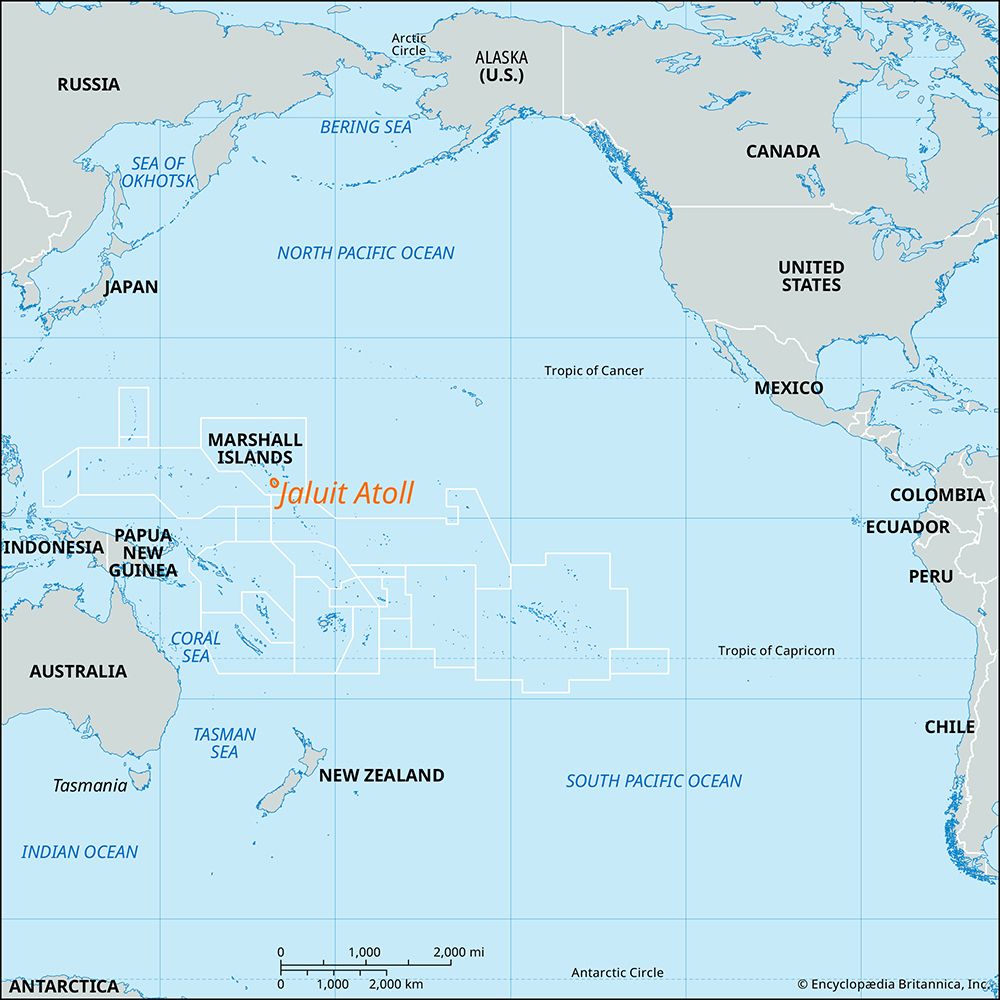
Jaluit Atoll is a coral formation located in the Ralik chain of the Marshall Islands in the west-central Pacific Ocean. The atoll features a total land area…
What is Jaluit Atoll?
Jaluit Atoll is a coral formation located in the Ralik chain of the Marshall Islands in the west-central Pacific Ocean. The atoll features a total land area of 4.4 square miles and includes a lagoon that serves as an accessible anchorage.12
Historically, the atoll has played a significant role in the region:
- Missionary Arrival: It was the site where the first missionaries arrived in the Marshall Islands in 1857.1
- Colonial Administration: In 1885, Germany declared a protectorate over the islands at Jaluit, which subsequently served as an administrative center under both German and Japanese rule.1
- World War II: The atoll was heavily fortified by the Japanese and later devastated by U.S. bombing during World War II.1
Today, the economy of the atoll, which has a population of 1,788 (2011), relies on fishing and the export of copra.1
How is a coral atoll formed?
A coral atoll is typically formed through a process of gradual subsidence, a theory first proposed by Charles Darwin in 1842.34
The Subsidence Model
- Fringing Reef Stage: Coral reefs initially grow in shallow waters surrounding a volcanic island.34
- Barrier Reef Stage: As the volcanic island slowly sinks (subsides) or the sea level rises, the reef continues to grow upward and outward to remain in the sunlit, shallow water. This creates a barrier reef separated from the island by a lagoon.34
- Atoll Stage: Eventually, the volcanic cone becomes completely submerged. The reef remains at the surface, forming a ring-shaped structure that encloses a central lagoon.34
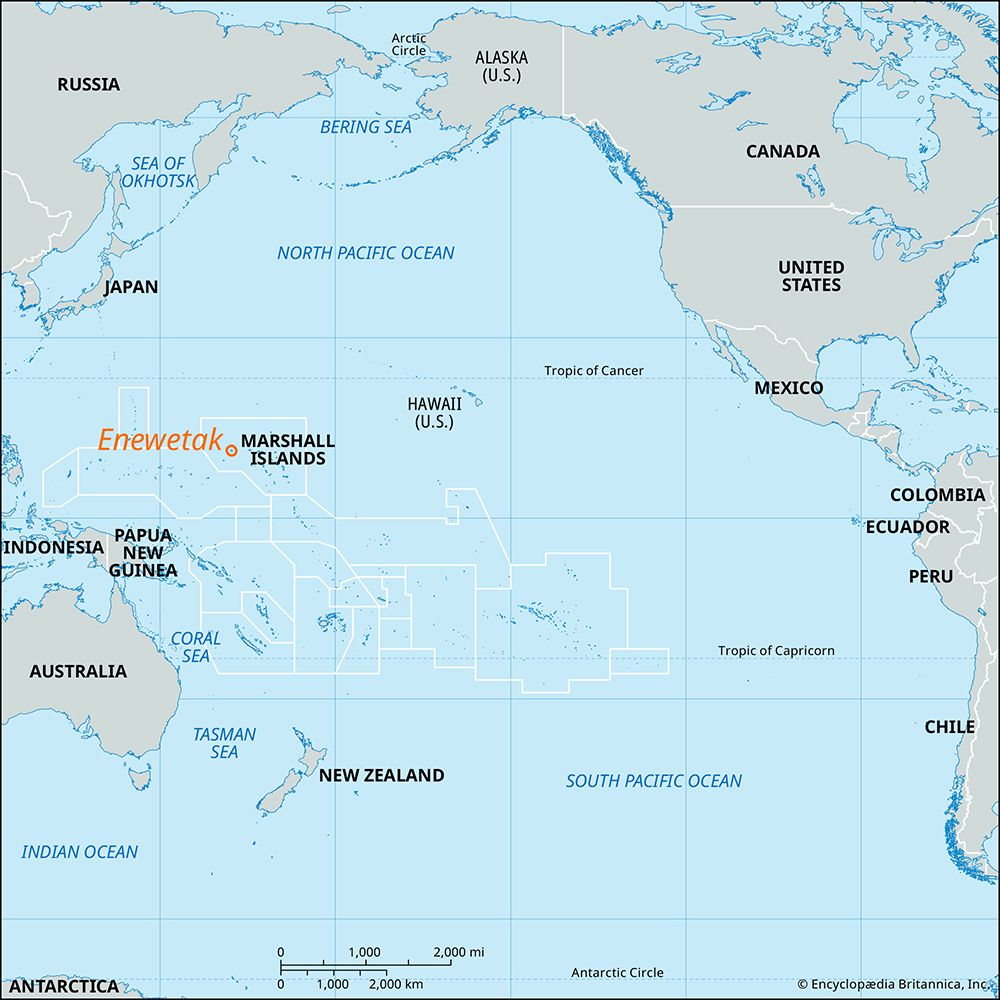
Geologic drilling, such as at Enewetak atoll, has confirmed this by revealing volcanic rock deep beneath the reef surface. While subsidence is a primary driver, fluctuations in sea level—particularly those linked to the Pleistocene Epoch—also significantly influence the development and upward growth of these structures.43
What is the history of the Marshall Islands?
The history of the Marshall Islands is defined by early indigenous navigation, colonial shifts, and the profound impact of 20th-century global conflicts.
Early History and Exploration
Settled around the beginning of the Common Era by Micronesians, the islands were home to skilled navigators who traversed the Pacific in canoes. While Spanish navigator Álvaro Saavedra made contact in 1529, European powers initially showed little interest. By the late 18th and 19th centuries, the islands were visited by British explorers, Russian expeditions, and American whalers and missionaries.5
Colonial Era and World War II
In 1885, Germany established a protectorate, using Jaluit Atoll as an administrative center. Japan seized the islands in 1914, later administering them under a League of Nations mandate. During World War II, the islands were the site of heavy fighting before being occupied by the United States.5
Nuclear Testing and Independence
From 1946 to 1958, the U.S. used Bikini and Enewetak atolls for 67 nuclear tests, including the devastating 1954 Castle Bravo explosion. These tests caused widespread environmental contamination and displacement of local populations. Following a period as a U.S.-administered Trust Territory, the Marshall Islands adopted a constitution in 1979 and signed a Compact of Free Association with the U.S. in 1982. The republic became a member of the United Nations in 1991.56
What is copra and how is it produced?
Copra consists of the dried meat of the coconut, which is the kernel of the fruit from the coconut palm. It is primarily valued for the coconut oil extracted from it, while the remaining residue, known as coconut-oil cake, is commonly used as livestock feed.7
Production Process
The production of copra involves several steps to reduce the moisture content of the coconut meat:
- Preparation: The nuts are husked and cracked into halves to expose the meat, which initially contains about 50 percent water.7
- Drying: Several methods are used to remove moisture until the content reaches 4 to 5 percent:
- Sun Drying: Exposing kernels to the sun is the traditional method, producing high-quality white copra.7
- Kiln Drying: A more rapid process used in humid climates where copra is placed on a grid over a fire pit.7
- Hot-Air Drying: A more uniform method where copra is drawn through a heated tunnel, resulting in a higher-value product.7
- Extraction: Once dried, the copra is cleaned and crushed, and the oil is obtained through pressing or solvent extraction. and the oil is obtained through pressing or solvent extraction.78
Sources
- Jaluit Atoll — Encyclopædia Britannica
- Jaluit — Merriam-Webster
- coral reef - Origin and development of reefs — Encyclopædia Britannica
- atoll — Encyclopædia Britannica
- history of the Marshall Islands — Encyclopædia Britannica
- Marshall Islands atomic bomb tests — Encyclopædia Britannica
- Copra — Encyclopædia Britannica
- coconut oil — Encyclopædia Britannica
- Pacific Islands - Growth of trading communities — Encyclopædia Britannica
Published on · 3 min read