Japanese Beetle
The Japanese beetle (Popillia japonica) undergoes a complete life cycle consisting of four stages: egg, larva, pupa, and adult.
What is the life cycle of a Japanese beetle?
The Japanese beetle (Popillia japonica) undergoes a complete life cycle consisting of four stages: egg, larva, pupa, and adult.
- Egg: Female beetles burrow 25 to 100 mm into the soil to deposit their eggs, which typically hatch in about 14 days.1
- Larva: Known as grubs, the larvae live underground throughout the winter, feeding on the tender roots of plants.12
- Pupa: During May, the larvae transform into a prepupa stage and subsequently into a pupa.1
- Adult: The adult beetles emerge from the soil in June or July. Unlike the root-feeding larvae, adults feed on the flowers, fruit, and foliage of over 200 plant species.12
This cycle is a significant concern for agriculture, as the insect is considered a major pest. Efforts to manage populations include the use of biological control methods, such as the bacterium Bacillus popilliae, which induces “milky disease” in the larvae.1
What are the physical characteristics of the Japanese beetle?
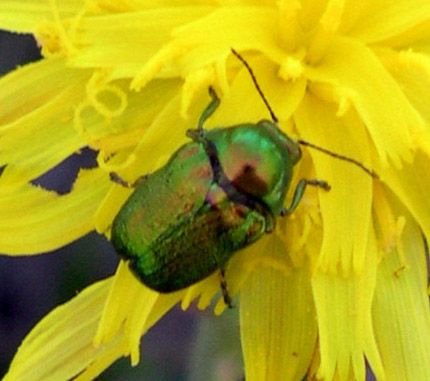
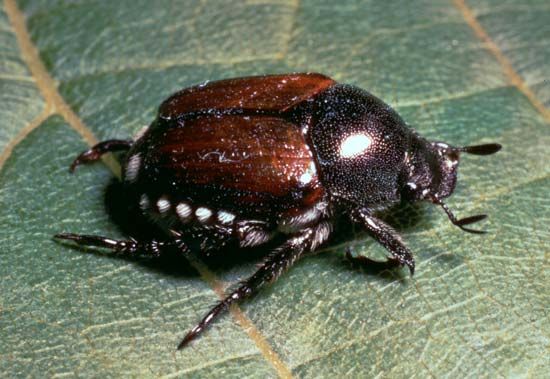
The adult Japanese beetle (Popillia japonica) is a small insect measuring approximately 10 mm (0.4 inch) in length. Its physical appearance is characterized by a bright, metallic green body complemented by coppery-brown wing covers, known as elytra.12
Key identifying features include:
- Coloration: A distinct metallic green and brown scarab beetle appearance.12
- Markings: Each side of the body features five patches of white spots.1
- Abdomen: There are two prominent white tufts located on top of the exposed tip of the abdomen.1
These beetles are gregarious, often congregating in large groups to feed on the foliage, flowers, and fruit of a wide variety of plants.1
How can you identify Japanese beetle damage on plants?
Identifying damage caused by the Japanese beetle (Popillia japonica) involves observing how the insect affects different parts of a plant throughout its life cycle.
- Adult Damage: Adult beetles are gregarious and feed in large groups on the foliage, flowers, and fruit of over 200 plant species. Their feeding pattern often results in skeletonized leaves, where the soft tissue between the veins is consumed, leaving behind a lace-like network. In severe cases, a swarm can quickly denude a plant, leaving behind only bare branches and fruit pits.41
- Larval Damage: The larval stage, known as a grub, lives underground and feeds on the tender roots of plants, particularly grasses. This damage is often less visible initially but can lead to the wilting, yellowing, or death of lawns and nursery plants as the root system is compromised.41
Because these beetles are highly destructive to both ornamental and agricultural plants, monitoring for skeletonized leaves or thinning turf is essential for early detection.
Where did the Japanese beetle originate, and how did it spread to other parts of the world?
The Japanese beetle (Popillia japonica) is native to Japan. It was accidentally introduced into the United States around 1916, likely arriving as larvae hidden within the soil of imported plants.12
Since its introduction, the beetle has spread significantly across North America. Its current range extends from Maine to South Carolina, with additional infestations reported in other parts of the continent. Because the larvae live underground and feed on plant roots, they are easily transported through the movement of soil and nursery stock, which has facilitated their expansion into new regions. Efforts to manage the population include the use of biological control methods, such as introducing natural predators like parasitic wasps and the bacterium Bacillus popilliae, which induces milky disease in the larvae.1
Sources
- Japanese beetle — Encyclopædia Britannica
- Japanese beetle — Merriam-Webster
- Asian longhorned beetle: Top Questions — Encyclopædia Britannica
- Coleoptera - As plant feeders — Encyclopædia Britannica
Published on · 3 min read