Jenolan Caves
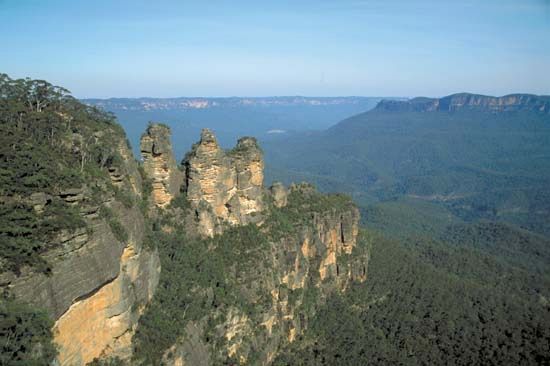
Jenolan Caves are a renowned series of tunnels and caverns located in east-central New South Wales, Australia. Situated 70 miles (113 km) west of Sydney on…
What is Jenolan Caves?
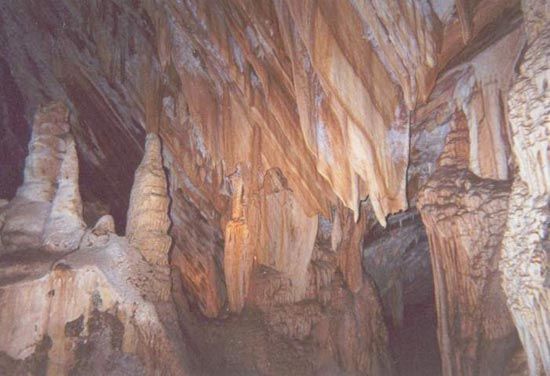
Jenolan Caves are a renowned series of tunnels and caverns located in east-central New South Wales, Australia. Situated 70 miles (113 km) west of Sydney on the western edge of the Blue Mountains, these caves were formed by two converging streams within a thick bed of limestone at an elevation of 2,600 feet (800 meters).1
The caves are noted for their distinct levels and unique limestone formations, most notably stalactites. Historically, the site was used by Aboriginal peoples, and it is said that the bushranger James McKeown was the first European to visit the area in the 1830s. The site has been protected as a government reserve since 1866. Today, twelve of the caves are open to the public, drawing over 150,000 visitors each year.1
How do stalactites and stalagmites form?
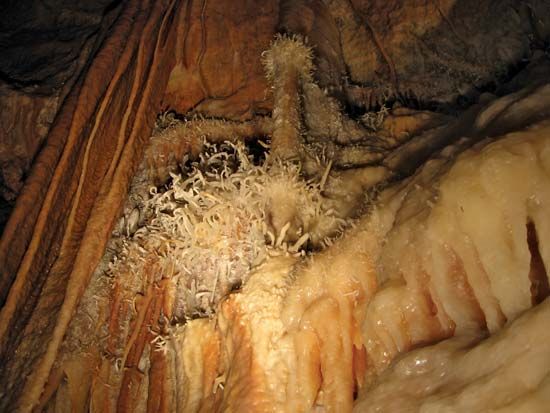
Stalactites and stalagmites are speleothems—secondary mineral deposits formed in caves by the action of water. Their formation begins when rainwater infiltrates soil and absorbs carbon dioxide, creating a dilute carbonic acid solution. As this acidic water moves through limestone bedrock, it dissolves calcite (calcium carbonate).23
When this mineral-rich water emerges from a crack in a cave ceiling, it hangs as a pendant drop. As carbon dioxide escapes into the cave atmosphere, the water loses its ability to hold the dissolved calcite, causing a small ring of mineral to deposit on the ceiling.42
- Stalactites: These form as water continues to drip from the same point, building an icicle-like structure downward. They often feature a central canal that carries water to the tip.42
- Stalagmites: These form on the cave floor when the mineral-laden water droplets fall from the ceiling or a stalactite. As the water hits the floor, it deposits the remaining calcite, building a mound-like structure upward.42
If a stalactite and stalagmite grow long enough to meet, they form a column.4
What is the significance of the Blue Mountains region?
The term “Blue Mountains” refers to several distinct geographical regions, each with unique significance.
Blue Mountains, Australia
Located in New South Wales as part of the Great Dividing Range, this region is a well-dissected sandstone plateau. Its significance includes:7
- Historical Exploration: It was first crossed by Europeans in 1813 by Gregory Blaxland, William C. Wentworth, and William Lawson.7
- Tourism and Nature: The area is a popular destination featuring the Blue Mountains National Park and the Jenolan Caves.7
- Natural Phenomenon: The mountains are named for their bluish hue, caused by light diffusing through oil droplets released by indigenous eucalyptus trees.7
Blue Mountains, Jamaica
This range in eastern Jamaica is significant for both its ecology and history:
- UNESCO Recognition: In 2015, the Blue and John Crow mountains were designated a World Heritage site for their biodiversity and cultural history.8
- Cultural Refuge: The mountains served as a vital shelter for Taino people and Maroons—enslaved Africans who escaped captivity to form highland communities.8
- Agriculture: The region is world-renowned for its high-quality coffee cultivation.8
How does limestone erosion create cave systems?
The formation of solution caves is a complex geological process primarily driven by the chemical interaction between groundwater and limestone or dolomite bedrock.10
The Initiation Phase
Because limestone is largely impermeable, water initially moves through mechanical fractures, such as joints and bedding-plane partings. As rainwater infiltrates the soil, it absorbs carbon dioxide to form a dilute carbonic acid solution. This acidic water slowly dissolves the calcium carbonate in the bedrock. This initiation phase is extremely slow, often requiring 3,000 to 10,000 years to enlarge a fracture to a width of 5 to 10 millimetres.111213
Conduit Development
Once a continuous pathway reaches this threshold size, the flow dynamics shift from slow percolation to turbulent, pipe-like flow. As water velocity increases, the rate of dissolution accelerates, allowing the system to transport insoluble sediments and flush out soil. Over time, these conduits enlarge into extensive cave systems, often integrating surface drainage into the subsurface. The final shape of these passages—whether elliptical tubes or canyon-like structures—is determined by the hydraulic forces of the water and the structural arrangement of the rock.1161014
Sources
- Jenolan Caves — Encyclopædia Britannica
- stalactite and stalagmite — Encyclopædia Britannica
- cave - Depositional materials and features — Encyclopædia Britannica
- cave deposit — Encyclopædia Britannica
- cave - Solution caves — Encyclopædia Britannica
- cave — Encyclopædia Britannica
- Blue Mountains — Encyclopædia Britannica
- Blue Mountains — Encyclopædia Britannica
- Blue Mountains — Merriam-Webster
- cave - Initiation phase — Encyclopædia Britannica
- cave - Fluviokarst — Encyclopædia Britannica
- cave - Geomorphic characteristics of solution caves — Encyclopædia Britannica
- carbonic acid — Encyclopædia Britannica
- cave - Solutional sculpturings — Encyclopædia Britannica
Published on · 3 min read