Jerboa
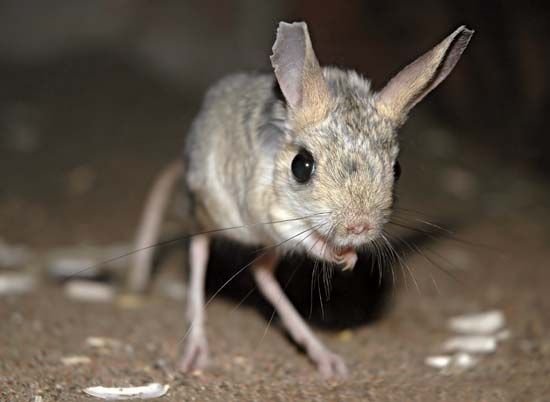
Jerboas are small, mouselike rodents specifically adapted for life in deserts and steppes. Their most distinctive physical features include:
What are the distinctive physical characteristics of jerboas?
Jerboas are small, mouselike rodents specifically adapted for life in deserts and steppes. Their most distinctive physical features include:
- Body and Limbs: They possess short forelegs and extremely long, powerful hind legs designed for leaping. Depending on the species, they have between three and five hind toes.1
- Tail: They feature a long tail, ranging from 7 to 25 cm, which is often tufted. This tail is essential for balance when the animal springs away and acts as a prop when the jerboa stands upright.1
- Ears: Ear size is highly variable across species, ranging from small and round to slender and rabbitlike, or in some cases, remarkably large and broad.1
- Fur: Their dense, silky, or velvety fur is typically light in color, allowing them to blend into their arid habitats.1
Overall, these jumping rodents measure between 5 and 15 cm in body length.1
Where are jerboas typically found in the wild?
Jerboas are primarily found in the arid environments of eastern Europe, Asia, and northern Africa. These rodents are specifically adapted to thrive in harsh deserts and steppes, where they spend their days resting in burrows to escape the heat and emerge at night to forage.12
What are the different species of jerboas, and how do they vary?
There are 33 recognized species of jerboas, which are taxonomically diverse and categorized into five distinct subfamilies within the family Dipodidae. While they share common traits like long hind legs for leaping and long tails for balance, they vary significantly in ear size—ranging from small and round to large and rabbitlike—and in the number of hind toes, which can range from three to five.1
The species are classified as follows:
- Subfamily Allactaginae (15 species): Includes the genera Allactaga (four- and five-toed jerboas), Pygeretmus (fat-tailed jerboas), and Allactodipus.1
- Subfamily Dipodinae (9 species): Includes the genera Jaculus (desert jerboas), Stylodipus (thick-tailed three-toed jerboas), Dipus (feather-footed jerboa), and Eremodipus.1
- Subfamily Cardiocraniinae (7 species): Includes the genera Salpingotus (three-toed dwarf jerboas) and Cardiocranius (five-toed dwarf jerboa).1
- Subfamily Euchoreutinae (1 species): The long-eared jerboa (Euchoreutes naso), noted for its distinctively large ears and pig-like snout.13
- Subfamily Paradipodinae (1 species): The comb-toed jerboa (Paradipus).1
How have jerboas adapted to their desert environment?
Jerboas have evolved several specialized physical and behavioral traits to survive in the harsh conditions of deserts and steppes. Their adaptations include:
- Locomotion and Balance: Jerboas possess extremely long hind legs that allow them to leap up to 3 meters (10 feet) when traveling swiftly or escaping predators. Their long, often tufted tails provide essential balance during these springs and act as a prop when the animal stands upright.1
- Thermoregulation and Shelter: To avoid the intense daytime heat, jerboas are nocturnal and spend their days resting in underground burrows. Some species actively plug their burrow entrances with soil to maintain internal humidity and block out hot air.1
- Water Conservation: While they may drink water in captivity, jerboas in the wild obtain all necessary moisture directly from their diet, which consists of seeds, insects, and succulent plant parts.1
- Camouflage: Their dense, silky or velvety fur is typically light in color, which helps them blend into the sandy or arid ground of their natural habitat, providing protection from predators.1
Sources
- jerboa — Encyclopædia Britannica
- jerboa — Merriam-Webster
- long-eared jerboa — Merriam-Webster
- Dipodidae — Merriam-Webster
- caddisfly - Annotated classification — Encyclopædia Britannica
Published on · 2 min read