Johnston Atoll
Johnston Atoll served as a critical strategic asset for the United States in the Pacific due to its location and development as a military installation.
What was the military significance of Johnston Atoll during World War II and the Cold War?
Johnston Atoll served as a critical strategic asset for the United States in the Pacific due to its location and development as a military installation.
World War II
Placed under the jurisdiction of the U.S. Navy in 1934, the atoll was transformed into a vital military outpost. By 1941, the military had constructed a naval air station on the island, featuring a landing strip that spanned nearly the entire length of Johnston Island to support aerial operations in the region.1
The Cold War
Following the war, the atoll’s role shifted significantly:
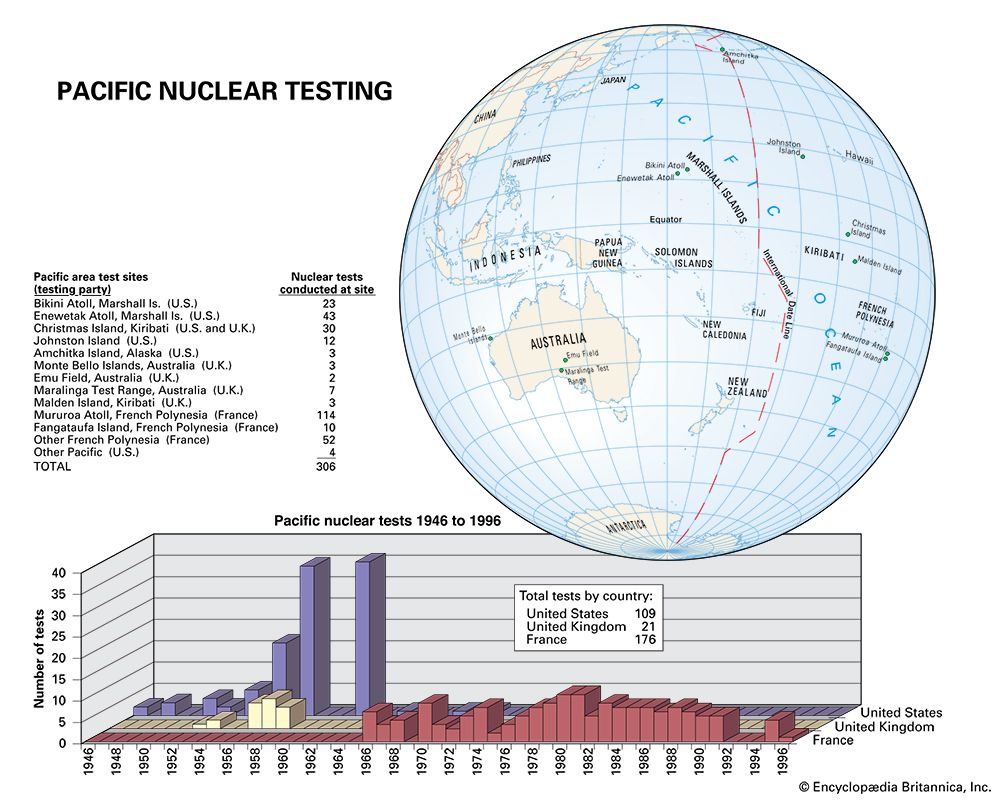
- Nuclear Testing: Transferred to the U.S. Air Force in 1948, the site was utilized for nuclear weapons tests until 1962](https://www.britannica.com/technology/nuclear-testing) until 1962.1
- Chemical Weapons Storage: From 1974 to 1999, the atoll served as a storage facility for chemical weapons, managed by the Defense Nuclear Agency. This culminated in the operation of an incineration facility on the island during the 1990s to destroy these stockpiles.1
How has the history of Johnston Atoll affected its current ecosystem?
The history of Johnston Atoll has profoundly altered its physical and ecological landscape through extensive military development and industrial use.
The most significant physical change occurred during the 20th century, when the U.S. military transformed the atoll’s geography. Originally consisting of two natural islands, the atoll was expanded through dredging and grading to accommodate a large naval air station, and two additional artificial islands were created to support military operations. These activities fundamentally reshaped the atoll’s landmass and reef structure.1
Beyond physical construction, the atoll’s ecosystem was subjected to decades of intensive military activity, including its use as a site for nuclear weapons testing until 1962 and as a storage and incineration facility for chemical weapons from 1974 until 2000. Following the decommissioning of these facilities and the removal of all military personnel, the atoll was designated a U.S. National Wildlife Refuge in 2004 and later incorporated into the Pacific Remote Islands Marine National Monument. Today, the atoll serves as a habitat for various marine life, including green sea turtles and numerous seabirds, marking a transition from a site of industrial and military use to one of environmental conservation.1
What is the ecological importance of Johnston Atoll for marine life and seabirds?
Johnston Atoll serves as a vital ecological site within the central Pacific Ocean. Its surrounding waters host a diverse array of marine life, including a large variety of fishes and green sea turtles, which rely on the atoll’s unique coral atoll formation for habitat.1
Furthermore, the atoll is of significant importance to avian populations, as it is visited by vast numbers of seabirds. Recognizing this ecological value, the area was designated as a bird sanctuary as early as 1926. Following the cessation of military activities and the decommissioning of the site, the atoll was established as a U.S. National Wildlife Refuge in 2004 to ensure the continued protection of these species and their nesting grounds.1
What is the geographical location and size of Johnston Atoll?
Johnston Atoll is an unincorporated territory of the United States situated in the central Pacific Ocean, located approximately 825 miles (1,330 km) southwest of Honolulu.1
The atoll consists of four small islands situated on a raised coral atoll formation, which is partially enclosed by a 7.5-mile (12-km) semicircular reef. The combined land area of these islands is approximately 1.1 square miles (2.8 square km), with Johnston Island comprising the vast majority of this total.1
Sources
- Johnston Atoll — Encyclopædia Britannica
- Marshall Islands atomic bomb tests — Encyclopædia Britannica
- Bikini — Encyclopædia Britannica
- Procellariiform - Importance to humans — Encyclopædia Britannica
Published on · 3 min read