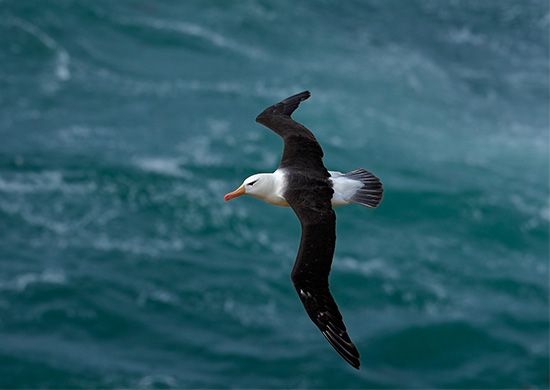
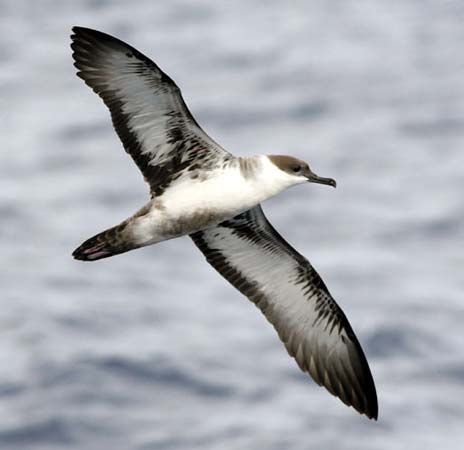
Procellariiform
Procellariiform birds, also known as tubinares, exhibit a highly specialized reproductive strategy characterized by long-term monogamy and protracted nesting…
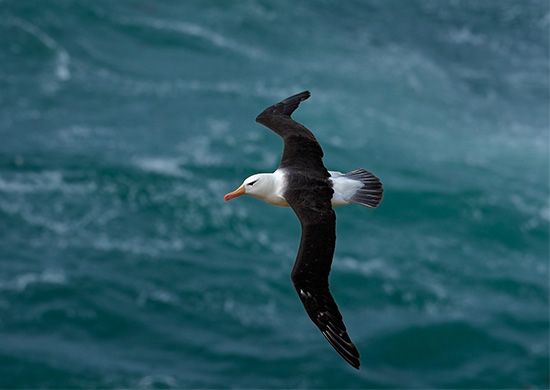
How do procellariiform birds reproduce, and what are their nesting habits like?
Procellariiform birds, also known as tubinares, exhibit a highly specialized reproductive strategy characterized by long-term monogamy and protracted nesting periods.12
Reproduction and Nesting Habits
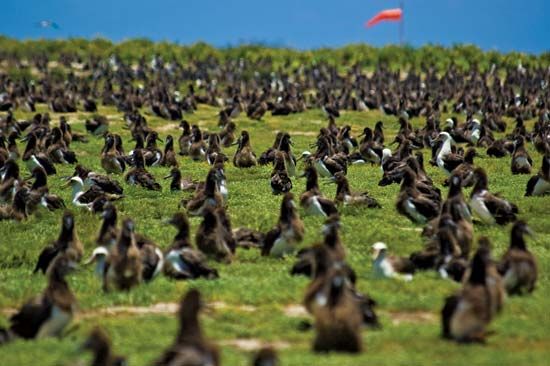
- Pair Bonding: Adults typically return to the same breeding site annually and remain faithful to their mates for life. Before laying, pairs engage in elaborate greeting ceremonies—involving bill-fencing, cackling, and, in albatrosses, dancing—to facilitate recognition and reduce aggression.1
- Nesting: Nest types vary by species: albatrosses build mounds or shallow depressions, diurnal petrels nest on ledges or ground, and many shearwaters and storm petrels dig burrows or utilize crevices.1
- Incubation and Care: Parents share incubation duties, fasting for days at a time while their partner forages at sea. Upon hatching, the chick is brooded and fed an oily, semidigested broth of marine organisms.1
- Development: Because of the slow growth rate and long fledgling periods—ranging from two months in small petrels to nine months in large albatrosses—many species can only rear one young every other year. Before fledging, parents desert the chick to molt at sea, leaving the young to survive on stored fat until it is ready to fly.1
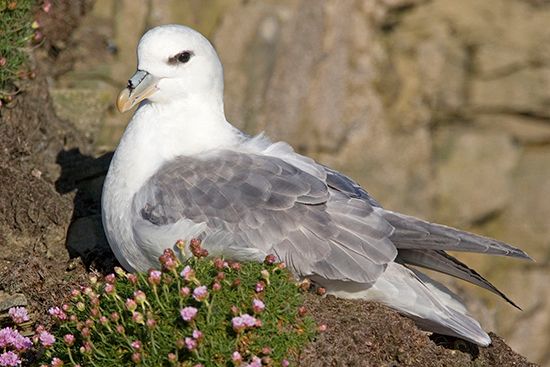
How are procellariiform birds adapted for life at sea?
Procellariiform birds, also known as “tube-nosed” seabirds, possess several specialized physiological and morphological adaptations that allow them to thrive in oceanic environments.
Morphological Adaptations
- Flight Efficiency: Many species are adapted for long-distance travel through dynamic soaring, a flight technique that utilizes horizontal air currents near the sea surface to maintain altitude with minimal energy expenditure. This is supported by long, narrow wings, which in some albatrosses reach an aspect ratio exceeding 14:1, functioning as high-lift airfoils for fixed-wing gliding.47
- Nostrils: Their namesake tubular nostrils, located on the upper bill, are a distinct feature of the order.87
- Feet: These birds have webbed feet, which aid in movement on the water, while the hind toe is typically vestigial or entirely absent.87
Physiological Adaptations
- Salt Excretion: Because they live in a saline environment, these birds utilize a specialized nasal gland located above each eye. This gland extracts sodium chloride from the blood more efficiently than the kidneys and excretes it as brine through the nostrils, allowing the birds to maintain osmotic balance while living without fresh water.9
- Stomach Oil: All species produce a powerful, musky-smelling stomach oil. This substance serves as a defensive mechanism, as it can be discharged through the mouth when the bird is alarmed.8
What is the unique tube-shaped nose structure of procellariiform birds called, and how does it function?
The unique tube-shaped nose structure of procellariiform birds is referred to as tubular nostrils or, collectively, as Tubinares, which translates to “tube-nosed”.7
These structures are located on the culmen (the upper ridge of the bill). Their arrangement varies by family: in albatrosses, the two nasal tubes are separated on the right and left sides of the bill, whereas in all other procellariiforms, the nostrils are fused into a single tube positioned on the dorsal midline.74
While these tubes are a defining morphological feature, they are primarily associated with the bird’s sense of smell and respiratory function. It is important to clarify that the excretion of excess salt—a critical adaptation for marine birds living without fresh water—is performed by a specialized nasal gland located above each eye, rather than by the nostrils themselves. This gland removes sodium chloride from the blood and excretes it as brine, which is then discharged through the nostrils or mouth.10
What are the defining characteristics of procellariiform birds?
Procellariiform birds, also known as Tubinares (“tube-nosed”), are a group of approximately 117 species of seabirds that include albatrosses, shearwaters, fulmars, prions, and various petrels.15
Their defining characteristics include:
- Tubular Nostrils: All species possess conspicuous nostrils that project upon the culmen (upper bill). In albatrosses, these tubes are separated on the sides of the bill, while in other procellariiforms, they are fused into a single tube on the dorsal midline.154
- Physical Build: They are generally long-winged, short-necked birds with webbed feet and a vestigial or absent hind toe. Their plumage lacks bright colors, consisting instead of black, white, or shades of brown and gray, though some species exhibit polymorphism.154
- Stomach Oil: These birds produce a characteristic, powerful musky odor caused by the excretion of stomach oil, which can be discharged as a defense mechanism.15
- Flight Adaptations: Many species are highly adapted for oceanic life, with some albatrosses possessing long, narrow wings with an aspect ratio exceeding 14:1, facilitating efficient fixed-wing gliding.4
Sources
- Procellariiform - Reproduction and growth — Encyclopædia Britannica
- Animal social behavior - Social interactions involving the costs and benefits of parental care — Encyclopædia Britannica
- Reproductive behaviour - Parental care — Encyclopædia Britannica
- Procellariiform — Encyclopædia Britannica
- Procellariiform - Locomotion — Encyclopædia Britannica
- Procellariidae — Merriam-Webster
- Nasal gland — Encyclopædia Britannica
- Locomotion - Soaring — Encyclopædia Britannica
- Biosphere - Salinity — Encyclopædia Britannica
- Procellariiform - General features — Encyclopædia Britannica
- Marine ecosystem - Physical and chemical properties of seawater — Encyclopædia Britannica
- fish - Olfaction — Encyclopædia Britannica
- Chemoreception - Homing — Encyclopædia Britannica
- Chemoreception - Finding and recognizing food — Encyclopædia Britannica
- Procellariiform - Distinguishing taxonomic features — Encyclopædia Britannica
- Procellariiform - Critical appraisal — Encyclopædia Britannica
Published on · 4 min read