Agavoideae
The evolutionary history of the Agavoideae subfamily is primarily understood through its classification within the order Asparagales and the family…
What is the evolutionary history of the Agavoideae subfamily?
The evolutionary history of the Agavoideae subfamily is primarily understood through its classification within the order Asparagales and the family Asparagaceae.12
Botanical classification has evolved significantly regarding this group. While members of the subfamily were formerly treated as a distinct family known as Agavaceae, the Angiosperm Phylogeny Group III (APG III) system reclassified them as a subfamily within the broader Asparagaceae family. This taxonomic shift reflects a deeper understanding of their genetic relationships to other monocotyledonous plants within the Asparagales order.12
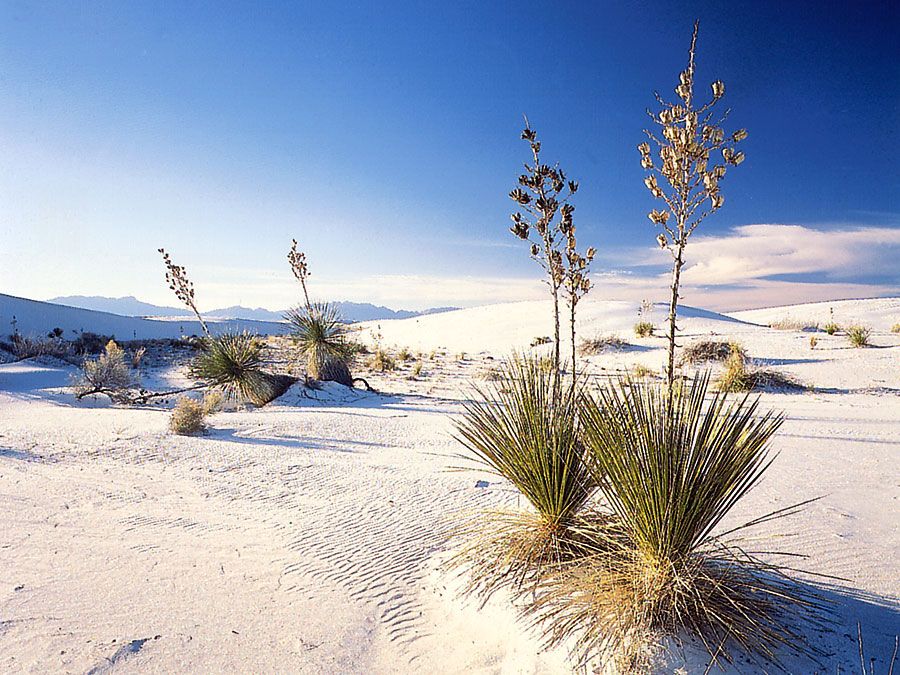
The subfamily currently comprises 23 genera and approximately 637 species, which are widely distributed across tropical, subtropical, and temperate regions. These plants are characterized by their adaptation to diverse environments, including many well-known desert species, such as those in the genera Agave and Yucca.12
How are plants in the Agavoideae subfamily adapted to their environments?
Plants in the Agavoideae subfamily, which includes well-known desert species like Agave and Yucca, are highly adapted to arid environments through specialized mechanisms for water storage and conservation.34
Water Storage and Xerophytic Adaptations
As xerophytes, these plants possess thick, fleshy leaves that serve as primary water-storage organs. This succulence allows them to survive in regions with limited or seasonal water availability. Beyond their fleshy tissues, they often exhibit other xeromorphic adaptations, such as:35
- Waxy coatings: Thick layers of epicuticular wax on the leaf surface help prevent water loss.56
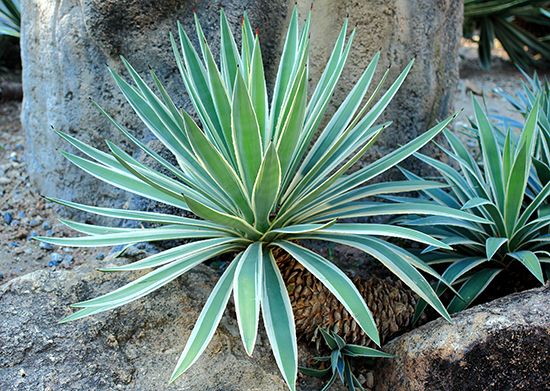
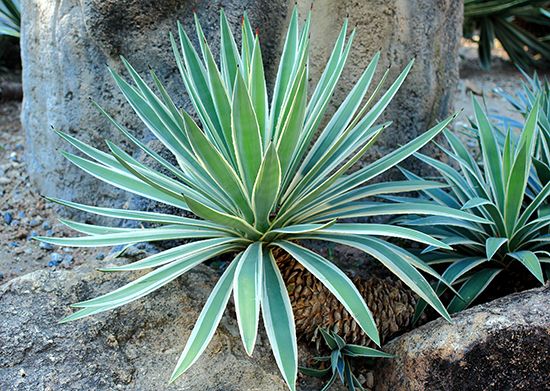
- Leaf structure: Many species have narrow, lance-shaped leaves that are clustered at the base, often with a high volume-to-surface ratio to minimize exposure and moisture loss.64
- Protective features: Some species feature spiny leaf margins or tips, which can protect the plant from herbivores and help manage heat.547
Photosynthetic Efficiency
Many Agavoideae utilize crassulacean acid metabolism (CAM), a specialized photosynthetic pathway that significantly reduces water loss. Unlike most plants, CAM species keep their stomata closed during the hot, dry day and open them at night when temperatures are cooler and humidity is higher. This allows them to take up carbon dioxide at night, storing it as malate in their vacuoles to be used for photosynthesis during the day. This temporal separation of carbon fixation makes them exceptionally water-efficient compared to other plant types.31
How do Agavoideae plants differ from other subfamilies within the Asparagaceae family?
The Agavoideae subfamily is one of seven subfamilies within the Asparagaceae family. While the family as a whole is genetically related, it is highly diverse, making it difficult to distinguish subfamilies based on simple physical characteristics alone. However, Agavoideae can be differentiated from other subfamilies through several distinct features and habits:1011
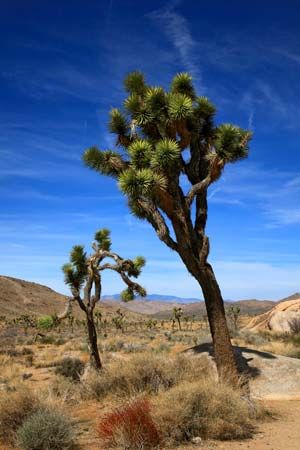
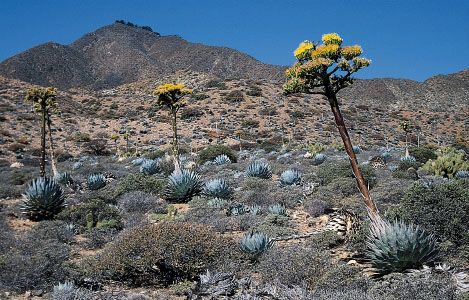
- Growth Habit: Many members of Agavoideae are characterized as short-stemmed, often woody plants. In the Americas, certain species within this subfamily—such as those in the genera Yucca, Agave, Furcraea, and Nolina—exhibit an arborescent (tree-like) habit, featuring thick trunks composed of fibrous tissue.122
- Leaf Morphology: Agavoideae plants typically possess narrow, lance-shaped leaves that are clustered at the base of the plant. These leaves are often fleshy or toothed, an adaptation common among the subfamily’s many well-known desert species.12
- Reproductive Traits: Some species within Agavoideae are monocarpic, meaning the entire plant dies after a single flowering event, which can produce hundreds of individual blossoms. This contrasts with the diverse reproductive strategies found in other Asparagaceae subfamilies, such as the bulb-forming species in Scilloideae or the vining habits of Asparagoideae.111
Which important genera are included in the Agavoideae subfamily?
The Agavoideae subfamily, a group within the Asparagaceae family, consists of 23 genera and approximately 637 species. While many members are recognized for their roles as desert plants or ornamentals, several genera are particularly notable for their economic and ecological significance:1
- Agave: Perhaps the most well-known genus in the subfamily, Agave is essential for the production of hard fibers like sisal and henequen. Additionally, the sap of certain species, such as A. tequilana, is fermented to create beverages including tequila and mescal.110
- Yucca: This genus includes about 40 species, ranging from the iconic Joshua tree to various ornamental plants like Spanish daggers. They are also known for containing saponins, which have historically been used as natural detergents.11310
- Polianthes: This genus includes the tuberose (Polianthes tuberosa), which is widely cultivated for its highly fragrant volatile oil.1
- Furcraea and Nolina: These are also recognized as important genera within the subfamily, often exhibiting the woody, tree-like habits characteristic of many Agavoideae.1
Sources
- Agavoideae — Encyclopædia Britannica
- Asparagaceae — Encyclopædia Britannica
- succulent — Encyclopædia Britannica
- photosynthesis - Carbon fixation via crassulacean acid metabolism (CAM) — Encyclopædia Britannica
- xerophyte — Encyclopædia Britannica
- angiosperm - Root systems — Encyclopædia Britannica
- angiosperm - Leaves — Encyclopædia Britannica
- Asparagales - Leaves — Encyclopædia Britannica
- angiosperm - Leaf modifications — Encyclopædia Britannica
- Asparagales - Organization and taxonomy — Encyclopædia Britannica
- Asparagales - Order growth characteristics — Encyclopædia Britannica
- Asparagales - Flowers — Encyclopædia Britannica
- yucca — Encyclopædia Britannica
- Asparagales — Encyclopædia Britannica
Published on · 4 min read