Kame
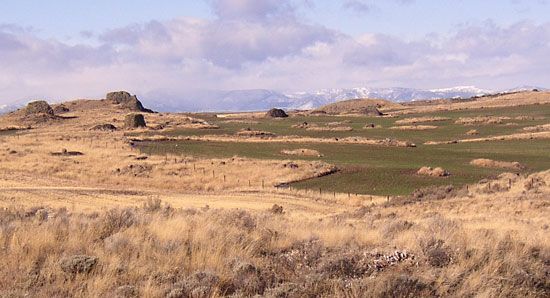
A kame is a moundlike hill or short ridge composed of poorly sorted, stratified drift—primarily sand and gravel—that is deposited by glacial meltwater.
What is kame?
A kame is a moundlike hill or short ridge composed of poorly sorted, stratified drift—primarily sand and gravel—that is deposited by glacial meltwater.123
These landforms typically develop at or near the terminus of a glacier. They are formed when meltwater streams deposit sediment into depressions on the ice surface or in channels; as the supporting ice eventually melts away, the accumulated debris slumps and collapses into its characteristic mound shape.13
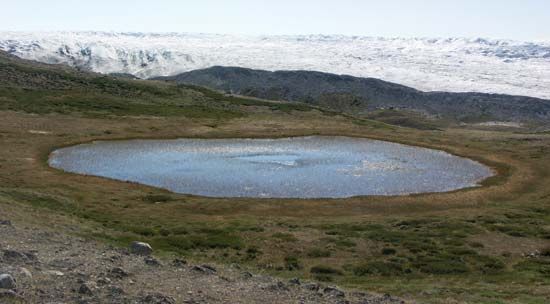
Kames are often found in groups known as a kame field or kame complex, which may be interspersed with kettles or kettle lakes. A related feature, the kame terrace, forms when similar sediments are deposited between the lateral margin of a glacier and a valley wall.13
How do kettle lakes form in relation to kames?
Kettle lakes and kames are both features of glacial deposition that often occur together in the same landscape, a terrain known as “kettle and kame topography”.4
While they are distinct landforms, their formation is closely linked by the presence of stagnant glacial ice and meltwater:
- Kames are moundlike hills or ridges of stratified sand and gravel deposited by meltwater streams at or near a glacier’s terminus. They form when sediment accumulates in depressions on the ice surface or in channels; as the ice melts, the debris slumps into a mound.31
- Kettle lakes form when till or outwash is deposited around blocks of ice that have detached from the main glacier. These ice blocks may remain insulated under a layer of debris for years. Once the ice finally melts, it leaves behind a steep-sided depression, which becomes a kettle lake if it fills with water.43
Because both features rely on the melting of stagnant ice and the accumulation of glacial debris, they frequently appear in close proximity, creating a characteristic landscape of alternating mounds and basins.41
What is the difference between a kame and an esker?
Kames and eskers are both landforms composed of stratified drift—primarily sand and gravel—deposited by glacial meltwater, but they differ significantly in their shape and formation process.153
Key Differences
Feature
Shape
Formation Process
Kame
Moundlike hill, short ridge, or isolated mound.
Formed when meltwater deposits sediment in depressions or channels on the ice surface; as the ice melts, the debris slumps into a mound.
Esker
Long, narrow, winding, linear ridge.
Formed by sediment deposited in subglacial or englacial tunnels; as the ice retreats, these channel deposits are left on the ground surface.
While kames are typically associated with sediment accumulation at or near the glacier’s terminus, eskers represent the remnants of former meltwater streams that flowed through tunnels within or beneath the ice. Both features are considered “ice-contact” deposits, as their final form is determined by the melting of the surrounding glacial ice.153
What is a kame terrace and how does it differ from a standard kame?
A kame terrace is a specific type of glacial landform consisting of stratified sand and gravel deposited by meltwater streams flowing between a glacier and an adjacent valley wall.16
The primary differences between a kame terrace and a standard kame lie in their geometry and depositional environment:
- Shape: A standard kame is typically a moundlike hill or an isolated, irregular mound of poorly sorted drift. In contrast, a kame terrace forms a bench-like, linear feature along the side of a valley.16
- Formation: A standard kame is often produced as a delta of a meltwater stream or by the accumulation of debris released directly onto the ground surface as a glacier melts. A kame terrace is specifically created by the confinement of meltwater streams between the ice mass and the valley wall, which forces the sediment to settle into a terrace shape rather than a mound.16
Sources
- kame — Encyclopædia Britannica
- kame — Merriam-Webster
- glacial landform - Glaciofluvial deposits — Encyclopædia Britannica
- kettle — Encyclopædia Britannica
- esker — Encyclopædia Britannica
- kame terrace — Merriam-Webster
Published on · 3 min read