Kangaroo
Marsupials, such as kangaroos, are a unique group of mammals defined primarily by their reproductive strategy. Unlike placental mammals, marsupials give…
What are the unique characteristics that define marsupials like kangaroos?
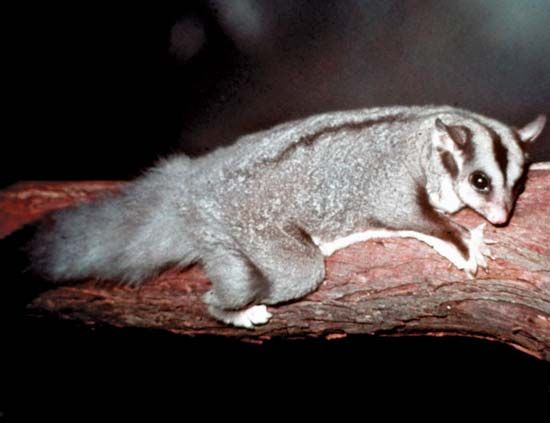
Marsupials, such as kangaroos, are a unique group of mammals defined primarily by their reproductive strategy. Unlike placental mammals, marsupials give birth to young at a very premature stage of development. These newborns must then migrate to the mother’s lower belly to attach to milk-giving teats, where they continue to develop for weeks or months.1
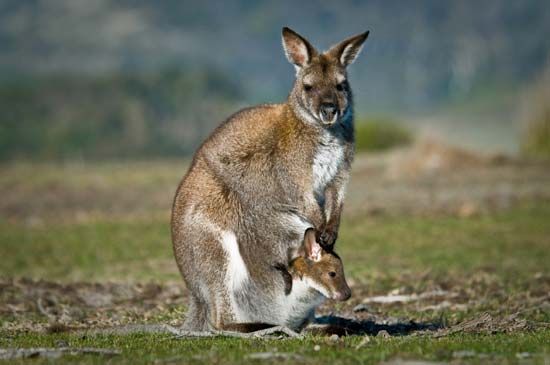
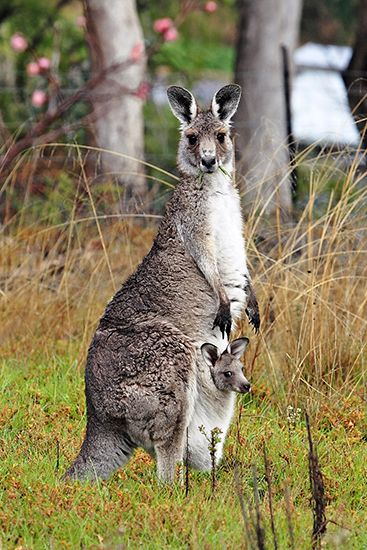
This process is often facilitated by a marsupium—a specialized pouch or skin fold that protects and carries the developing young. While iconic, the pouch is not universal; some species have exposed teats or only vestigial pouch remnants.12
Other defining characteristics include:
- Brain Structure: Marsupials have smaller, simpler brains that lack a corpus callosum, which may contribute to more limited vocalization and behavior compared to placental mammals.1
- Reproductive Anatomy: Females possess a didelphous reproductive tract, featuring paired uteri and vaginas.3
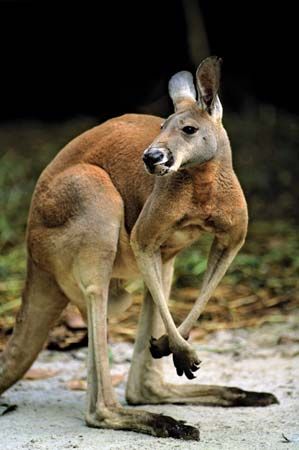
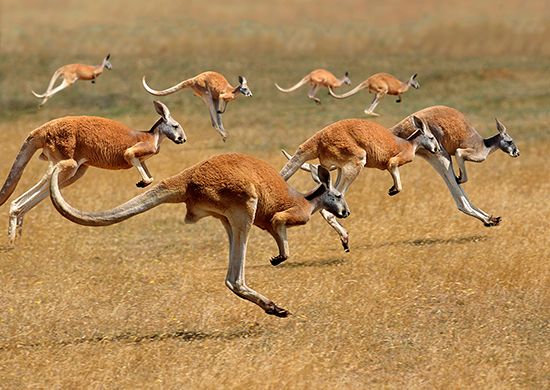
- Locomotion: Many species, particularly macropodids like kangaroos, utilize powerful hind limbs for hopping and long, thick tails for balance.4
How have kangaroos been significant in Australian culture and history?
Kangaroos have played a complex role in Australian history and culture, serving as both a vital resource and a national symbol. Historically, Aboriginal Australians interacted with these animals through hunting and landscape management; the regular burning of forests and grasslands by Aboriginal hunters opened up habitats that favored large grazers like kangaroos. There is ongoing debate regarding whether these human activities contributed to the extinction of Australian megafauna during the Pleistocene Epoch.67
Following European colonization in the 19th century, the relationship shifted as land clearing and the introduction of non-native species—such as sheep, foxes, and rabbits—disrupted ecosystems, driving several kangaroo species toward extinction. Conversely, pastoralists inadvertently benefited kangaroos by clearing dense vegetation and creating permanent water sources in arid regions.67
Today, the kangaroo is a prominent national symbol, though its status remains politically sensitive. Their population growth has led to a major industry involving the harvest of millions of kangaroos annually for their skins and meat. While they are valued as an iconic part of the Australian identity, they are also managed as competitors for livestock forage.6
How have kangaroo populations been affected by human activities and climate change?
Human activities have had a significant, multifaceted impact on kangaroo populations. Historically, Aboriginal land management, specifically the use of fire, created open habitats that favored large grazers like kangaroos. European colonization brought more drastic changes, including large-scale land clearing and the introduction of non-native species such as sheep, foxes, and rabbits, which contributed to the extinction of several kangaroo species.68
However, kangaroos have also benefited from human presence. Pastoralists cleared dense vegetation and established permanent water sources in arid regions, which supported population growth. By the late 20th century, the three most abundant species—the eastern gray, western gray, and red kangaroo—numbered in the tens of millions. Today, these populations are managed through large-scale harvesting for meat and skins, and they are often culled due to competition with livestock for forage.6
While the provided search results do not explicitly detail the direct effects of climate change on kangaroo populations, they note that climate change and associated events like drought and bushfires have had devastating impacts on other Australian marsupials, such as the koala.4
What are the different species of kangaroos, and where are they found?
The term “kangaroo” is used in several ways, ranging from a specific group of six large species to a broader classification of the family Macropodidae, which includes about 65 species such as wallabies, tree kangaroos, and the quokka.10
The six species most specifically identified as kangaroos include:
- Eastern gray kangaroo: Found primarily in the open forests of eastern Australia and Tasmania.11
- Western gray kangaroo: Inhabits the southern coast into southwestern Western Australia, with ranges overlapping the eastern gray in parts of New South Wales and Victoria.11
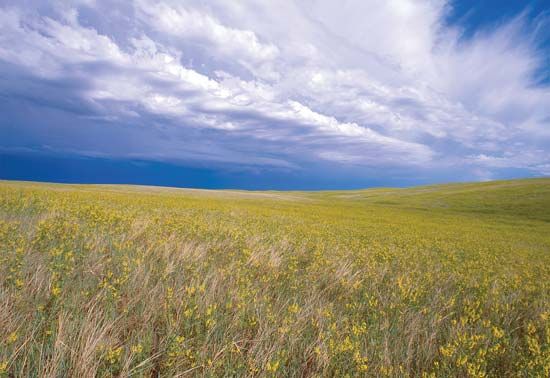
- Red kangaroo: The largest species, found throughout the interior grasslands of Australia.11
- Antilopine kangaroo: Located in the tropical northern plains, from the Cape York Peninsula to the Kimberleys.11
- Wallaroo (or euro): Found in hilly country across mainland Australia.11
- Woodward’s (or black) wallaroo: Replaces the common wallaroo in the far north.11
These species are native to Australia, New Guinea, and nearby islands, with some species introduced to New Zealand.10
Sources
- marsupial — Encyclopædia Britannica
- marsupium — Encyclopædia Britannica
- kangaroo - Common features — Encyclopædia Britannica
- marsupial - Paleontology and recent history — Encyclopædia Britannica
- mammal - The female tract — Encyclopædia Britannica
- kangaroo - Behaviour — Encyclopædia Britannica
- Why Are Kangaroos Only Found in Australia? — Encyclopædia Britannica
- Australia - Conservation — Encyclopædia Britannica
- koala — Encyclopædia Britannica
- kangaroo - Descriptions of selected species — Encyclopædia Britannica
- kangaroo — Encyclopædia Britannica
Published on · 4 min read