Katangan Complex
The Katangan Complex is a major division of late Precambrian rocks located primarily in central Africa, with significant presence in the Katanga province of…
What is Katangan Complex?
The Katangan Complex is a major division of late Precambrian rocks located primarily in central Africa, with significant presence in the Katanga province of the Democratic Republic of the Congo.1
This geological formation consists of a complex array of diverse sedimentary and metamorphic rocks, including shales, quartzites, limestones, sandstones, dolomites, and slates. These layers are remarkably thick, exceeding 7,000 meters (23,000 feet), and have been radiometrically dated to more than 620 million years in age.1
The complex is of immense economic importance, as it serves as a primary source for abundant mineral deposits, including copper, cobalt, uranium, and zinc. These deposits are part of the broader Copperbelt, a zone of industrial development that extends into Zambia and represents one of the most significant concentrations of industry in sub-Saharan Africa. Geologically, the Katangan rocks are associated with the Pan-African episode, a period of mobile-belt formation that occurred between 950 and 550 million years ago.123
How are copper and cobalt extracted from these ancient rocks?
The extraction of copper and cobalt from the ancient rocks of the Katangan Complex involves a multi-stage process that transitions from physical separation to complex chemical refining.
Mineral Processing and Concentration
The initial step is mineral processing, which separates valuable minerals from waste rock (gangue) through comminution and concentration. For copper-cobalt ores, the material is typically treated by flotation, a process using mechanical agitation and reagents to create air bubbles that carry specific mineral particles to the surface. This produces a copper-cobalt concentrate, which is then further separated to create a cobalt-rich concentrate for specialized treatment.56
Extractive Metallurgy
Once concentrated, the metals are extracted using either pyrometallurgical or hydrometallurgical methods:
- Sulfide Ores: These are often roasted under controlled conditions to convert cobalt sulfide into a soluble sulfate while minimizing the solubility of copper and iron. The product is leached, and after removing copper and iron, the cobalt is recovered via electrolysis.7
- Oxidized Ores: Copper is typically removed first through electrolysis in a sulfuric acid solution. Cobalt is then precipitated from the remaining electrolyte by adjusting the solution’s acidity and is eventually recovered in its metallic state through further electrolysis.7
These processes are often combined in a sequence to achieve the necessary purity levels, as the choice of method depends on the specific chemical compound of the ore and the desired end-product quality.3
What defines the Precambrian era in geological history?
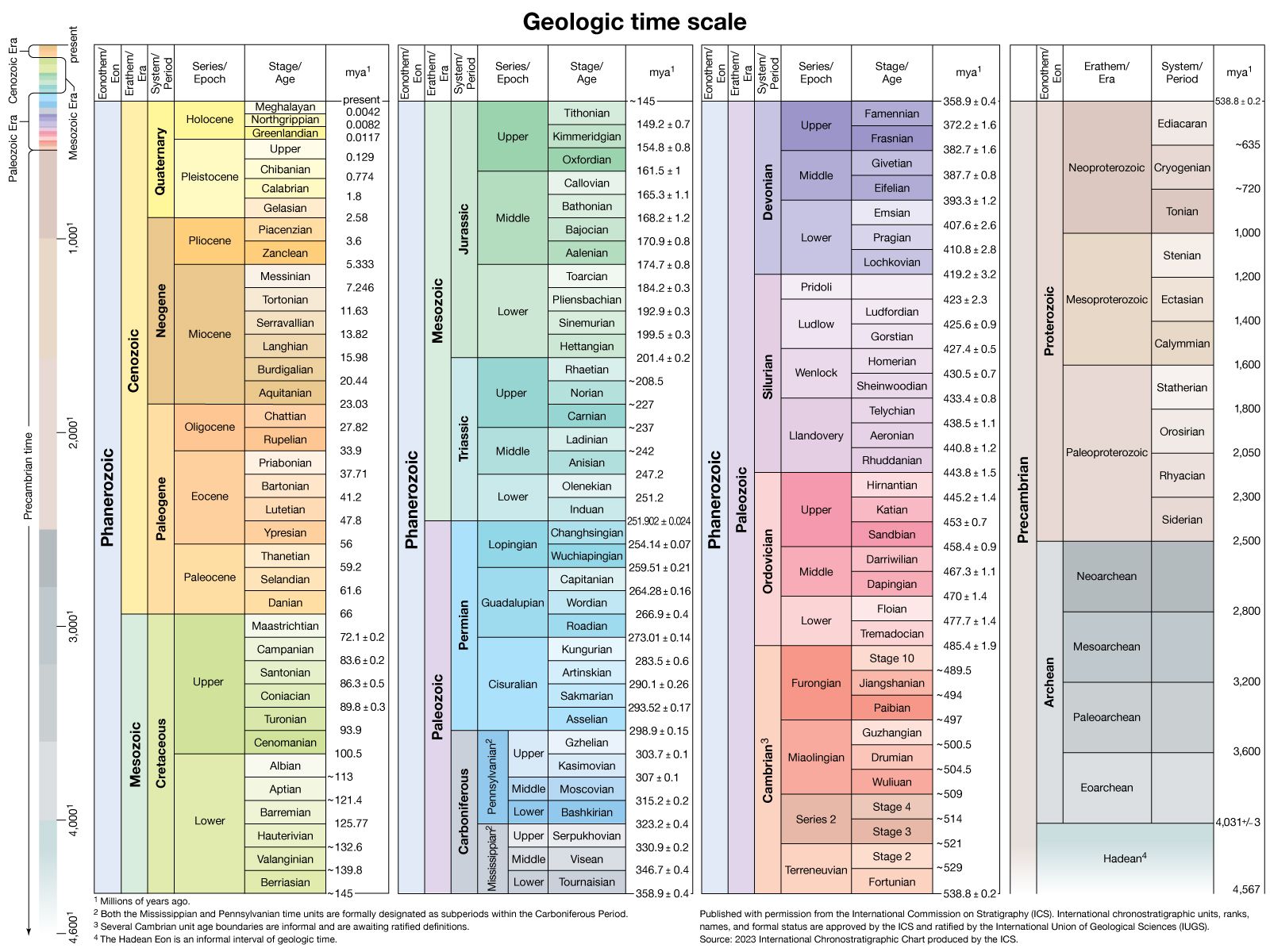
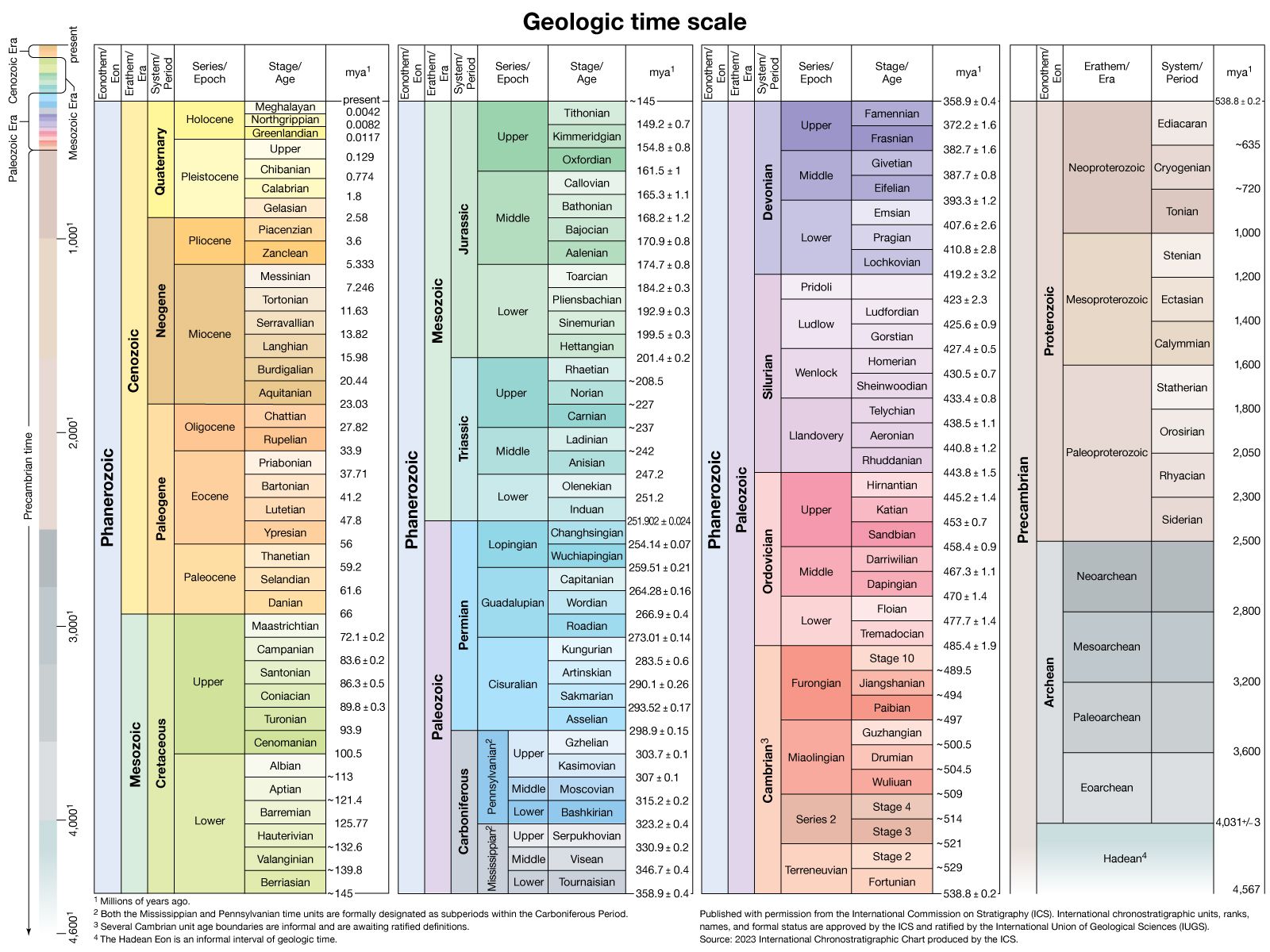
The Precambrian is the vast span of geologic time extending from the formation of Earth about 4.6 billion years ago to the beginning of the Cambrian Period 541 million years ago. Representing more than 80 percent of the total geologic record, it encompasses the Hadean, Archean, and Proterozoic eons.10
Because Precambrian rocks lack the abundant fossil remains found in younger strata, they cannot be subdivided using traditional biostratigraphy. Instead, scientists rely on isotopic age determinations and field relationships—such as unconformities and crosscutting dikes—to establish chronologies. While stromatolites provide some biostratigraphic utility, the chronometric time scale remains the primary method for correlating rocks globally.111210
The era witnessed the emergence of primitive life-forms approximately 3.5 billion years ago, the evolution of multicellular organisms, and the development of sexual division, ultimately setting the stage for the Cambrian explosion.10
How does the Copperbelt impact the economy of Central Africa today?
The Copperbelt remains a cornerstone of the economies in both the Democratic Republic of the Congo and Zambia, serving as the primary industrial heart of the region. Its impact is defined by several key factors:1314
- Economic Foundation: Historically, the region’s copper deposits have been the most significant source of government revenue and foreign exchange earnings for both nations. While the industry faced severe declines in the late 20th century due to fluctuating world market prices, political instability, and mismanagement, it remains a critical driver of national gross domestic product (GDP).31413
- Industrial Infrastructure: The Copperbelt is the greatest concentration of industry in sub-Saharan Africa outside of South Africa. It supports extensive ancillary industries, including refining plants and hydroelectric power networks, which are essential for regional development.1314
- Privatization and Reform: Since the 1990s, the shift from state-controlled mining to privatization has aimed to increase competitiveness and stabilize the sector. In the Democratic Republic of the Congo, these reforms, supported by international institutions like the World Bank and the International Monetary Fund, have contributed to periods of positive GDP growth following years of economic crisis.13143
Despite its importance, the region’s reliance on a single commodity makes it vulnerable to global price volatility, and the industry continues to face challenges regarding infrastructure maintenance and the need for sustained macroeconomic stability.13314
Sources
- Katangan Complex — Encyclopædia Britannica
- Katanga — Encyclopædia Britannica
- Copperbelt — Encyclopædia Britannica
- Africa - General considerations — Encyclopædia Britannica
- cobalt processing - From ores — Encyclopædia Britannica
- Copperbelt — Encyclopædia Britannica
- cobalt processing - Mineral processing — Encyclopædia Britannica
- metallurgy - Extractive metallurgy — Encyclopædia Britannica
- mineral processing — Encyclopædia Britannica
- Precambrian — Encyclopædia Britannica
- Precambrian - Major subdivisions of the Precambrian System — Encyclopædia Britannica
- Precambrian - Correlation of Precambrian strata — Encyclopædia Britannica
- Central Africa - Economic organization — Encyclopædia Britannica
- history of Zambia - Zambia under colonial rule — Encyclopædia Britannica
- Democratic Republic of the Congo - Economy of the Democratic Republic of the Congo — Encyclopædia Britannica
- Zambia - Manufacturing — Encyclopædia Britannica
Published on · 3 min read