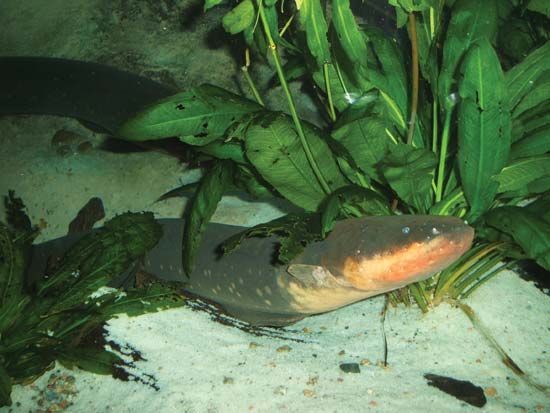
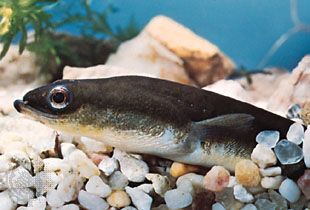
Knifefish
Knifefish generate and detect electrical fields through specialized biological systems that allow them to navigate and communicate in murky environments…
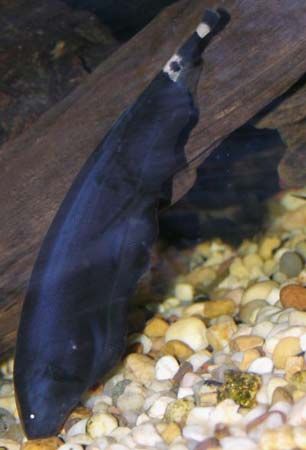
How do knifefish generate and detect electrical fields?
Knifefish generate and detect electrical fields through specialized biological systems that allow them to navigate and communicate in murky environments where vision is ineffective.1
Generation of Electric Fields
Knifefish possess a bioelectric organ typically located in the tail, which is derived from modified muscle or nerve tissue. This organ consists of numerous flattened cells called electroplaques (or electrocytes)2. When the fish’s nervous system sends a signal, these cells discharge simultaneously, creating a cascade of current that produces an electric field in the surrounding water.123
Detection of Electric Fields
To perceive their environment, these fish utilize electroreception, specifically through tuberous electroreceptor organs situated on the front part of their bodies. As the fish emits its own electric field, nearby objects distort the field, creating “electrical shadows” on the fish’s skin. These receptors detect the distortions, allowing the fish to interpret the location and electrical properties of objects—a process known as active electrolocation. This sense is also vital for social communication, enabling the fish to signal threats, courtship, or species recognition.14
What are some of the most well-known species of knifefish?
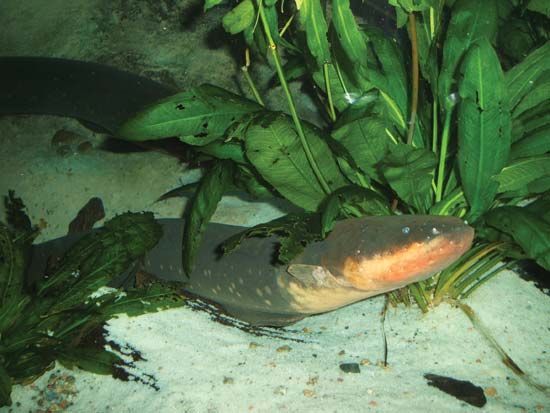
Knifefish belong to the suborder Gymnotoidei, which includes approximately 50 species of New World fishes found in Central and South American lakes and lagoons. These fish are characterized by their elongated, blade-shaped bodies and their ability to produce low-voltage electrical discharges for navigation.5
Some of the most well-known species and groups include:
- Gymnotus carapo: A yellow-striped species that reaches about 30 cm (12 inches) in length. It is a hardy, nocturnal fish often kept in home aquariums.5
- Nakedback knifefishes (Family Gymnotidae): This group includes the electric eel, which is closely related to other knifefishes and possesses powerful electric organs.56
- Glass knifefishes (Family Sternopygidae): A group native to Panama and South America.6
- Ghost knifefishes (Family Apteronotidae): Another group found in the waters of Panama and South America.6
- Bluntnose knifefishes (Family Hypopomidae): Distinguished by the absence of teeth on their oral jaws.6
- Rhamphichthyidae: A family known for their elephant-like snouts and weak electrical powers.6
Additionally, the name “knifefish” is sometimes applied to unrelated African and Asian fishes belonging to the family Notopteridae.5

How have knifefish adapted to their environment, particularly in terms of movement and feeding?
Knifefish have evolved specialized physical and sensory adaptations that allow them to thrive in the quiet, often murky lakes and lagoons of Central and South America.5
Adaptations for Movement
Knifefish possess an elongated, blade-shaped body that is compressed from side to side, a form highly efficient for navigating through weedy or cluttered environments. Because they have lost their dorsal and sometimes their caudal fins, they rely on a unique method of propulsion:59
- Anal Fin Undulation: They swim by rippling a long anal fin that extends nearly the entire length of their underside.59
- Maneuverability: This specialized fin allows them to swim with equal ease both forward and backward, providing the precision needed to navigate complex underwater habitats.59
Adaptations for Feeding and Sensing
Knifefish are nocturnal and often inhabit environments where vision is limited. To compensate, they have developed a sophisticated sensory system:5
- Active Electrolocation: They produce low-voltage electrical discharges from a specialized organ in their tail. By sensing distortions in these fields caused by nearby objects, they can “see” their surroundings—including potential prey—even in total darkness.53
- Dietary Flexibility: These fish are adapted to a variety of food sources, being either carnivorous or herbivorous, which allows them to exploit different niches within their aquatic ecosystems.5
What are the distinctive physical characteristics of knifefish?
Knifefishes, which belong to the suborder Gymnotoidei, are defined by several distinctive physical characteristics that facilitate their unique lifestyle in quiet, murky waters.5
- Body Shape: These fishes are characteristically elongated, sideways-flattened, and blade-shaped. This lateral compression is an adaptation for navigating through cluttered, weedy environments.54
- Fin Structure: A primary feature of knifefish is the loss of the dorsal fin and, in many species, the caudal (tail) fin. Instead, they possess an extremely long anal fin that extends along nearly the entire length of their underside.45
- Locomotion: Rather than using lateral body undulations common in other fish, knifefishes propel themselves through rippling movements of their long anal fin. This specialized adaptation allows them to swim with precision in both forward and backward directions.54
- Electrical Organs: Many knifefishes, including the related electric eel, possess specialized electric organs composed of modified muscle cells called electrocytes. These organs allow them to produce electrical discharges used for navigation and locating objects in dark or murky water.59
Sources
- Senses - Electric sense — Encyclopædia Britannica
- bioelectric organ — Encyclopædia Britannica
- Electroreception — Encyclopædia Britannica
- electric eel — Encyclopædia Britannica
- knifefish — Encyclopædia Britannica
- killifish — Encyclopædia Britannica
- ostariophysan - Annotated classification — Encyclopædia Britannica
- knife fish — Merriam-Webster
- ostariophysan - Swimming — Encyclopædia Britannica
Published on · 4 min read