Krapina Remains
The Krapina remains are a collection of fossilized skeletal parts—including skulls, teeth, and limb bones—belonging to at least 24 early Neanderthal adults…
What is Krapina remains?
The Krapina remains are a collection of fossilized skeletal parts—including skulls, teeth, and limb bones—belonging to at least 24 early Neanderthal adults and children. Discovered in a rock shelter near Krapina, Croatia, between 1899 and 1905, these fossils date back approximately 130,000 years.1
The specimens display classic Neanderthal characteristics, such as heavy, sloping foreheads, projecting midfaces, and exceptionally large front teeth. The bones were found in a fragmented state, which has led researchers to propose several theories regarding their condition, including the possibility of cannibalism during times of food scarcity or damage caused by animal trampling. Evidence from dental lesions suggests that these individuals frequently endured periods of starvation. These findings provide significant insight into the physical form and environmental challenges faced by early human ancestors.12
What are the key physical characteristics of Neanderthals?
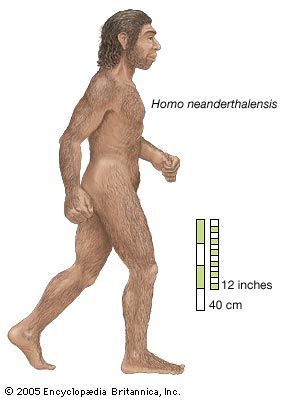
Neanderthals possessed a unique set of physical traits, many of which were adaptations to cold environments. Their morphology is characterized by a combination of robust skeletal features and specific craniofacial structures.
Craniofacial Features
Neanderthals typically exhibited a low-vaulted cranium with a large, long, and rounded braincase, often with a capacity equal to or greater than that of modern humans. Key facial characteristics included:34
- Midface: A large, projecting midface, particularly around the nose and teeth.4
- Brow Ridges: Prominent, arched brow ridges.34
- Jaw: A robustly built lower jaw with a receding chin and a mental foramen positioned farther back than in modern humans.3
- Teeth: Large front teeth, with some individuals exhibiting taurodontism (voluminous pulp cavities).35
Body Proportions
Neanderthals were generally stocky and heavily muscled, an adaptation to cold stress4. Their build included:5
- Torso and Limbs: A broad chest and relatively short lower limb extremities compared to their upper arms and legs.5
- Musculature: Stout limb bones with strong attachments for muscles, indicating significant physical strength.45
- Spine: Less lumbar lordosis (back curvature) compared to modern humans.3
We could dive deeper into the social behaviors and mortuary rituals that allowed these individuals to survive despite high rates of injury and physical degeneration.
How do scientists determine the age of ancient fossils?
Scientists determine the age of ancient fossils and artifacts using a variety of relative and absolute dating techniques.
Relative Dating
Relative dating establishes the chronological order of remains without providing a specific calendar age. The most common method is stratigraphy, which relies on the law of superposition: in undisturbed deposits, older layers are found at lower levels than younger ones. Archaeologists also use cross dating, where the age of an undated site is estimated by comparing its artifacts to objects from a culture with a known chronology.67
Absolute Dating
Absolute dating provides specific numerical ages through scientific analysis:
- Radiometric Dating: This measures the decay of radioactive isotopes. Carbon-14 dating is used for organic materials (like bone or wood) up to 50,000 years old. For much older geological samples, potassium-argon dating measures the decay of potassium-40 into argon-40 in rocks, allowing scientists to date fossils millions of years old.896
- Dendrochronology: This method dates wooden artifacts by analyzing the growth rings of trees.6
- Molecular Clocks: Geneticists use DNA sequencing to estimate how long ago species diverged from a common ancestor by measuring the accumulation of changes in genetic codes.10
What were the typical tools used by Neanderthals?
Neanderthals were sophisticated toolmakers who utilized a diverse array of implements to survive in varied environments. Their primary technological tradition is known as the Mousterian industry, which featured the Levallois flaking technique. This method involved striking flakes from prepared stone cores to create precise, standardized tools.1213
Key Tool Categories
- Hunting and Butchery: Neanderthals used wooden spears, sometimes fire-hardened to increase durability, to hunt large game. Their tool kits included hand axes, triangular points used as knives, and various scrapers for processing animal hides.131412
- Domestic and Craft Tools: They employed burins for cutting wood and bone, as well as awls for punching holes in hides to create clothing. Denticulate (toothed) instruments were likely used as saws or for straightening shafts.1213
- Advanced Technology: In some late sites, Neanderthals produced blade tools similar to those of early modern humans, a technology known as the Châtelperronian industry, which required significant planning and precision.12
Beyond utilitarian items, Neanderthals collected pigments like red ochre and manganese oxides and created nonutilitarian artifacts, including ornaments and decorated bone, suggesting complex cognitive abilities.12
Sources
- Krapina remains — Encyclopædia Britannica
- Krapina man — Merriam-Webster
- Neanderthal - Craniofacial features — Encyclopædia Britannica
- La Chapelle-aux-Saints — Encyclopædia Britannica
- Neanderthal - Body proportions and cold stress — Encyclopædia Britannica
- potassium-argon dating — Encyclopædia Britannica
- Archaeology - Dating — Encyclopædia Britannica
- stratigraphy — Encyclopædia Britannica
- carbon-14 dating — Encyclopædia Britannica
- Did you know? — Merriam-Webster
- Homo sapiens - Evolution — Encyclopædia Britannica
- Neanderthal - Neanderthal culture — Encyclopædia Britannica
- Mousterian industry — Encyclopædia Britannica
- human evolution - Speech and symbolic intelligence — Encyclopædia Britannica
- hand tool - The Acheulean industry — Encyclopædia Britannica
Published on · 3 min read