Lake Bled
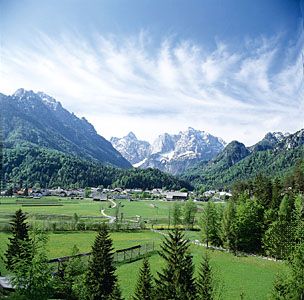
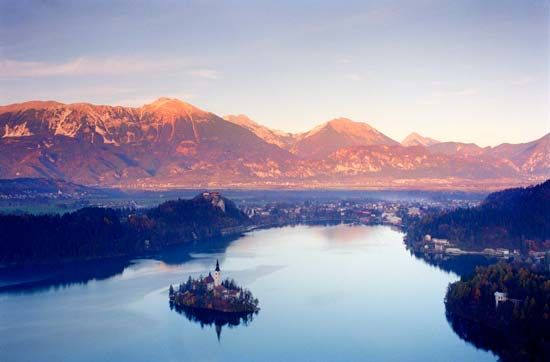
Lake Bled is a glacial lake located in the northwestern region of Slovenia. Positioned at the foot of the Julian Alps and northwest of Ljubljana, it sits…
What is Lake Bled?
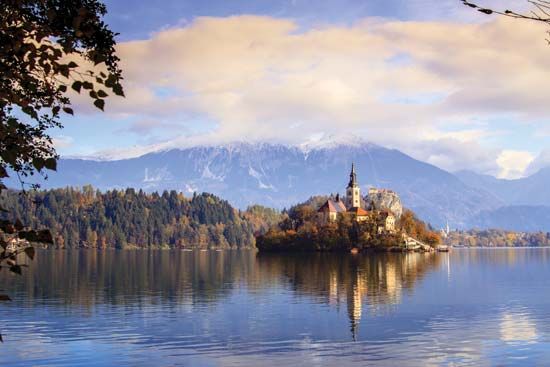
Lake Bled is a glacial lake located in the northwestern region of Slovenia. Positioned at the foot of the Julian Alps and northwest of Ljubljana, it sits 1,558 feet above sea level.1
The area serves as a popular destination for both summer holidays and winter sports, benefiting from a mild subalpine climate. The town of Bled features significant historical landmarks, including Bled Castle, which overlooks the water from a 460-foot cliff. Additionally, a small island within the lake houses the Church of the Assumption, a site that previously hosted a Slavic pagan shrine until the 11th century.1
How are glacial lakes formed?
Glacial lakes are primarily formed through the mechanical action of glaciers and the damming effects of ice and glacial debris. The process occurs through several key mechanisms:2
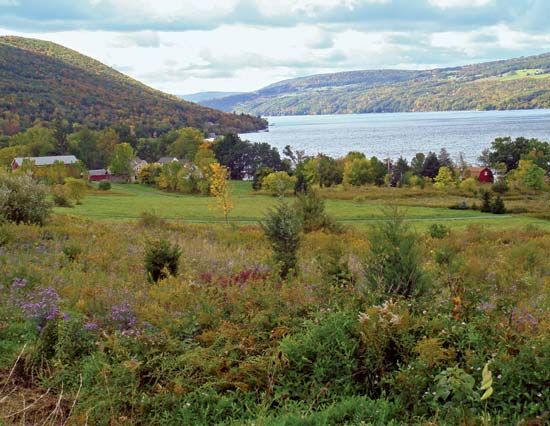
- Glacial Scouring: As massive ice sheets move over land, they erode and deepen existing valleys or scour depressions into relatively level surfaces. This creates rock basins that fill with water, such as the Great Lakes and the Finger Lakes in North America. In mountainous regions, the freezing and thawing of snow at the head of a valley can carve out a deep, circular basin known as a cirque.234
- Damming: Lakes are often formed when water is confined by ice masses or moraines—heterogeneous sedimentary deposits left at glacier margins2. For example, the Finger Lakes were formed by scouring and subsequently blocked at their ends by morainic deposits.52
- Other Deposits and Thawing: Various basins form within glacial drift, including kettle lakes, which originate from melting ice, and basins created by thawing in permafrost.2
What activities are popular in Triglav National Park?
Triglav National Park is a protected area defined by its diverse Alpine plant life and numerous glacial lakes. The park is centered around Triglav, the highest mountain peak in both Slovenia and the Julian Alps.
A primary activity in the park is mountain climbing. The summit of Triglav, which reaches 9,396 feet (2,864 meters), has been a destination for climbers since its first ascent in 1778. The mountain is particularly noted for its north wall, an immense limestone face nearly 2 miles (3 kilometers) wide. Upon reaching the summit, climbers are rewarded with expansive views that stretch north into Austria and south toward the Adriatic Sea.
While the provided information highlights mountaineering and sightseeing as central activities, the park’s unique geography also makes it a significant site for nature observation and exploration of its glacial features.
What is the history of the Julian Alps?
The Julian Alps are a range of the Eastern Alps that have been shaped by both geological forces and significant human history.
Geological Origins
The mountains emerged during the Alpine orogeny, a tectonic event beginning about 65 million years ago. The range is composed primarily of limestone that was deposited in the ancient Tethys Sea and later folded and uplifted. During the Quaternary Period, extensive glaciation carved the landscape, creating deep valleys, cirques, and the rugged peaks seen today, including Triglav, the highest point in Slovenia.78
Military and Strategic History
The Julian Alps have historically served as a critical strategic barrier. During World War I, the region became the site of intense conflict between Italy and Austria-Hungary.
- Isonzo Front: Following Italy’s entry into the war in 1915, the lower valley of the Isonzo (Soča) River became a site of prolonged trench warfare and numerous fruitless offensives.910
- Battle of Caporetto: In 1917, the Battle of Caporetto saw Austro-German forces successfully penetrate the mountain barrier of the Julian Alps. This offensive resulted in a major Italian retreat to the Piave River and led to significant changes in Italian military leadership and Allied command structures.10
Sources
- Lake Bled — Encyclopædia Britannica
- lake - Basins formed by glaciation — Encyclopædia Britannica
- glacial landform - Glaciolacustrine deposits — Encyclopædia Britannica
- Quaternary - Lakes — Encyclopædia Britannica
- Quaternary - Landforms — Encyclopædia Britannica
- Triglav — Encyclopædia Britannica
- Julian Alps — Encyclopædia Britannica
- Alps - Geology — Encyclopædia Britannica
- Alps - Settlement — Encyclopædia Britannica
- Julian Alps — Merriam-Webster
- World War I - Italy and the Italian front, 1915–16 — Encyclopædia Britannica
- Battle of Caporetto — Encyclopædia Britannica
Published on · 3 min read