Ice in Lakes and Rivers
The formation and duration of ice on lakes and rivers are fundamentally linked to air temperature, as the seasonal cycle of ice cover generally coincides…
How does climate change affect ice formation on lakes and rivers?
The formation and duration of ice on lakes and rivers are fundamentally linked to air temperature, as the seasonal cycle of ice cover generally coincides with periods when average daily temperatures remain below the freezing point.1
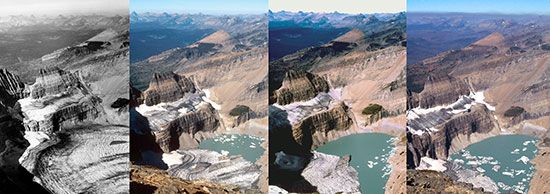
Because climate change and rising global temperatures directly influence these thermal thresholds, they disrupt traditional ice patterns. As air temperatures rise, the duration of the ice-covered season shortens, and the extent of ice formation decreases. In regions where temperatures are already near the freezing point, such as latitudes lower than 45° N, these shifts can lead to increasingly erratic freeze-up dates or years where no ice forms at all.123
While local factors like water depth, wind, and warm water inflows also play a role in ice stability, the overarching trend of warming temperatures reduces the time available for ice to form and accelerates its decay in the spring. These changes can have significant ecological consequences, as seen in the loss of critical habitats for various species.142
What is the concept of ‘ice jams’ in rivers and how do they form?
An ice jam is an accumulation of ice that obstructs the flow of a river, often leading to localized flooding as water builds up behind the blockage.
How Ice Jams Form
Ice jams typically occur when the quantity of moving ice exceeds a river’s transport capacity. This often happens at specific locations, such as where a river’s slope changes from steeper to milder, or where moving ice encounters an intact ice cover, such as in a large pool or at the point of outflow into a lake.67
During late winter or early spring, rising temperatures and increased runoff from rain or snowmelt raise water levels, breaking ice loose from riverbanks. If the forces exerted by the increased flow exceed the strength of the ice, the cover breaks up and is transported downstream, where it may cluster and stack to form a jam.67
Types of Jams
- Spring Breakup Jams: Composed of large quantities of stacked ice, these are generally more destructive and can cause sudden flooding or damage to structures like bridges.67
- Freeze-up Jams: These form as a result of water freezing in narrow river stretches or at lake outlets.7
How does ice on lakes and rivers affect human activities like transportation and recreation?
Ice on lakes and rivers significantly impacts human activities, primarily by creating obstacles to transportation and necessitating complex management strategies.
Transportation Challenges
The presence of ice can severely disrupt navigation. On major waterways like the St. Lawrence River and the Great Lakes, icebreaking vessels are essential to clear paths for commercial shipping and maintain supply chains during winter months. Without these efforts, ice accumulation can halt vessel movement entirely.6
Risks to Infrastructure and Safety
Ice dynamics, particularly the formation of ice jams, pose direct threats to human infrastructure. During spring breakups, moving ice can collide with and damage bridges, docks, and other riverside structures. Furthermore, the sudden flooding caused by these jams can endanger communities and disrupt local land transportation networks.8
Management and Recreation
To mitigate these risks, various methods are employed, such as using floating ice booms to retain ice in specific areas or using explosives to clear jams. While these measures protect infrastructure, they also alter the natural state of the water, which can affect recreational activities that rely on stable or predictable ice conditions.6
What is the difference between lake ice and river ice formation?
The formation of ice in lakes and rivers differs primarily due to the influence of water velocity and turbulence.
Lake Ice Formation
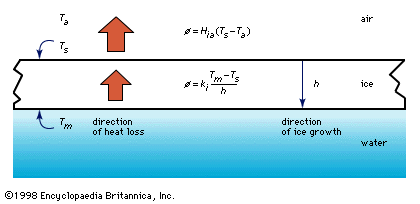
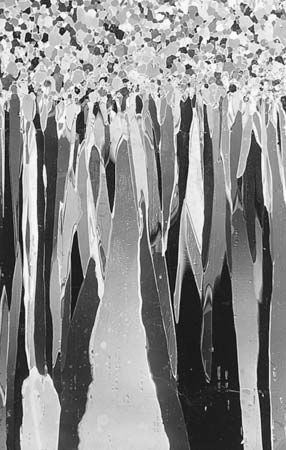
In lakes, ice formation is largely governed by the thermal structure of the water. As the water cools, it reaches a point of maximum density (4° C), after which further cooling creates a layer of lighter, colder water at the surface. Once this surface layer reaches the freezing point, ice begins to form. This process is often influenced by wind, which can mix the surface water and create smaller crystals or prevent a stable cover from forming on large or deep lakes. Once a stable, fixed ice cover is established, it typically thickens through the growth of columnar crystals into the water below.1091112
River Ice Formation
River ice formation is more complex because turbulence and water velocity keep the water column uniformly cooled.13
- Frazil Ice: Unlike lakes, the first ice in rivers is typically frazil ice—small, disk-shaped ice particles that form in supercooled, turbulent water.13
- Accumulation: These particles can flocculate into slush, pans, or floes that accumulate at the surface. These masses may freeze together to form an accumulating ice cover that progresses upstream.1314
- Anchor Ice: Frazil particles can also adhere to the riverbed, creating a porous layer known as anchor ice.13
While both environments eventually develop fixed ice covers that thicken similarly, river ice is frequently disrupted by flow velocity, which can melt the underside of the ice or prevent thickening in high-velocity areas.11
Sources
- ice in lakes and rivers - The seasonal cycle — Encyclopædia Britannica
- ice in lakes and rivers - Freeze-up — Encyclopædia Britannica
- iceberg - Impacts on ice sheets and sea level — Encyclopædia Britannica
- ice in lakes and rivers - Melting — Encyclopædia Britannica
- sea ice - The emerging impacts of recent changes to sea ice — Encyclopædia Britannica
- ice in lakes and rivers - Decay and ice jams — Encyclopædia Britannica
- ice jam — Encyclopædia Britannica
- ice in lakes and rivers - Mechanical methods — Encyclopædia Britannica
- ice in lakes and rivers - Changes in temperature structure — Encyclopædia Britannica
- ice in lakes and rivers - Growth of fixed ice cover — Encyclopædia Britannica
- ice in lakes and rivers — Encyclopædia Britannica
- ice in lakes and rivers - Ice particles — Encyclopædia Britannica
- ice in lakes and rivers - Nucleation of ice crystals — Encyclopædia Britannica
- ice in lakes and rivers - Accumulating ice cover — Encyclopædia Britannica
- ice in lakes and rivers - Effects of wind mixing — Encyclopædia Britannica
- ice in lakes and rivers - Variations in ice structure — Encyclopædia Britannica
Published on · 4 min read