Lake Kisale
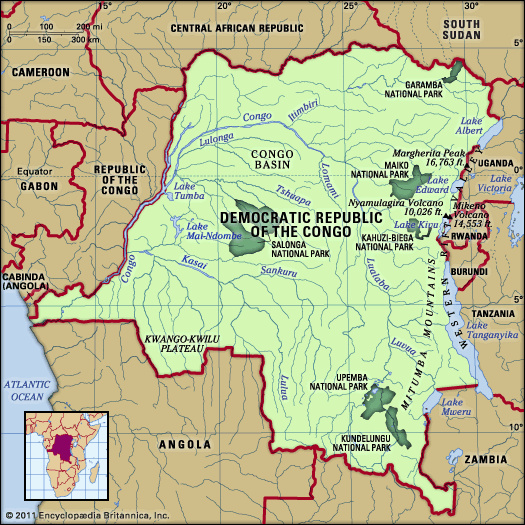
Lake Kisale is a marshy expansion of the Lualaba River located on the Katanga (Shaba) plateau in the Democratic Republic of the Congo. Situated north of Lake…
What is Lake Kisale?
Lake Kisale is a marshy expansion of the Lualaba River located on the Katanga (Shaba) plateau in the Democratic Republic of the Congo. Situated north of Lake Upemba, the lake measures approximately 10 miles (16 km) in length and 12 miles (19 km) in width.12
The area is characterized by its swampy nature and is heavily overgrown with papyrus and floating vegetation. The southern and southeastern shores of the lake are included within the boundaries of Upemba National Park. Additionally, the Lufira River joins the Lualaba River by flowing through Lake Kisale.123
What is the significance of Upemba National Park?
Upemba National Park, established in 1939, is a significant protected area in the southeastern Democratic Republic of the Congo. Spanning 4,529 square miles (11,730 square km), the park plays a vital role in the conservation of the region’s diverse biodiversity by providing a sanctuary for various animal species that have otherwise faced population declines due to hunting.45
The park’s ecological significance is rooted in its varied landscape, which encompasses the Lualaba River, the swampy Lake Upemba, and the forested Kibara Mountains. This range of habitats supports a wide array of wildlife, including:
- Large Mammals: Elephants, zebras, buffalo, lions, and various species of antelopes.4
- Avian Life: A diverse population of aquatic birds.4
By protecting these critical environments, the park serves as an essential refuge for species within the broader context of the country’s national park system, which works to mitigate the loss of animal life across the region.5
How does the Lualaba River contribute to the Congo River system?
The Lualaba River serves as the primary headstream of the Congo River, effectively acting as its upper course. Rising on the Katanga (Shaba) plateau, the Lualaba flows for approximately 1,100 miles (1,800 km) before its identity transitions into the Congo River proper at the Boyoma Falls, a series of seven cataracts that mark the end of the Lualaba and the beginning of the navigable Congo.36
The Lualaba contributes to the broader river system through several key characteristics:
- Confluences: The upper reaches of the Congo system are defined by the union of several major streams. The Lualaba joins with the Luvua River and the Lukuga River, integrating their waters into the main channel.36
- Lacustrine Expansions: Along its course, the Lualaba expands into marshy lakes, such as Lake Upemba and Lake Kisale, which are typical of the upper Congo’s physiography.36
- Hydroelectric Potential: The river’s descent from the plateaus provides significant energy, which is harnessed for hydroelectric power, such as at the Nzilo Dam.3
What role do papyrus and marshy vegetation play in these lakes?
Papyrus and marshy vegetation, such as various species of Cyperaceae, play a fundamental role in the ecology of lakes like Lake Kisale and Lake Upemba. Their contributions include:
- Primary Productivity and Hydrology: These plants are crucial to the primary productivity of wetland ecosystems and significantly influence the hydrologic cycle through processes like evaporation and transpiration.1
- Habitat and Food Sources: Large stands of marsh vegetation provide essential cover for many aquatic and amphibious animals. Furthermore, the shoots, fruits, and tubers produced by these plants serve as vital food sources for diverse wildlife.1
- Wetland Succession: Sedges are often the first colonizers on bare soil in newly created wetlands. In stable environments, they help maintain the integrity of the ecosystem, though their growth can eventually accelerate the transition of a lake into a shallower state, potentially contributing to its long-term extinction as a body of water.17
- Water Quality: By slowing water flow and trapping sediments, this vegetation helps regulate the movement of nutrients and particulate matter within the Congo River system.18
Sources
- Lake Kisale — Encyclopædia Britannica
- Lufira River — Encyclopædia Britannica
- Lualaba River — Encyclopædia Britannica
- Upemba National Park — Encyclopædia Britannica
- Democratic Republic of the Congo - Plant and animal life — Encyclopædia Britannica
- Congo River - Physiography — Encyclopædia Britannica
- Cyperaceae - Economic and ecological importance — Encyclopædia Britannica
- lake - Sediments and sedimentation — Encyclopædia Britannica
- lake - Chemical precipitates — Encyclopædia Britannica
- Congo River - Plant life — Encyclopædia Britannica
- Swamp — Encyclopædia Britannica
Published on · 3 min read