Primary Productivity
Primary productivity is the rate at which energy is converted into organic substances by autotrophs. This process is primarily driven by photosynthetic…
What is primary productivity?
Primary productivity is the rate at which energy is converted into organic substances by autotrophs. This process is primarily driven by photosynthetic producers (photoautotrophs) that harness sunlight, though some energy is also produced by chemosynthetic organisms (chemoautotrophs) through oxidation.12
The total energy conversion in an ecosystem is known as gross primary productivity. After accounting for the energy used by producers to sustain their own life, the remaining energy is referred to as net primary productivity, which is available to support consumers in the food chain.12
Productivity is typically measured by tracking the uptake of carbon dioxide or the output of oxygen, with rates expressed as grams of organic carbon per unit area per unit time. Factors such as the availability of nutrients—specifically nitrogen and phosphorus—and the intensity of light significantly influence these rates.12
What is the difference between photoautotrophs and chemoautotrophs?
The primary difference between photoautotrophs and chemoautotrophs lies in the source of energy they use to synthesize organic molecules from inorganic carbon, such as carbon dioxide.34
- Photoautotrophs: These organisms harness energy from sunlight through the process of photosynthesis. Typical examples include green plants, algae, and cyanobacteria. They use this light energy to convert water and carbon dioxide into energy-rich organic compounds like sugars, releasing oxygen as a byproduct in many cases.345
- Chemoautotrophs: These organisms obtain energy through the oxidation of inorganic chemical compounds rather than light. They utilize substances such as ammonia, methane, or hydrogen sulfide combined with oxygen to generate the energy required for their metabolism. This group consists exclusively of certain [bacteria], such as sulfide or hydrogen oxidizers, which can thrive in environments where light is unavailable.34
Both groups serve as essential primary producers in their respective ecosystems, providing the foundational energy that supports [heterotrophs].34
How do nitrogen and phosphorus levels limit ecosystem growth?
Nitrogen and phosphorus are essential macronutrients that act as fundamental building blocks for life, yet their limited availability often restricts the growth and productivity of ecosystems.78
Nutrient Limitation
- Phosphorus: Often the most limiting nutrient in terrestrial ecosystems and aquatic environments, phosphorus is scarce because it lacks a volatile gaseous state and is primarily released through the slow weathering of bedrock primarily released through the slow weathering of bedrock. Much of the Earth’s phosphorus is sequestered in ocean sediments, making it difficult to cycle back into active biological use.7910
- Nitrogen: While also critical, nitrogen availability is frequently a bottleneck for plant growth. When the supply of these essential nutrients falls below the required threshold, plants exhibit deficiency symptoms, including stunted growth, leaf malformation, and reduced reproductive success.7
The Impact of Excess
While these nutrients limit growth in natural states, human activities—such as the use of fertilizers, sewage, and detergents—have introduced excess nitrogen and phosphorus into ecosystems. This leads to eutrophication, where explosive growth of algae and microorganisms creates dense water blooms. These blooms block light and, upon decomposition, deplete oxygen levels, often resulting in hypoxia and the death of fish and other wildlife.10211
What role does phytoplankton play in the global carbon cycle?
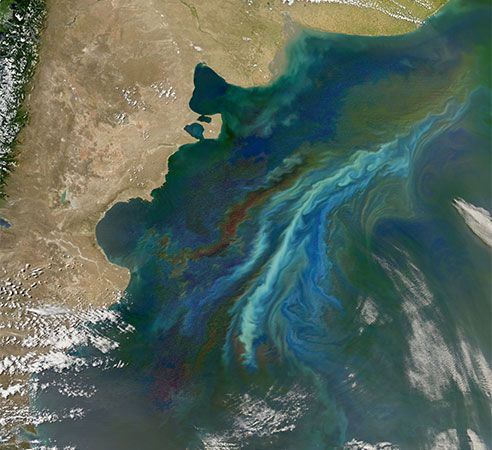
Phytoplankton are microscopic, free-floating organisms that play a critical role in the global carbon cycle by acting as a major biological sink for carbon dioxide.122
Although they represent only 1 to 2 percent of Earth’s primary-producer biomass, phytoplankton are responsible for approximately 40 percent of the planet’s total carbon fixation. Through photosynthesis, they absorb dissolved CO₂ from the upper ocean to build their tissues. This process is a key component of the “biological pump,” which transports carbon from the atmosphere and surface waters to the deep ocean.122
Unlike terrestrial vegetation, which releases CO₂ back into the atmosphere upon decomposition, phytoplankton sink to the ocean floor when they die. Because decomposition occurs more slowly in the deep ocean, this carbon is effectively sequestered away from the atmosphere for hundreds of years, eventually becoming stored in sedimentary rock. Additionally, phytoplankton absorb 30 percent of the carbon emissions produced annually by human activities, making them vital to climate regulation.12213
Sources
- Marine ecosystem - Biological productivity — Encyclopædia Britannica
- primary productivity — Encyclopædia Britannica
- photoautotroph — Merriam-Webster
- autotroph — Encyclopædia Britannica
- chemoautotrophic — Merriam-Webster
- life - Energy , carbon, and electrons — Encyclopædia Britannica
- Biosphere - The cycling of phosphorus and other essential nutrients — Encyclopædia Britannica
- eutrophication — Encyclopædia Britannica
- Plant disease - Adverse environment — Encyclopædia Britannica
- Inland water ecosystem - Biological productivity — Encyclopædia Britannica
- Phosphorus cycle — Encyclopædia Britannica
- decarbonization - Natural carbon removal — Encyclopædia Britannica
- Geoengineering - Ocean fertilization — Encyclopædia Britannica
- Greenhouse gas - Carbon dioxide — Encyclopædia Britannica
- phytoplankton — Encyclopædia Britannica
Published on · 3 min read