Lufira River
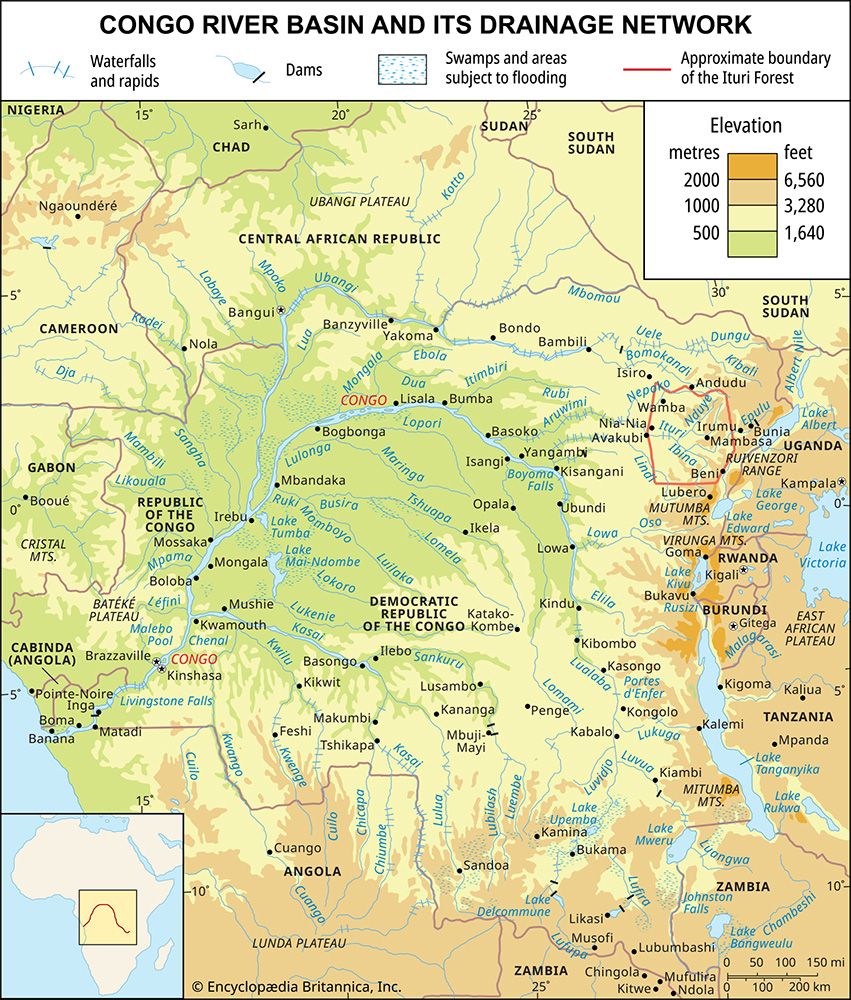
The Lufira River is a 300-mile (500-km) tributary of the Lualaba River, which serves as a primary headstream of the Congo River in the Democratic Republic of…
What is Lufira River?
The Lufira River is a 300-mile (500-km) tributary of the Lualaba River, which serves as a primary headstream of the Congo River in the Democratic Republic of the Congo.1
Rising in the Katanga (Shaba) plateau south of Likasi, the river flows northeast and north-northwest across the Bia Mountains before joining the Lualaba through Lake Kisale. The river is economically significant due to a dam near Likasi that created a 160-square-mile reservoir. This facility provides essential hydroelectric power for the smelting industry in Likasi and the copper-rich region spanning from Kambove to Lubumbashi.1
How does the Lualaba River connect to the Congo River?
The Lualaba River serves as the primary headstream of the Congo River in terms of water volume. The connection between the two is defined by the river’s physical progression through the central African landscape.23
As the Lualaba flows northward, it traverses various terrains, including marshy lakes and deep gorges, before reaching Boyoma Falls (formerly Stanley Falls). These seven cataracts mark the definitive end of the Lualaba River and the beginning of the Congo River proper. Downstream of these falls lies the city of Kisangani, which serves as the starting point for the navigable middle section of the Congo River.24
While the Chambeshi River is considered the remotest source of the Congo in terms of total length, the Lualaba is recognized as the main stream by volume, effectively feeding the massive Congo basin network that eventually drains into the Atlantic Ocean.3
What is the importance of hydroelectric power in the Democratic Republic of the Congo?
Hydroelectric power is a cornerstone of the economy in the Democratic Republic of the Congo, as nearly all electricity generated in the country is derived from this source. The nation possesses immense hydroelectric potential, estimated at approximately one-sixth of the world’s known resources, largely due to the extensive rapids within the Congo River system.678
Industrial and Economic Impact
The primary focus of hydroelectric development has been to support the country’s vital mining and manufacturing sectors. The Inga Falls project, located on the lower Congo River, serves as the central hub for this power. Since the completion of its initial phases, the facility has provided electricity to industrial operations, including uranium-enrichment sites and the copper-rich regions of Katanga.96
Challenges and Future Potential
Despite this massive capacity, only a small fraction of the potential has been harnessed, and many citizens lack reliable access to electricity, often relying on firewood for domestic fuel. Ambitious proposals like the “Grand Inga” scheme aim to further develop these resources, potentially creating one of the largest hydroelectric power systems in the world.679
What are some unique features of the Congo River basin?
The Congo River basin is a vast, ecologically significant region in west-central Africa characterized by several unique features:
- Immense Scale and Geography: Covering over 1.3 million square miles, it is the world’s second-largest river basin. The central portion, known as the cuvette (or “shallow bowl”), is a massive depression filled with thick alluvial deposits that have accumulated since the Precambrian era.113
- Equatorial Rainforest: The basin hosts the world’s second-largest rainforest, which stretches continuously across the central depression and is bordered by a mosaic of savanna and deciduous forest.113
- Hydrological Stability: Despite its vast size, the Congo has a remarkably regular flow because its tributaries span both sides of the Equator. This ensures that the river receives rainfall throughout the year, preventing extreme fluctuations in water levels.12
- Distinct Aquatic Biodiversity: The river system functions as a separate ecological milieu. It contains over 230 species of fish in Malebo Pool alone, and unique adaptations like lungfish, which survive dry periods by encysting in mucus cocoons.13
Sources
- Lufira River — Encyclopædia Britannica
- Lualaba River — Encyclopædia Britannica
- Congo basin — Encyclopædia Britannica
- Congo River - Physiography — Encyclopædia Britannica
- Congo River — Encyclopædia Britannica
- Inga Falls — Encyclopædia Britannica
- Democratic Republic of the Congo - Manufacturing — Encyclopædia Britannica
- Congo River - Power — Encyclopædia Britannica
- Democratic Republic of the Congo: Top Questions — Encyclopædia Britannica
- Democratic Republic of the Congo - Resources and power — Encyclopædia Britannica
- Congo River: Top Questions — Encyclopædia Britannica
- Republic of the Congo - Drainage — Encyclopædia Britannica
- Congo River - Hydrology of the Congo River — Encyclopædia Britannica
- Congo River - Animal life — Encyclopædia Britannica
Published on · 3 min read