Lake Peipus
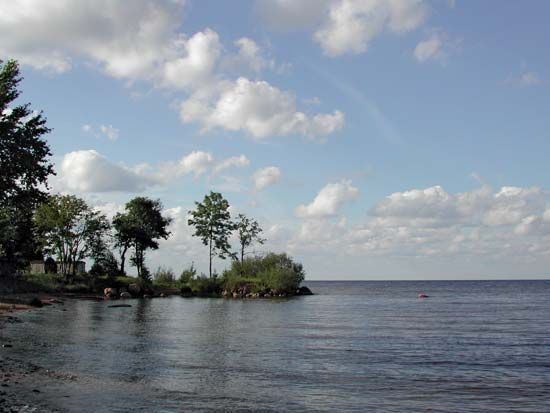
Lake Peipus is located in northeastern Europe, where it forms a significant portion of the international boundary between Estonia and Russia.
Where is Lake Peipus located and what countries border it?
Lake Peipus is located in northeastern Europe, where it forms a significant portion of the international boundary between Estonia and Russia.123
The lake is part of a larger system of interconnected bodies of water, including Lake Tyoploye and Lake Pskov, which together serve as a natural border between the two nations. Known as Peipsi in Estonian and Chudskoye Ozero in Russian, the lake is historically significant as the site of the 1242 “Battle on the Ice,” where forces under Alexander Nevsky defeated the Teutonic Knights1.132
What is the historical significance of Lake Peipus, particularly in relation to medieval battles?
Lake Peipus holds significant historical importance as the site of the 1242 “Battle on the Ice” (Ledovoye Poboishche), a pivotal conflict between the forces of Novgorod led by Alexander Nevsky and the Teutonic Knights.14
In the early 13th century, the Livonian Knights and their affiliates, the Teutonic Knights, launched a campaign to expand their territory into northwestern Russia and convert the population to Roman Catholicism. After the Knights captured Pskov in 1241 and advanced toward Novgorod, Alexander Nevsky mobilized an army to intercept them.14
On April 5, 1242, the two forces engaged on the frozen surface of a narrow channel between Lake Peipus and Lake Pskov. Nevsky’s decisive victory halted the eastward expansion of the German and Swedish forces, forcing the grand master of the Knights to relinquish all claims to conquered Russian lands. This triumph significantly reduced the threat to northwestern Russia and cemented Nevsky’s legacy as a national hero.14
What is the size and depth of Lake Peipus compared to other European lakes?
Lake Peipus covers an area of approximately 1,370 square miles (3,550 square km), though this figure can vary. In terms of depth, the lake is relatively shallow, with a bottom that reaches a maximum depth of about 50 feet (15 meters).
When compared to other major European lakes, Lake Peipus is significantly smaller than the largest bodies of water on the continent, such as Lake Ladoga (17,600 square km) and Lake Onega (9,720 square km), both located in Russia. While it does not rank among the top 20 largest lakes globally, it remains a vital geographical feature of northeastern Europe, serving as a natural border and the headwaters of the Narva River.56
What was the significance of the Battle on the Ice?
The “Battle on the Ice,” fought on April 5, 1242, was a decisive military engagement between the forces of Novgorod, led by Alexander Nevsky, and the Teutonic Knights.14
The battle’s significance lies in its role as a turning point for northwestern Russia:
- Halting Expansion: The victory effectively stopped the eastward military and religious expansion of the Teutonic and Livonian Knights, who had sought to conquer Russian lands and convert the population to Roman Catholicism.14
- Territorial Recovery: Following the defeat, the grand master of the Knights was forced to relinquish all claims to the Russian territories they had previously seized.1
- National Legacy: The triumph solidified Alexander Nevsky’s reputation as a brilliant military commander and a national hero, an image that has been invoked throughout Russian history, including during World War II to bolster national morale.4
Sources
- Lake Peipus — Encyclopædia Britannica
- Peipus — Merriam-Webster
- Estonia - Land — Encyclopædia Britannica
- Saint Alexander Nevsky — Encyclopædia Britannica
- world’s largest lakes — Encyclopædia Britannica
- Lake Pielinen — Encyclopædia Britannica
- Treaty of Novgorod — Encyclopædia Britannica
Published on · 2 min read