Lamb’s Quarters
Lamb’s quarters (Chenopodium album) is an annual weedy plant belonging to the Amaranthaceae family. It is widely distributed across Asia, Europe, and North…
What is lamb’s quarters?
Lamb’s quarters (Chenopodium album) is an annual weedy plant belonging to the Amaranthaceae family1. It is widely distributed across Asia, Europe, and North America.1
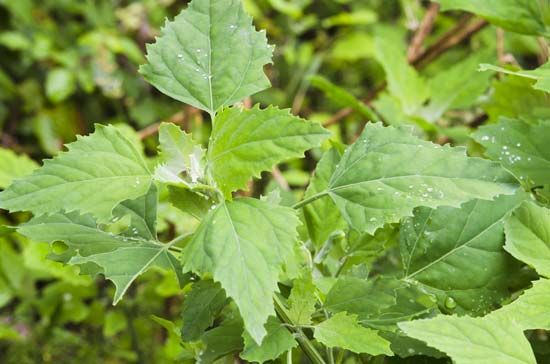
While the plant can reach heights of up to 3 meters (about 10 feet), it is typically smaller. Its blue-green leaves are characterized by a variable shape and a distinctive white, mealy coating on the underside.12
In the spring, the tender young shoots are sometimes harvested and consumed as potherbs or used in salads. These greens are considered a nutritious food source, providing notable amounts of vitamin A and iron. The term is also occasionally used to refer to various types of oraches.12
How do you distinguish lamb’s quarters from similar weeds?
To distinguish lamb’s quarters (Chenopodium album) from other weeds, look for its most diagnostic feature: a fine, white, mealy or powdery coating on the underside of its blue-green leaves.12
While the plant’s leaf shape and size can be quite variable, this distinct texture—often described as looking like dust or flour—is a key identifier. Additionally, as a member of the Amaranthaceae family, it is often confused with related species, such as various types of oraches, which may share similar growth habits.12
When identifying the plant, note that it is an annual that can grow up to 3 meters tall, though it is frequently found as a smaller weed in gardens and disturbed soil. If you are foraging, always ensure positive identification, as some look-alike weeds do not possess the characteristic mealy underside.1
What are some other common edible wild plants?
Beyond lamb’s quarters, several other wild plants are recognized for their edible properties:
- Lamb’s lettuce (Valerianella locusta): A member of the Caprifoliaceae family, this plant is native to southern Europe and is widely used as a salad green. It is known for its nutty, tangy flavor and is considered hardier than common lettuce. A related species, the Italian corn salad, is also edible and thrives in warmer climates.3
- Common sorrel (Rumex acetosa) and sheep’s sorrel (R. acetosella): These are common pasture plants and weeds within the Polygonaceae family. While this family includes popular vegetables like rhubarb and buckwheat, it also contains various wild species that have historically been utilized for their edible leaves.4
- Sea grape (Coccoloba uvifera): Found growing on beaches, this plant produces edible fruit that is frequently used in the preparation of jellies.4
Why is Chenopodium album often classified as a weed?
Chenopodium album, commonly known as lamb’s quarters, is frequently classified as a weed primarily due to its status as a highly adaptable and widely distributed annual plant within the Amaranthaceae family.1
Its classification as a weed stems from its ability to thrive across diverse environments in Europe, Asia, and North America, often appearing in disturbed soils where it can compete with cultivated crops. While it is often managed as an unwanted plant in agricultural and garden settings, it is also recognized for its resilience and historical use as a source of vitamin A and iron when harvested as a potherb in the spring.1
Sources
- lamb’s quarters — Encyclopædia Britannica
- lamb's-quarter — Merriam-Webster
- Lamb’s lettuce — Encyclopædia Britannica
- Caryophyllales - Polygonaceae — Encyclopædia Britannica
Published on · 2 min read