Leaf-rolling Cricket
A leaf-rolling cricket (subfamily Gryllacridinae) is a type of raspy cricket distinguished by its unique method of nest construction. These insects create…
What is leaf-rolling cricket?
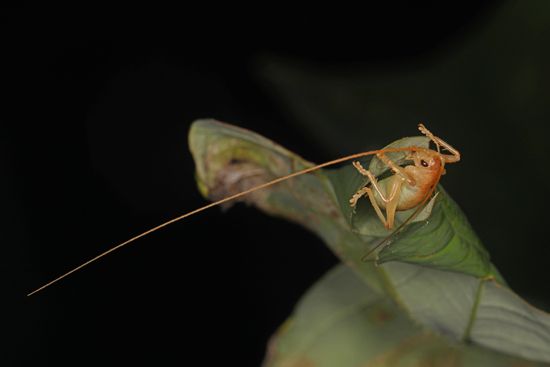
A leaf-rolling cricket (subfamily Gryllacridinae) is a type of raspy cricket distinguished by its unique method of nest construction. These insects create shelters by rolling a leaf and securing it with silk1.1
Key characteristics of leaf-rolling crickets include:
- Physical traits: They are wingless or nearly wingless, possess long antennae and cerci, and have a somewhat humpbacked appearance.2
- Behavior: They are nocturnal, spending their days hidden inside their rolled-leaf nests and emerging at night to feed, primarily on aphids.2
- Limitations: Unlike many other members of the order Orthoptera, these crickets do not jump and lack both sound-producing and hearing organs.2
- Species: The Carolina leaf roller (Camptonotus carolinensis) is the only member of this group found in North America.2
These crickets exhibit impressive homing abilities, using pheromones and spatial landmarks to return to their specific nests after foraging.1
How do raspy crickets produce their signature sound?
Raspy crickets produce their signature sound through a mechanical process known as femoral-abdominal stridulation. When threatened, the insect rubs the femur of its hind leg against a series of pegs located on its abdomen, which generates the characteristic raspy noise for which the family is named.2
In addition to this defensive stridulation, these insects use other mechanical methods for communication, particularly during courtship. These include:
- Drumming: Tapping their legs against their abdomens.2
- Tapping: Striking their hind legs against plant stems.2
- Stomping: Stomping their feet to create vibrations.2
Unlike many other members of the order Orthoptera, which typically produce sound by rubbing their wings together, raspy crickets are generally wingless and rely on these alternative mechanical actions to transmit information.23
What is the role of pheromones in cricket homing behavior?
In the context of homing behavior, certain crickets—specifically those within the raspy cricket family—utilize pheromones as a critical navigational tool. These insects are known for their ability to return to their individual nests after nocturnal foraging excursions, a feat achieved through a combination of spatial landmark recognition and the detection of individualized chemical signals.4
While pheromones serve various functions across the animal kingdom—such as mate attraction, kin recognition, and alarm signaling—in this specific homing context, they act as a personal marker. By depositing or detecting these unique chemical signatures, the cricket can identify its specific shelter, ensuring it successfully returns to its home base after moving through its environment.54
How do some crickets act as plant pollinators?
While most orthopterans are primarily known as herbivores that influence plant communities by consuming leaves, stems, and seeds, some species have evolved to act as pollinators.2
A notable example is a species of raspy cricket belonging to the genus Glomeremus, which is endemic to the wet forests of the Mascarene Islands. This insect is the first orthopteran discovered to regularly pollinate flowering plants, specifically the orchid Angraecum cadetii.6
The role of this cricket as a pollinator is driven by its feeding behavior:
- Dietary Shift: Due to a relative shortage of arthropods on the islands, these crickets have adapted to rely heavily on nectar, pollen, and seeds.6
- Pollination Mechanism: As the cricket feeds on the orchid, it carries the plant’s pollinia (sticky pollen packets) on its head. It then transfers these grains to neighboring flowers as it continues to feed, effectively facilitating the plant’s reproduction.6
Sources
- leaf-rolling cricket — Encyclopædia Britannica
- raspy cricket — Encyclopædia Britannica
- sound production — Encyclopædia Britannica
- Chemoreception - Pheromones — Encyclopædia Britannica
- Chemoreception - Blood-feeding insects — Encyclopædia Britannica
- Orthoptera - Importance — Encyclopædia Britannica
- Botanical Sex: 9 Alluring Adaptations — Encyclopædia Britannica
- major types of pollinators - Mammals — Encyclopædia Britannica
Published on · 2 min read