Lechwe
The lechwe is highly specialized for life in wetland environments, ranking as one of the most aquatic of all African antelopes. Its primary physical…
How are lechwes adapted to their wetland habitat?
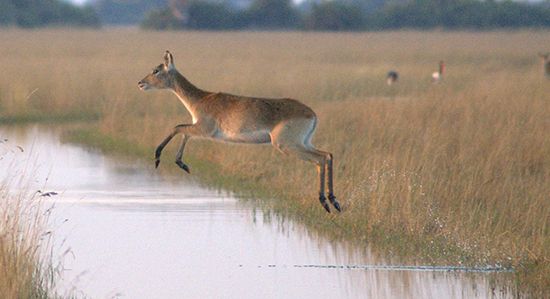
The lechwe is highly specialized for life in wetland environments, ranking as one of the most aquatic of all African antelopes. Its primary physical adaptations include:
- Hooves: They possess widely splayed, elongated hooves that provide necessary support on soft, marshy ground.1
- Coat: Their fur is greasy and water-repellent, helping them remain comfortable while navigating aquatic habitats.1
- Body Structure: They have a sturdy build with higher, more massive hindquarters, which assists in their movement through water.1
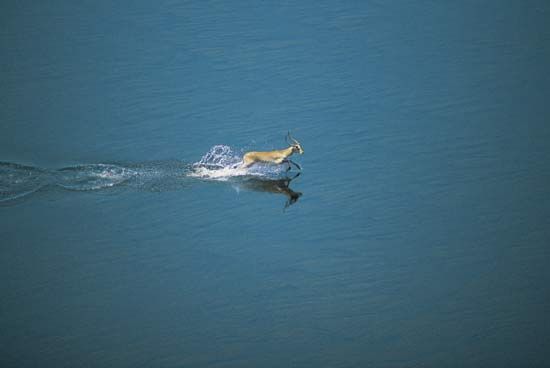
These antelopes are considered “edge” species that rely on water as a primary defense mechanism. While they are clumsy runners on dry land, they frequently enter water to feed on aquatic grasses—a resource largely underutilized by other herbivores—and use the water to escape predators. As floodwaters rise and fall, they migrate across vast floodplains to follow the growth of fresh grasses.1
What are the distinguishing physical characteristics of male and female lechwes?
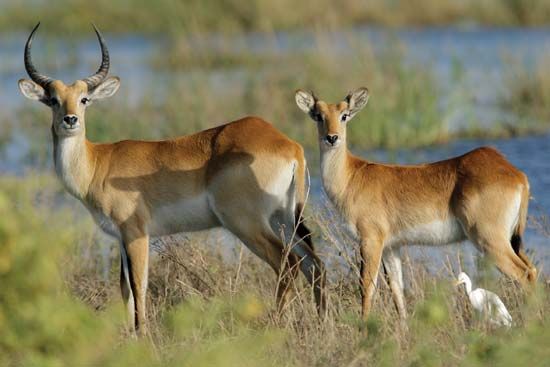
Lechwes exhibit significant sexual dimorphism in both size and appearance. Males are generally 20 percent larger than females and are the only sex to possess horns. These horns are lyre-shaped, heavily ridged, and measure between 45 and 90 cm (18–35 inches) in length.1
The physical differences between the sexes include:
- Coloration: Females typically have tawny to chestnut coats, while mature males display darker coats and markings. This contrast is most pronounced in the black lechwe, where males are dark blackish brown compared to the reddish-brown females. The most extreme difference is seen in Nile lechwe rams, which are dark chocolate brown with distinct whitish markings on the neck and shoulders.12
- Posture: Males are often identified by a proud, head-high posture, which they use alongside their sweeping horns to advertise their presence.1
While females look relatively similar to one another, they are characterized by bright chestnut coats with white underparts, throat patches, facial markings, and black stripes on the front of their legs.1
How do lechwes behave socially and during mating season?
Lechwes exhibit a highly social structure that is closely tied to their environment and seasonal changes. Because they rely on water to escape predators, their distribution is dictated by the rise and fall of floodwaters, leading them to form large, mobile aggregations that can reach concentrations of up to 1,000 individuals per square kilometer during the dry season.1
Social Organization
The social hierarchy is largely defined by sex and reproductive status:
- Females and Young: These groups typically remain closest to the water, which serves as their primary refuge.1
- Bachelor Males: These individuals generally aggregate on drier ground farther from the water, separated from the breeding population by the aggression of territorial males.1
- Territorial Males: Some males occupy sizeable properties inland where females congregate during the rainy season. However, most males only establish territories during the annual mating peak.1
Mating Behavior
Lechwes are one of only three antelope species known to utilize lekking—a system where males gather in a communal breeding arena to display for females.13
- The Lek: During the mating peak (typically December to January in Zambia), 50 to 100 males congregate in a temporary, roughly circular arena about 0.5 km in diameter.1
- Courtship: Females visit these arenas briefly to select a mate and copulate, but they do not form lasting pair bonds with the males.14
- Competition: While many males display, a few centrally placed individuals often monopolize the matings. Because the herds are constantly moving to follow fresh grazing, these leks are only temporary structures.13
What is the diet of lechwes, and how does it change with the seasons?
Lechwes are specialized herbivores that primarily consume aquatic grasses, a food source that is largely underutilized by other grazing animals. Their diet is intrinsically linked to the seasonal fluctuations of their floodplain habitats.1
Seasonal Dietary Shifts
The feeding habits of lechwes are dictated by the rise and fall of water levels:
- During Floods: As water levels rise, lechwes move to follow the availability of vegetation, often migrating distances of up to 80 km (50 miles). They enter the water to feed directly on aquatic grasses.1
- During Dry Seasons: As floodwaters recede, lechwes graze on the fresh, nutrient-rich grasses that emerge on the newly exposed land. Late in the dry season, they congregate in high densities on these shrinking greenbelts to access the remaining forage.1
Because they are “edge” species, their survival depends on their ability to track these shifting resources across the floodplains of the southern savanna and the Nile basin.1
Sources
- lechwe — Encyclopædia Britannica
- Kobus — Encyclopædia Britannica
- Lek — Encyclopædia Britannica
- topi — Encyclopædia Britannica
Published on · 4 min read