Great Bustard
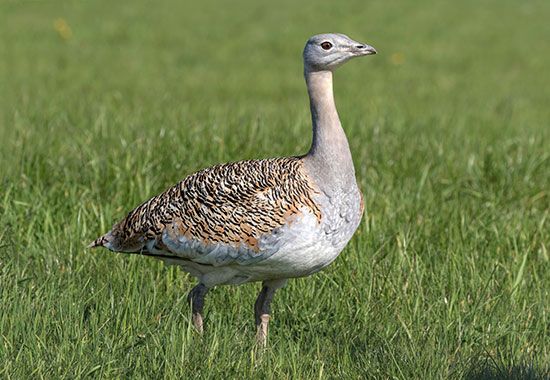
The great bustard (Otis tarda) is the largest member of the bustard family and is recognized as the largest land bird in Europe. It is also considered the…
What is Great bustard?
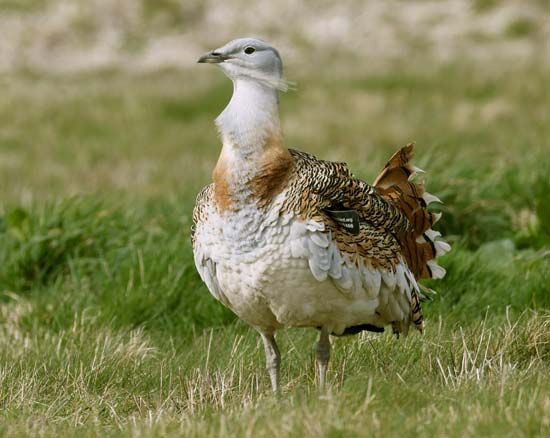
The great bustard (Otis tarda) is the largest member of the bustard family and is recognized as the largest land bird in Europe1. It is also considered the heaviest extant flying bird in the world, with males reaching weights of up to 14 kg (31 pounds) and wingspans of 240 cm (8 feet).12
These omnivorous birds inhabit open steppes and grain fields across a range extending from Morocco and the Iberian Peninsula to Central Asia, Mongolia, and China. They are known for their unique “lekking” mating ritual, where males perform a display to attract females.2
Unfortunately, the species is currently listed as endangered on the IUCN Red List due to habitat loss from agriculture and infrastructure development, as well as hunting. Conservation efforts, such as reintroduction programs, are underway in countries like the U.K. to help protect these birds.2
What is the lekking mating ritual?
Lekking is a specialized form of animal behaviour in which males of a species gather in a communal area, known as a lek or arena, to perform elaborate courtship displays to attract females. This behavior is observed across various species of birds, mammals, and insects.31
Key characteristics of lekking include:
- Display Arenas: Males congregate in a specific area to compete for the attention of females through posturing, dancing, song, or other visual cues.31
- No Lasting Bonds: Females visit the lek briefly to select a mate and copulate. They do not form long-term pair bonds with the males, and in many species, the female raises the offspring without assistance from the male.31
- No Nesting: The lek serves exclusively as a site for courtship and mating; no nesting or food gathering occurs within the arena.1
- Varied Interaction: The level of cooperation between males at a lek can vary significantly, ranging from minimal interaction to closely coordinated group dancing.3
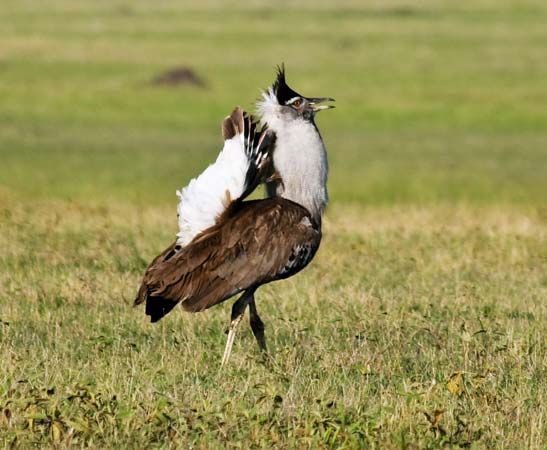
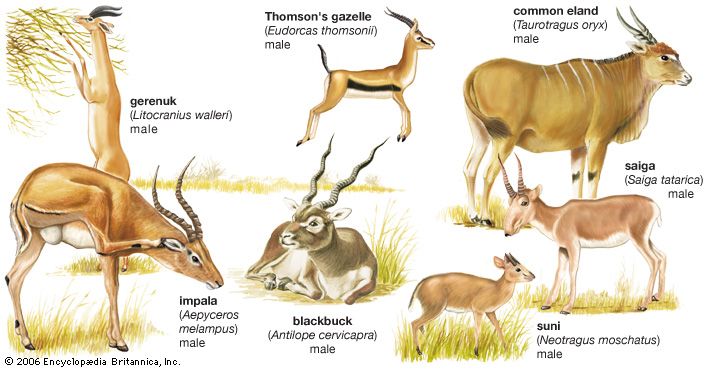
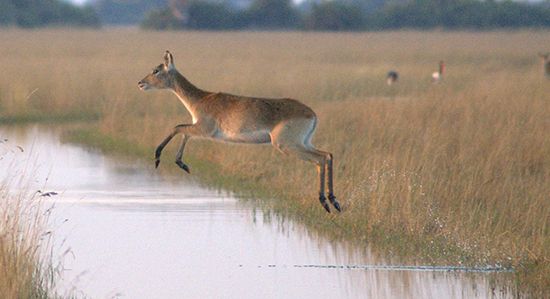
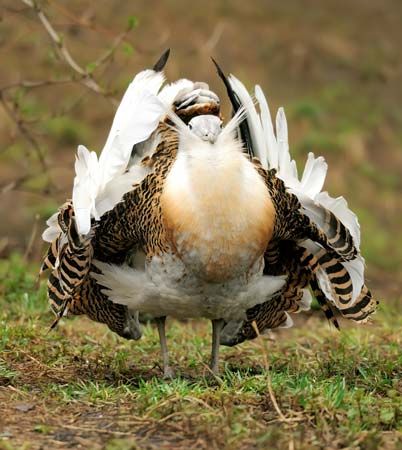
For example, male great bustards perform a dramatic display—sometimes called a “foam bath”—where they inflate a neck pouch and turn their wings inside out to reveal ultraviolet-reflective white feathers. Similarly, certain antelope species, such as the lechwe, form temporary leks where males compete for mating opportunities during peak breeding seasons.45
Why are great bustards unable to perch in trees?
Great bustards are unable to perch in trees due to the specific anatomy of their feet. Unlike many other bird species, their feet possess only three forward-facing toes and lack a hind toe, or hallux, which is typically required for gripping branches.61
Instead of perching, these birds are physically adapted for life on the ground, where they utilize their long legs to run swiftly across open steppes and grain fields.61
What conservation efforts are helping the great bustard?
Conservation efforts for the great bustard (Otis tarda) and the great Indian bustard (Ardeotis nigriceps) are critical due to their status as endangered or critically endangered species.61
Key conservation initiatives include:
- National Programs: In 2012, the Indian government launched Project Bustard, a national program modeled after Project Tiger. It aims to protect the great Indian bustard, along with the Bengal florican and the lesser florican, by safeguarding their habitats from further decline.6
- Reintroduction Efforts: Specific countries have taken direct action to restore populations. For instance, a reintroduction program for the great bustard was initiated in the U.K. in 2004.](https://www.britannica.com/place/United-Kingdom) in 2004.1
- Targeted Management: Since 2016, Morocco has focused on the great bustard as a priority for its national conservation programs.1
These efforts are essential to counter threats such as habitat loss, infrastructure development, mechanized farming, and hunting.619
Sources
- Great bustard — Encyclopædia Britannica
- great bustard — Merriam-Webster
- Lek — Encyclopædia Britannica
- lechwe — Encyclopædia Britannica
- Passeriform - Territoriality and courtship — Encyclopædia Britannica
- great Indian bustard — Encyclopædia Britannica
- Bustard — Encyclopædia Britannica
- 10 Critically Endangered Animals of India - Great Indian bustard ( Ardeotis nigriceps ) — Encyclopædia Britannica
- Great bustard: Top Questions — Encyclopædia Britannica
Published on · 3 min read