Leech
Leeches (subclass Hirudinea) are a specialized group within the phylum Annelida that exhibit several distinct characteristics:
What are the main characteristics of leeches as annelids?
Leeches (subclass Hirudinea) are a specialized group within the phylum Annelida that exhibit several distinct characteristics:
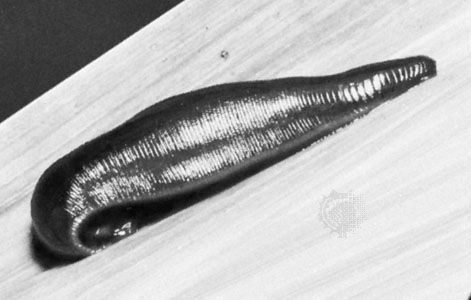
- Body Structure: Unlike many other annelids, leeches possess a fixed number of 34 body segments. While they are segmented, their body cavity (coelom) is reduced and filled with connective tissue. They lack the setae (movable bristles) typically found in other annelids.1234
- Suckers: A defining feature is the presence of a small sucker at the anterior end, which contains the mouth, and a large sucker at the posterior end.123
- Reproduction: Leeches are hermaphroditic, possessing both male and female reproductive organs. They reproduce by laying eggs in a cocoon secreted by a clitellum, which is present during the reproductive period. Development is direct, meaning there is no free-living larval stage.2315
- Physiology: They breathe through their skin and often possess one to four pairs of eyes at the anterior end. Many species are adapted for feeding on blood, utilizing specialized substances in their saliva to anesthetize wounds and prevent blood clotting.2
How do leeches reproduce and what is their life cycle like?
Leeches (subclass Hirudinea) are hermaphroditic, meaning each individual possesses both male and female reproductive organs. Despite this, they are not self-fertilizing; instead, they engage in reciprocal mating where the sperm of one individual fertilizes the eggs of another.74
Reproduction and Development
Their reproductive behavior is similar to that of earthworms. During mating, leeches typically align their bodies to facilitate the transfer of sperm into specialized storage sacs. Following fertilization, the leeches produce a cocoon in which the eggs are deposited. This cocoon may be laid on land or in water, and in some species, it remains attached to the parent.74
Life Cycle
The life cycle of a leech is characterized by direct development, meaning there is no free-living larval stage.84
- Embryonic Growth: Inside the cocoon, the developing embryos feed on albumin.8
- Hatching: Once the young leeches hatch, they are essentially miniature versions of the adults.8
- Parental Care: In certain species, the young remain attached to the “mother” until they are capable of independent survival. One specific African species is known to be viviparous, giving birth to live young and utilizing an internal incubating chamber for embryos.7
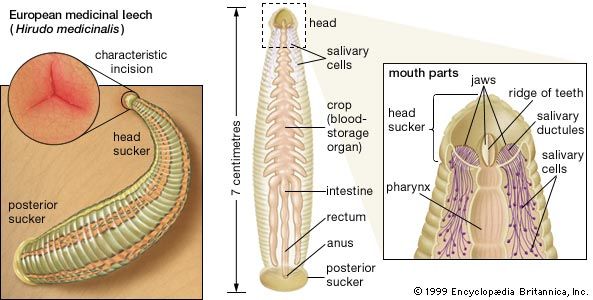
What is the internal anatomy of a leech, and how does it function?
The internal anatomy of a leech is highly specialized for its lifestyle, particularly for those that are parasitic bloodsuckers.910
Internal Structure and Function
- Coelomic Space: Unlike many other annelids, leeches have a reduced coelom (body cavity). Much of this space is filled with mesodermal connective tissue, which forms a series of interconnecting channels. In most species, these channels serve as the primary system for internal transport, with fluid movement driven by the contraction of longitudinal lateral channels rather than a traditional closed circulatory system.2
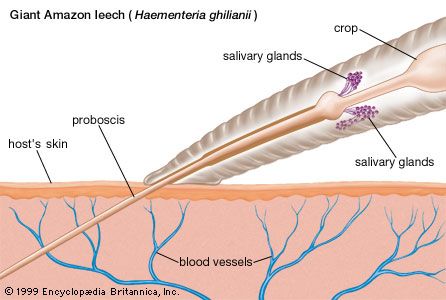
- Digestive System: Leeches possess a tubular digestive tract. A key feature is the crop, a large pouch that allows the animal to store significant quantities of blood, enabling it to go months without feeding again. Digestion is primarily extracellular. When feeding, they use specialized saliva containing hirudin and other substances to anesthetize the host, dilate blood vessels, and prevent blood clotting.3910
- Nervous System: The nervous system is centralized, featuring a brain located above the pharynx and a ventral nerve cord with segmental ganglia. Leeches are known for complex rhythmic behaviors, such as swimming and heartbeat, which are controlled by central rhythm generators and neuronal oscillators.11
- Respiration: Leeches lack specialized respiratory organs like gills; instead, they breathe directly through their skin.9
How do leeches differ from other types of annelids?
Leeches (class Hirudinea) are distinct from other annelids—such as polychaetes (marine worms) and oligochaetes (earthworms)—in several key anatomical and developmental ways:
- Fixed Segmentation: Unlike other annelids, which may have an unlimited or varying number of segments, leeches possess a fixed number of exactly 34 body segments.645
- Body Cavity: While most annelids have a spacious coelom that acts as a hydrostatic skeleton, the leech’s coelom is significantly reduced and largely filled with connective tissue.1563
- Lack of Setae: Most annelids utilize setae (movable bristles) for locomotion and anchoring. Leeches lack these structures entirely, relying instead on suckers at both the anterior and posterior ends for movement and attachment.156165
- Development: Leeches and oligochaetes both undergo direct development within a cocoon without a free-living larval stage. This contrasts with many polychaetes, which typically pass through a free-swimming trochophore larval stage.265
Sources
- annelid - Leeches — Encyclopædia Britannica
- leech — Encyclopædia Britannica
- annelid - External features — Encyclopædia Britannica
- annelid - Development — Encyclopædia Britannica
- annelid - Annotated classification — Encyclopædia Britannica
- annelid — Encyclopædia Britannica
- Reproductive behaviour - Segmented worms — Encyclopædia Britannica
- Cocoon — Encyclopædia Britannica
- Circulatory system - Annelida — Encyclopædia Britannica
- nervous system - Annelids — Encyclopædia Britannica
- annelid - Food and feeding — Encyclopædia Britannica
- Invertebrate digestive system — Encyclopædia Britannica
- ostariophysan - Air breathing — Encyclopædia Britannica
- Respiratory system - Gills of invertebrates — Encyclopædia Britannica
- annelid - Locomotion — Encyclopædia Britannica
- annelid - Tissues and fluids — Encyclopædia Britannica
Published on · 4 min read