Lefká Mountains
The Lefká Mountains, the highest massif in western Crete, are primarily associated with significant natural and historical features rather than…
Are there any significant historical or cultural sites associated with the Lefká Mountains?
The Lefká Mountains, the highest massif in western Crete, are primarily associated with significant natural and historical features rather than archaeological sites in the traditional sense.
Key sites and associations include:
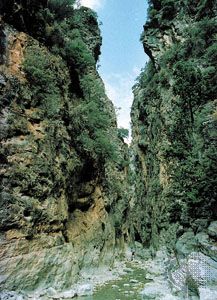
- Samaria Gorge: This 11-mile (18 km) long canyon is the longest mountain gorge in Europe. It serves as a vital route of transit through the range, connecting the high plains of Omalós to the town of Ayía Roumeli on the Mediterranean coast.1
- Natural Defense: Historically, the rugged, precipitous terrain of the Lefká Mountains provided a natural defensive barrier for the southwest coast of Crete. This geography was strategically utilized by local populations against various invaders, ranging from the Ottoman Turks to German forces during World War II.1
- Ecological Significance: The region is recognized as the last habitat of the Cretan agrimi, a rare species of wild goat.1
While the mountains themselves are a prominent landmark, they are distinct from the major Bronze Age palatial sites found elsewhere on the island, such as Knossos.23
What are some popular activities or attractions for visitors to the Lefká Mountains?
Visitors to the Lefká Mountains in western Crete primarily engage in outdoor exploration and nature-focused activities. The region is defined by its rugged limestone peaks and high plains, offering unique experiences for hikers and nature enthusiasts:
- Hiking the Samaria Gorge: This is the most popular attraction in the range. As the longest mountain gorge in Europe, the 11-mile (18 km) trail provides a dramatic route from the high plains of Omalós down to the Mediterranean Sea at the coastal town of Ayía Roumeli.16
- Exploring High Plains: The Omalós plain, situated at an elevation of 1,650–3,300 feet, serves as a gateway for visitors accessing the interior of the massif.16
- Wildlife Observation: The mountains are known as the habitat of the agrími, a rare species of wild goat. These animals are often found in remote areas and protected wildlife reserves, such as those within the Samariá National Park.16
- Seasonal Activities: While the mountains are temperate and cool, they are frequently snow-covered from November to May, offering a distinct landscape for those visiting during the cooler months.6
What role did the Lefká Mountains play in ancient Greek mythology, if any?
The Lefká Mountains of western Crete do not hold a prominent role in ancient Greek mythology. While other Cretan mountains, such as Ídi (also known as Mount Psilorítis), are famously associated with legends—specifically the myth that Zeus was reared in a cave on its slopes—the Lefká Mountains are primarily recognized for their rugged geography and historical role as a natural defensive barrier.178
It is possible that the Lefká Mountains are sometimes confused with other locations in Greek mythology due to the prevalence of mountain-related legends elsewhere in Greece. For instance, Cithaeron is a range deeply embedded in mythological tradition, serving as the setting for the stories of Actaeon, Oedipus, and the rites of Dionysus.9
What is the highest peak in the Lefká Mountains and how tall is it?
The highest peak in the Lefká Mountains is Mount Lefká, which reaches an elevation of 8,045 feet (2,452 meters).1
Sources
- Lefká Mountains — Encyclopædia Britannica
- Samaria — Encyclopædia Britannica
- Mount Gerizim — Encyclopædia Britannica
- Aegean civilizations - History of exploration — Encyclopædia Britannica
- Aegean civilizations - Period of the Early Palaces in Crete ( c. 2000–1700) — Encyclopædia Britannica
- Crete - Land — Encyclopædia Britannica
- Cithaeron — Encyclopædia Britannica
- Ídi — Encyclopædia Britannica
- Greece - The islands of Greece — Encyclopædia Britannica
Published on · 2 min read