Lehman Caves
Lehman Caves is a spectacular cavern located in Great Basin National Park in eastern Nevada, U.S. Situated at the base of the eastern slope of Wheeler Peak…
What is Lehman Caves?
Lehman Caves is a spectacular cavern located in Great Basin National Park in eastern Nevada, U.S. Situated at the base of the eastern slope of Wheeler Peak, the cave is formed from light gray and white limestone and features an extensive network of tunnels and galleries filled with stalactites, stalagmites, and other cave deposits.12
The site was discovered in the mid-1880s by a local rancher and prospector named Absalom Lehman. It was designated a national monument in 1922 and later incorporated into Great Basin National Park upon the park’s establishment in 1986. Archaeological evidence suggests that the cave was utilized as a burial site by prehistoric Native Americans.1
How do stalactites and stalagmites form?
Stalactites and stalagmites are types of speleothems—secondary mineral deposits formed by water in caves. Their formation begins when rainwater absorbs carbon dioxide from soil, creating a dilute carbonic acid that dissolves calcium carbonate from limestone bedrock as it percolates downward.34
When this mineral-rich water emerges from the cave ceiling, it loses carbon dioxide to the cave atmosphere, reducing its ability to hold calcite in solution and causing the mineral to precipitate.34
- Stalactites: As water hangs from the ceiling, it deposits a ring of calcite. Over time, this creates a hollow, icicle-like tube with a central canal. Continued deposition on the exterior thickens the structure into a downward-tapering cone.35
- Stalagmites: When water droplets fall to the cave floor, the remaining mineral matter is deposited, building up mounds or columns from the ground up. Unlike stalactites, stalagmites do not have a central canal and are typically thicker in proportion.35
What other features can be found in Great Basin National Park?
Beyond the famous Lehman Caves, Great Basin National Park features a diverse array of natural landmarks shaped by its high-elevation mountain and desert environment:
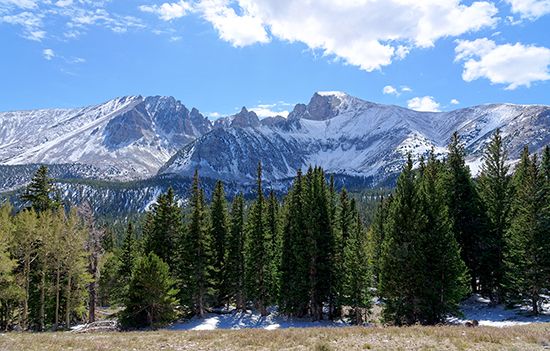
- Wheeler Peak: Rising to 13,065 feet (3,982 meters), this mountain is a central feature of the park. Near its summit, visitors can find the southernmost permanent icefield in the United States.6
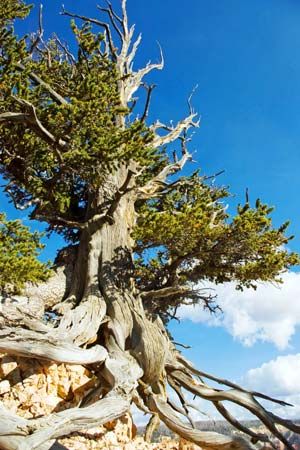
- Ancient Bristlecone Pines: The park is home to groves of bristlecone pines, some of the oldest living organisms on Earth. Certain trees in the park are known to be over 3,000 years old, and the area was historically the site of the “Prometheus” tree, which was dated to nearly 5,000 years of age.61
- Lexington Arch: This impressive limestone natural arch stands 75 feet (23 meters) high, serving as another significant geological attraction within the park’s boundaries.6
The park’s landscape is defined by the southern portion of the Snake Range, which rises abruptly from the desert floor, creating a vertical succession of ecological zones that support varied flora and fauna.67
How do caves provide evidence of prehistoric human activity?
Caves serve as vital repositories of prehistoric human activity, offering archaeologists a window into the lives, beliefs, and technological development of early hominins and modern humans. Evidence is typically gathered through the analysis of physical remains and environmental traces left within these subterranean spaces.
Material Culture and Tools
Excavations often reveal stone implements, such as those found at Zhoukoudian, which provide insight into the technological capabilities of early humans like Homo erectus. These include stone chips, choppers, and hand axes, which indicate how these groups manufactured tools and potentially processed food. In sites like Kent’s Cavern, the discovery of various tool industries—ranging from the Acheulean to the Magdalenian—allows researchers to map the chronological progression of human occupation.1213
Dietary and Domestic Evidence
Evidence of subsistence strategies is frequently found in the form of charred animal bones, which suggest that early humans hunted or scavenged and may have used fire for cooking. The presence of ash, charcoal, and seeds—such as the hackberry seeds found at Zhoukoudian—points to the use of caves as living spaces or temporary shelters where food was prepared and consumed.12
Symbolic and Ritual Activity
Caves are perhaps most famous for cave art, including paintings, engravings, and sculptures. Sites like Chauvet–Pont d’Arc demonstrate that these spaces were often used for ceremonial purposes rather than daily habitation. The deliberate placement of objects, such as bear skulls arranged by early visitors, suggests complex symbolic or ritualistic behaviors. Additionally, geometric signs and hand stencils provide evidence of early human expression and potential shamanic practices.1415
Sources
- Lehman Caves — Encyclopædia Britannica
- Lehman Caves — Merriam-Webster
- cave - Depositional materials and features — Encyclopædia Britannica
- stalactite and stalagmite — Encyclopædia Britannica
- cave deposit — Encyclopædia Britannica
- Great Basin National Park — Encyclopædia Britannica
- Wheeler Peak — Merriam-Webster
- Wheeler Peak — Encyclopædia Britannica
- Indigenous peoples of the Great Basin — Encyclopædia Britannica
- Bristlecone pine — Encyclopædia Britannica
- Great Basin National Park — Merriam-Webster
- Cave art — Encyclopædia Britannica
- Kent’s Cavern — Encyclopædia Britannica
- Homo erectus - Behavioral inferences — Encyclopædia Britannica
- Chauvet–Pont d’Arc — Encyclopædia Britannica
Published on · 3 min read