Bristlecone Pine
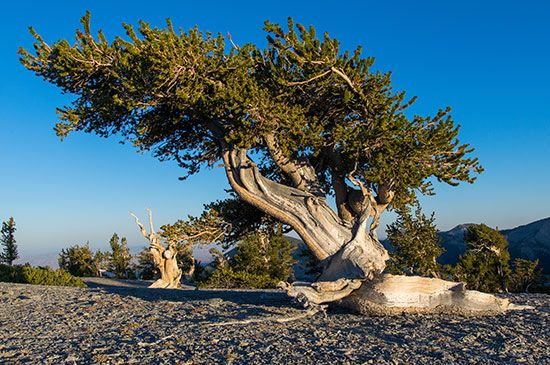
Bristlecone pines (Pinus longaeva and P. aristata) possess several remarkable adaptations that allow them to thrive in the harsh, high-elevation environments…
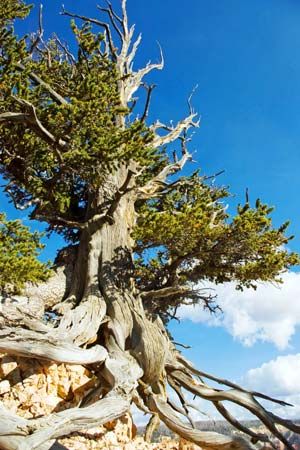
What adaptations do bristlecone pines have that allow them to survive in harsh conditions?
Bristlecone pines (Pinus longaeva and P. aristata) possess several remarkable adaptations that allow them to thrive in the harsh, high-elevation environments of the southwestern United States.12
Key survival strategies include:
- Needle Protection: These trees exhibit a high resistance to winter desiccation, a common threat at high altitudes, due to a thick coating of wax and cuticle on their needles.3
- Resource Allocation: In response to the limited energy available in their environment, these pines exhibit a slower growth rate and allocate a larger proportion of their carbon to root systems rather than stems and leaves.3
- Efficient Metabolism: Their ability to survive is supported by efficient water use and a low-maintenance body plan. Because much of an older tree consists of dead woody tissue, it requires less metabolic activity to maintain its structure.34
- Environmental Resilience: They are well-adapted to the cold, high-wind, and nutrient-poor conditions of the alpine timberline. Furthermore, their longevity is aided by a relative lack of pathogens in their extreme, isolated habitats.34
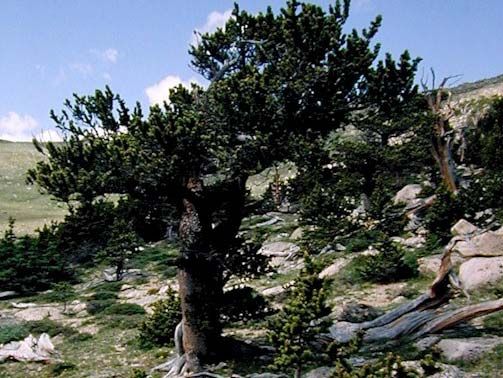
How do bristlecone pines compare to other long-lived tree species like giant sequoias or coastal redwoods?
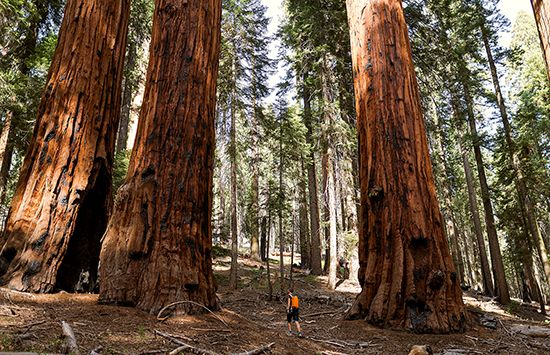
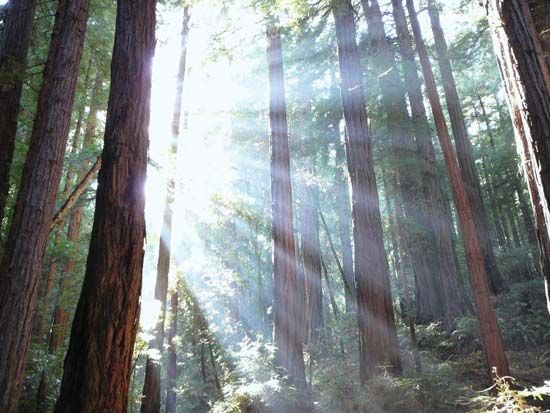
While bristlecone pines, giant sequoias, and coast redwoods are all iconic, long-lived conifers, they occupy distinct ecological niches and possess different record-breaking characteristics.561
Longevity vs. Size
- Longevity: Bristlecone pines are the world’s oldest known non-clonal organisms, with some individuals exceeding 5,000 years of age. While giant sequoias were once thought to be the oldest, tree-ring studies have shown them to be younger than the oldest bristlecone pines, typically under 4,000 years old.571
- Size: Giant sequoias are the most massive trees by volume, whereas coast redwoods hold the record for the tallest trees, reaching heights over 110 meters (361 feet). In contrast, bristlecone pines are relatively small, windblown trees, usually ranging from 5 to 16 meters (15 to 50 feet) in height.617
Survival Strategies
All three species benefit from a low-maintenance body plan where the majority of the tree consists of dead woody tissue, requiring little metabolic energy to maintain. However, their environments differ significantly:5
- Bristlecone pines thrive in harsh, arid, high-elevation alpine environments where their slow growth and efficient resource allocation allow them to endure for millennia.57
- Giant sequoias have evolved thick, fibrous, fire-resistant bark to survive in their native groves, though they are currently threatened by drought and changing fire patterns.1
What are the unique characteristics that make bristlecone pines stand out among other tree species?
Bristlecone pines (Pinus longaeva and P. aristata) are distinguished by several unique characteristics that allow them to survive in extreme environments and reach extraordinary ages:
- Unmatched Longevity: They are the oldest known non-clonal organisms on Earth, with some individuals exceeding 5,000 years of age. Unlike many animals, they show no significant increase in mutation rates as they age.12
- Extreme Hardiness: These trees thrive at high elevations and in arid climates where other species struggle. They possess a thick coating of wax and cuticle on their needles, which provides superior resistance to winter desiccation.5
- Efficient Resource Management: Bristlecone pines exhibit a slow growth rate and allocate a larger proportion of their carbon to root systems rather than stems and leaves. Their body plan is highly efficient, as up to 95 percent of an old tree may consist of dead woody tissue that requires no metabolic energy to maintain.52
- Environmental Resilience: Their isolated, harsh habitats provide a natural defense, as these areas often host fewer pathogens than lower-elevation forests.52
How do scientists use bristlecone pines in dendrochronology and climate research?
Scientists utilize bristlecone pines as vital tools in dendrochronology, the scientific discipline of dating and interpreting past events through the analysis of annual tree rings.88
Climate Research and Dating
Because bristlecone pines are exceptionally long-lived—with some individuals exceeding 5,000 years of age—they provide a continuous, high-resolution record of environmental conditions. Their growth rings vary in width based on annual precipitation and temperature, serving as a “signature” of past climates. By correlating ring patterns from living trees with those from deadwood, researchers have extended these climatic chronologies back more than 7,500 years.91081
Calibration of Scientific Methods
Beyond paleoclimatology, these trees are essential for verifying other dating techniques. Scientists use the long, accurately dated ring sequences from bristlecone pines to calibrate carbon-14 dating, helping to correct potential offsets between radiocarbon years and actual calendar years. This cross-verification is critical for maintaining the accuracy of historical and geological timelines.81
Sources
- bristlecone pine — Encyclopædia Britannica
- Tree - Tree lines — Encyclopædia Britannica
- pine - Major North American pines — Encyclopædia Britannica
- pine - Physical description and natural history — Encyclopædia Britannica
- How Can Some Trees Survive for Thousands of Years? — Encyclopædia Britannica
- conifer - Diversity of size and structure — Encyclopædia Britannica
- giant sequoia — Encyclopædia Britannica
- dendrochronology — Encyclopædia Britannica
- Holocene Epoch - Chronology and correlation — Encyclopædia Britannica
- geochronology - Tree-ring growth — Encyclopædia Britannica
Published on · 4 min read