Lesser Himalayas
The Lesser Himalayas (also known as the Himachal) constitute the middle section of the vast Himalayan mountain system in south-central Asia. Stretching…
What is Lesser Himalayas?
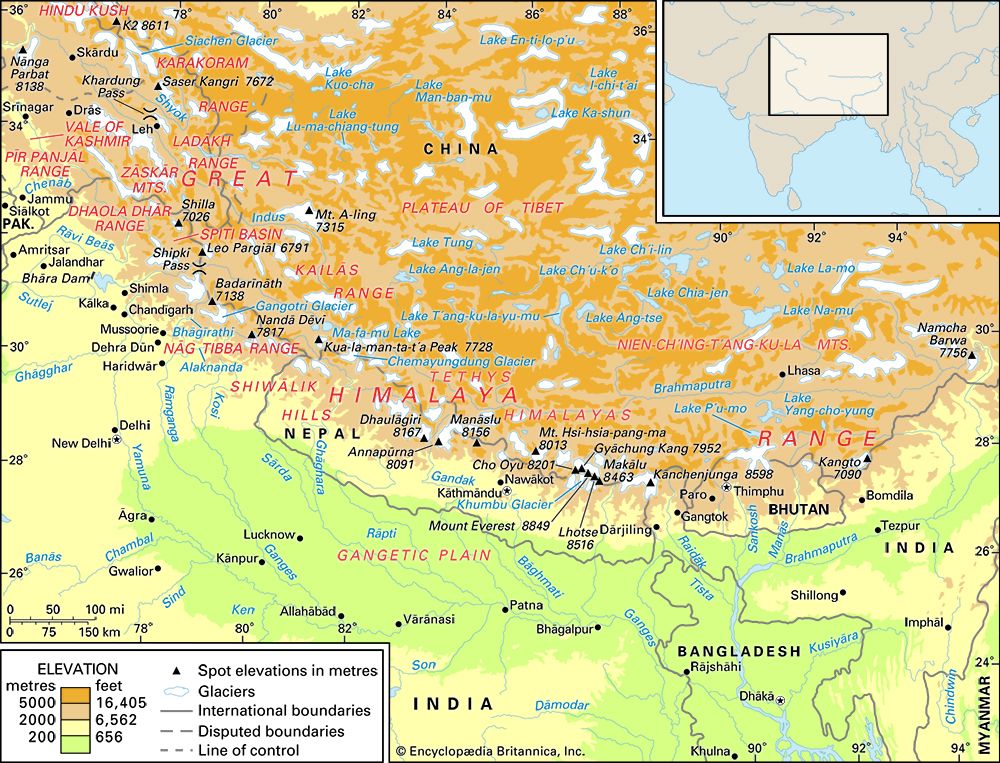
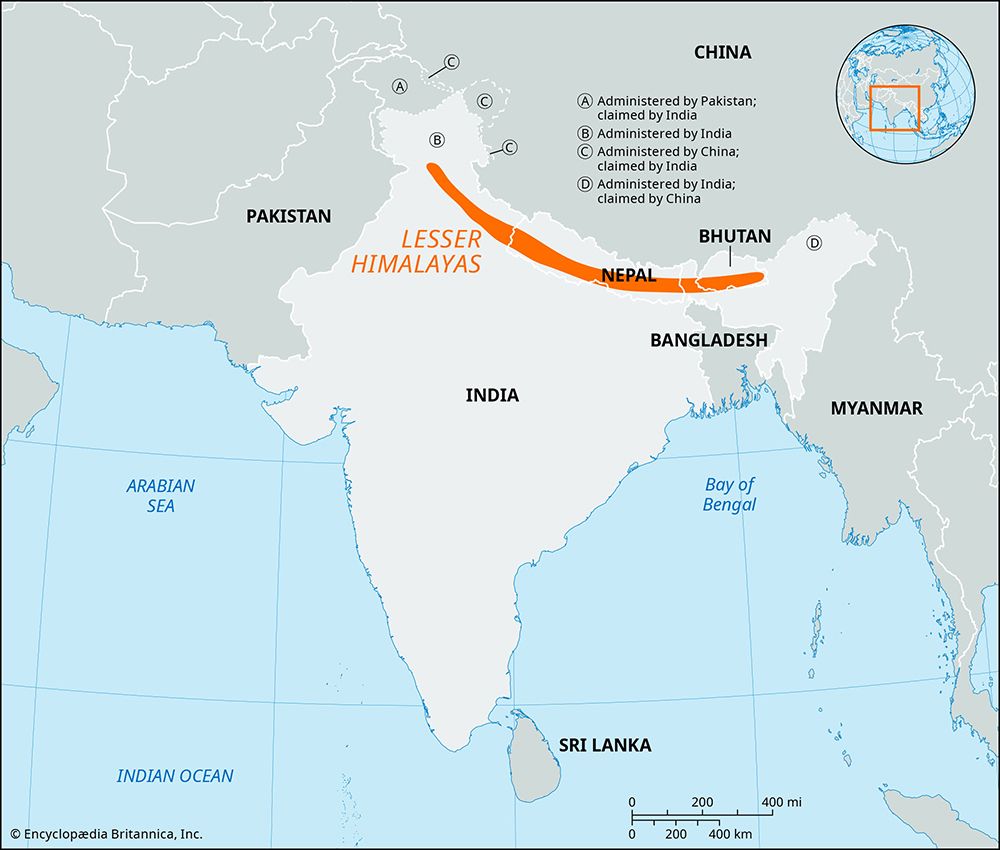
The Lesser Himalayas (also known as the Himachal) constitute the middle section of the vast Himalayan mountain system in south-central Asia. Stretching approximately 1,550 miles (2,500 km) across the northern limit of the Indian subcontinent, this range is situated between the Great Himalayas to the northeast and the Siwalik Range (Outer Himalayas) to the south.12
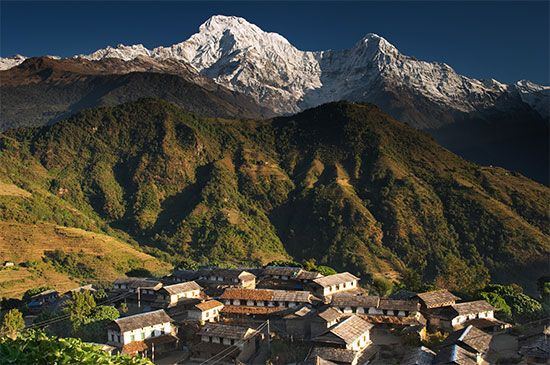
The region averages 12,000 to 15,000 feet (3,700 to 4,500 meters) in elevation and features a highly dissected landscape of mountains and valleys. Its three principal ranges—the Nag Tibba, the Dhaola Dhar, and the Pir Panjal—branch off from the Great Himalaya Range. The area encompasses diverse geography, including the picturesque Vale of Kashmir, and supports temperate forests characterized by conifers and broad-leaved trees2.123
The Lesser Himalayas span several regions, including parts of Kashmir, the Indian states of Himachal Pradesh, Uttarakhand, and Sikkim, as well as Nepal and Bhutan.1
How do the Lesser Himalayas differ from the Great Himalayas in terms of elevation and climate?
The Lesser Himalayas and the Great Himalayas differ significantly in their physical characteristics and climatic roles.
Elevation
- Great Himalayas: This range serves as the backbone of the mountain system and reaches extreme heights, containing 10 of the world’s 13 highest peaks, each exceeding 26,250 feet (8,000 meters). It rises into a zone of perpetual snow, with mountain passes typically situated between 16,000 and 19,000 feet (5,000 and 6,000 meters).52
- Lesser Himalayas: Located to the south, this range has a lower average elevation, typically ranging from 12,000 to 15,000 feet (3,700 to 4,500 meters). Its valleys are much lower, often found at elevations around 3,000 to 5,000 feet (900 to 1,500 meters).562
Climate
- Great Himalayas: This range acts as a major climatic barrier. It obstructs cold continental air from the north during winter and forces moisture-laden monsoon winds to release their precipitation on the southern slopes, creating arid conditions in the Tibetan plateau to the north.27
- Lesser Himalayas: Situated in a more temperate, forested zone, the Lesser Himalayas experience a climate that supports human habitation, grazing, and agriculture in its river valleys. While the Great Himalayas are characterized by barren, uninhabitable highlands and glaciers, the Lesser Himalayas feature temperate forests and more accessible terrain.25
What are some famous hill stations located within the Lesser Himalayas?
The Lesser Himalayas are home to several famous hill stations, which were historically developed by the British as cool retreats from the heat of the Indian plains and as seasonal administrative capitals. Today, these locations remain popular destinations for tourism and outdoor recreation.910
Notable hill stations in the Lesser Himalayas include:
- Shimla: Located in Himachal Pradesh, Shimla sits on a ridge at an elevation of about 7,100 feet. It served as the summer capital of India during the British colonial period and remains a major administrative and tourist center.1112
- Darjeeling: Situated in the eastern Himalayas, this well-known hill station is characterized by its recreational facilities and colonial-era infrastructure.912
- Dharamshala: Also located in Himachal Pradesh, this town has gained prominence as a significant cultural and sacred site, particularly for the Tibetan Buddhist community and the Dalai Lama.10
- Dalhousie: Another popular destination in Himachal Pradesh, known for its scenic setting and opportunities for outdoor activities.10
- Manali: Located in the Kullu valley, Manali is a key hub for trekking, mountaineering, and other forms of outdoor recreation.1012
What role do the Pir Panjal and Dhaola Dhar ranges play in the region’s geography?
The Pir Panjal and Dhaola Dhar ranges are two of the three principal ranges that constitute the Lesser Himalayas, a massive mountainous tract branching off from the Great Himalayas.122
The Pir Panjal Range
The Pir Panjal serves as a critical geographic barrier in the northern Indian subcontinent. It acts as a separator between the Jammu Hills to the south and the Vale of Kashmir to the north. With an average crest line of 12,500 feet (3,800 meters), it is a heavily glaciated range composed of ancient rock, including granite and slate. It plays a vital role in regional accessibility; for example, a highway tunnel near the Banihal Pass allows the Vale of Kashmir to remain connected to the south even during winter.1516
The Dhaola Dhar Range
The Dhaola Dhar is a prominent, snow-capped range within the Lesser Himalayas, particularly noted for its presence in Himachal Pradesh. Like the Pir Panjal, it contributes to the complex, dissected topography of the region, where mountains rise to approximately 15,000 feet (4,500 meters).212
Together, these ranges define the rugged landscape of the western Himalayas, influencing local drainage patterns and creating the structural basins that characterize the region.1216
Sources
- Lesser Himalayas — Encyclopædia Britannica
- Himalayas - Physiography of the Himalayas — Encyclopædia Britannica
- Himalayas - Plant life — Encyclopædia Britannica
- hill station — Merriam-Webster
- Nepal Himalayas — Encyclopædia Britannica
- Himalayas - Climate of the Himalayas — Encyclopædia Britannica
- Mountain ecosystem - Environment — Encyclopædia Britannica
- Highland climate — Encyclopædia Britannica
- Shimla — Encyclopædia Britannica
- India - Urban settlement — Encyclopædia Britannica
- Himachal Pradesh - Cultural life — Encyclopædia Britannica
- Pir Panjal Range — Encyclopædia Britannica
- Himalayas - Transportation — Encyclopædia Britannica
- Nepal - Relief — Encyclopædia Britannica
- Jammu and Kashmir - The Pir Panjal Range — Encyclopædia Britannica
- Himachal Pradesh - Relief and drainage — Encyclopædia Britannica
Published on · 4 min read