Great Himalayas
The Great Himalayas contain many of the world's tallest peaks, with 10 of the 13 highest mountains on Earth—each exceeding 26,250 feet (8,000 meters)—located…
What are some of the highest peaks in the Himalayas, and how tall are they?
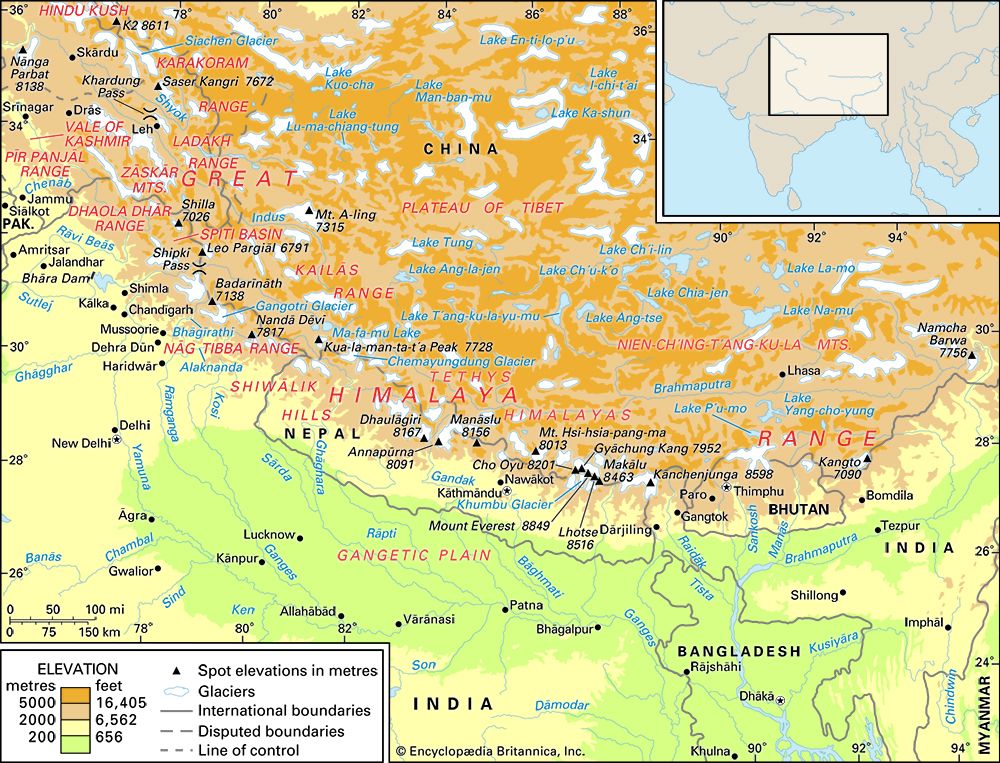
The Great Himalayas contain many of the world’s tallest peaks, with 10 of the 13 highest mountains on Earth—each exceeding 26,250 feet (8,000 meters)—located within this range.1
The following are some of the most prominent peaks in the Himalayas, listed from west to east:
- Nanga Parbat21
- Dhaulagiri 11
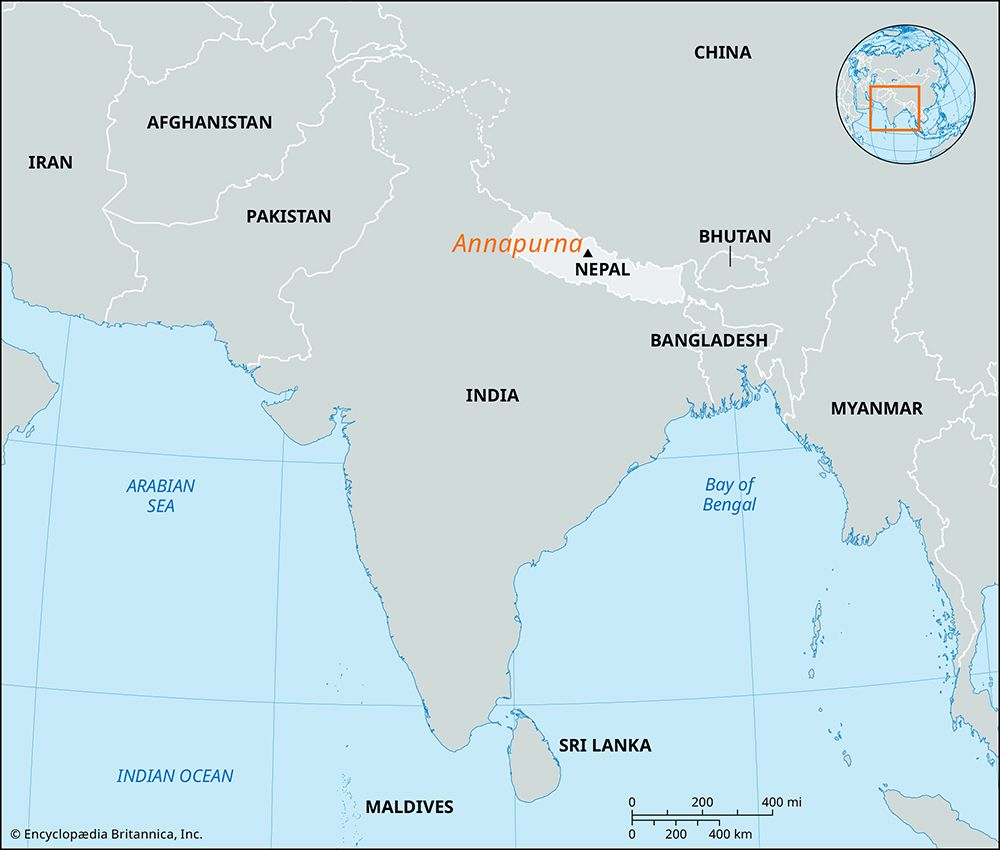
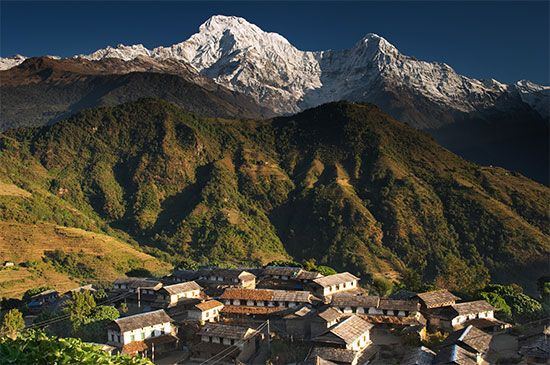
- Annapurna 121
- Manaslu 11
- Xixabangma1
- Cho Oyu1
- Mount Everest: The highest mountain in the world, with an officially recognized elevation of 29,031.69 feet (8,848.86 meters).341
- Lhotse1
- Makalu 11
- Kanchenjunga 121
These mountains are part of a massive system that reaches its maximum height in Nepal and extends across several countries, including Pakistan, India, Bhutan, and China.21
What unique flora and fauna can be found in the Himalayan region?
The Himalayan region is characterized by immense biodiversity, with flora and fauna varying significantly based on elevation, precipitation, and geography.
Flora
The vegetation is broadly classified into four zones: tropical, subtropical, temperate, and alpine.
- Tropical and Subtropical: The humid foothills of the eastern and central Himalayas feature tropical evergreen rainforests with dipterocarps, bamboos, and oaks. In the west, drier conditions support sal forests and subtropical thorn steppe.5
- Temperate: Between 4,500 and 11,000 feet, mixed forests contain conifers like deodar cedar, blue pine, and spruce.5
- Alpine: Above the tree line, vegetation includes juniper, rhododendrons, mosses, and lichens.5
Fauna
The region’s animal life is divided between eastern influences (similar to Southeast Asia) and western influences (similar to Mediterranean and Ethiopian regions).67
- Forest Denizens: The Tarai region hosts elephants and Indian rhinoceroses. Other forest inhabitants include Asiatic black bears, clouded leopards, langurs, and tahr.67
- High-Altitude Specialists: Remote, high-elevation areas are home to snow leopards, brown bears, lesser pandas, and yaks, the latter of which are genetically adapted to low oxygen levels.78
- Invertebrates and Birds: Above 20,000 feet, insects, spiders, and mites are the primary animal life. The region also hosts diverse bird species, including lammergeiers and various magpies.67
How were the Himalayas formed, and how old are they?
The formation of the Himalayas is a result of a massive, ongoing continental collision between the Indian subcontinent and the Eurasian Plate.910
Geologic Formation
For millions of years, the Indian plate moved northward, closing the Tethys Ocean that once separated it from Eurasia. The actual collision began approximately 40 to 50 million years ago. As the Indian plate continued to push into the Eurasian continent, the crust underwent intense deformation, folding, and faulting, which forced the land upward to create the mountain range.91011
Timeline and Age
While the initial collision occurred tens of millions of years ago, the process of mountain building happened in stages:
- Early Stages: Significant mountain building began in earnest about 20 million years ago during the Miocene Epoch, characterized by horizontal thrusting and the formation of nappes.9
- Recent Uplift: The Himalayas only reached their status as the highest mountains on Earth within the last 600,000 years, during the Pleistocene Epoch, when intense vertical uplift occurred.9
Because the Indian plate continues to move northward, the Himalayas remain tectonically active and are still rising today.12
Where are the Great Himalayas located, and which countries do they span?
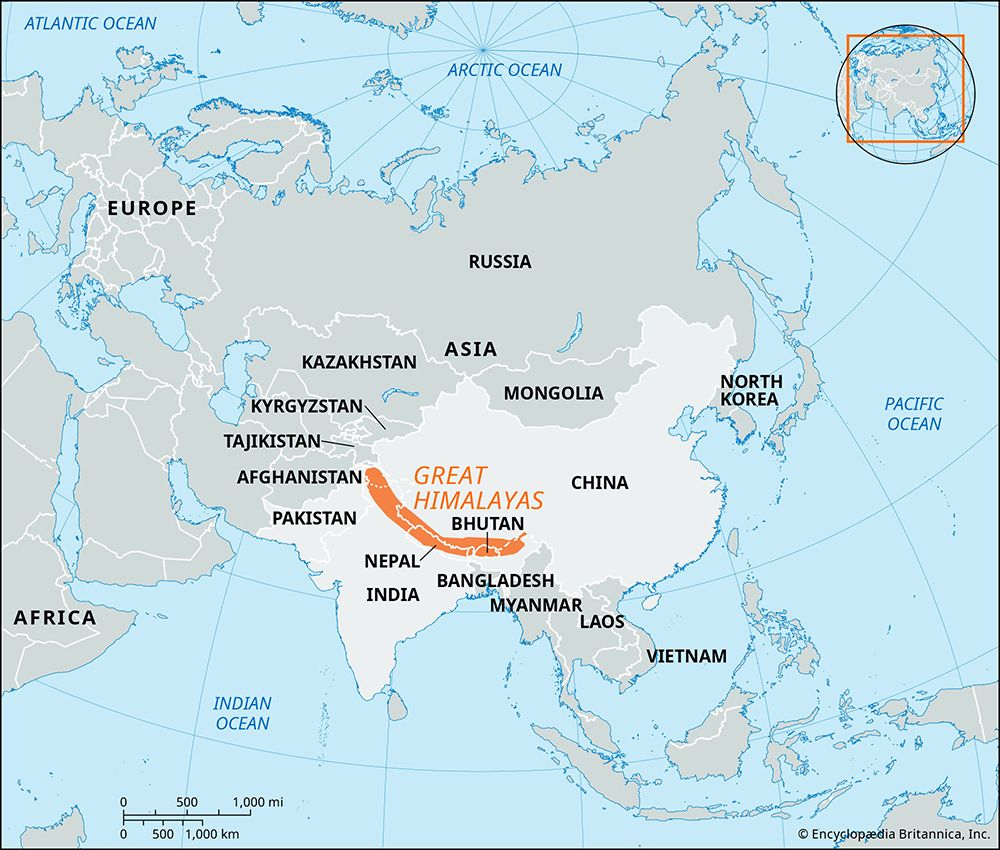
The Great Himalayas constitute the highest and northernmost section of the Himalayan mountain system. This range serves as the backbone of the entire system, reaching an average elevation of more than 20,000 feet (6,100 meters) and containing many of the world’s tallest peaks, such as Mount Everest, Kanchenjunga, Annapurna, and Nanga Parbat.213
The range extends approximately 1,400 miles (2,300 km) in a southeastward direction, spanning several countries and regions:
- Pakistan: The range begins in the west within the Pakistani-administered portion of the Kashmir region.24
- India: It traverses northern India, including the state of Sikkim and the state of Arunachal Pradesh in the east.213
- Nepal and Bhutan: The range runs through these two countries, where it reaches some of its highest elevations.2413
- China: Throughout nearly its entire length, the range adjoins the southern Tibet Autonomous Region of China to the north.2
Sources
- Mount Everest — Encyclopædia Britannica
- Great Himalayas — Encyclopædia Britannica
- Mount Everest - The height of Everest — Encyclopædia Britannica
- Himalayas - Physiography of the Himalayas — Encyclopædia Britannica
- Exploring 7 of Earth’s Great Mountain Ranges - Himalayas — Encyclopædia Britannica
- Himalayas - Plant life — Encyclopædia Britannica
- Himalayas - Animal life — Encyclopædia Britannica
- human respiratory system - High altitudes — Encyclopædia Britannica
- Himalayas - Geologic history — Encyclopædia Britannica
- plate tectonics - Mountains by continental collision — Encyclopædia Britannica
- mountain - The Himalayan chain — Encyclopædia Britannica
- India - The Himalayas of India — Encyclopædia Britannica
- Himalayas — Encyclopædia Britannica
Published on · 3 min read