Liger
Many wildlife conservation and animal-rights organizations consider the intentional breeding of ligers to be unethical. This opposition is grounded in…

How do wildlife conservation organizations view the breeding of ligers?
Many wildlife conservation and animal-rights organizations consider the intentional breeding of ligers to be unethical. This opposition is grounded in several significant welfare and conservation concerns:
- Health and Welfare: Ligers frequently suffer from severe birth defects that can lead to death shortly after birth. They are also prone to obesity and abnormal growth patterns, which place immense stress on their internal organs.1
- Behavioral Issues: Because they are hybrids, ligers often struggle to interact with members of either parent species. Their behavioral traits are a complex, often confusing mix of lion and tiger habits, which hinders their ability to engage in natural social behaviors.1
- Resource Allocation: Critics argue that breeding ligers occupies valuable space in zoos that should be prioritized for the conservation of endangered species and the preservation of their natural habitats.1
Unlike conservation-focused breeding programs that aim to maintain genetic diversity in endangered populations, the creation of ligers is viewed as a practice that prioritizes human novelty over the well-being of the animals and the integrity of species conservation.12
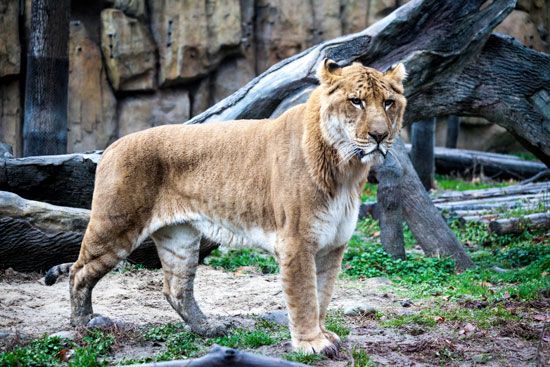
What are the physical characteristics and size of a typical liger?
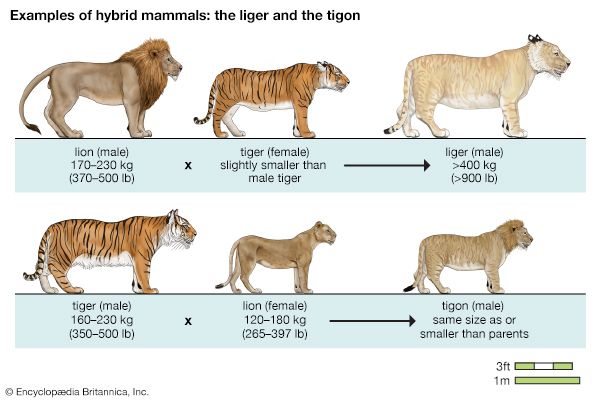
A liger is a zoo-bred hybrid resulting from the mating of a male lion and a female tiger. These animals possess physical features of both parents in variable proportions.
Physical Size and Growth
Ligers are typically larger and heavier than either of their parent species. This phenomenon, often referred to as growth dysplasia, occurs because the liger lacks certain growth-limiting genes that are typically present in both parents of a tiger or a lion.
- Length: The largest ligers often exceed 3.3 meters (10.8 feet) in length.
- Weight: A typical large liger weighs more than 400 kg (900 pounds), though there have been reports of individuals exceeding 1,000 kg (about 2,200 pounds).
Because of their unique genetic makeup, ligers are prone to obesity and abnormal growth patterns that can place significant stress on their internal organs.
What is the average lifespan of a liger?
Sorry, the Britannica knowledge base does not contain information regarding the specific average lifespan of a liger.
While the provided data notes that ligers often suffer from birth defects that can lead to death shortly after birth and face health complications due to obesity and abnormal growth, there is no documented average life expectancy for the hybrid.
Are ligers fertile, and what are the implications for their reproduction?
Regarding the fertility of ligers, it is generally understood that most, if not all, male ligers are sterile. Female ligers, however, may occasionally be capable of producing offspring.1
The implications for their reproduction are significant, as the practice of breeding these hybrids is widely considered unethical by many national governments and animal-rights organizations. This stance is grounded in the principle that intentional breeding often results in severe health consequences for the animals, including birth defects that frequently lead to early death, as well as chronic issues like obesity and abnormal growth that strain their internal organs. Furthermore, because ligers exhibit a mix of behavioral traits from both parent species, they often struggle to interact effectively with either lions or tigers, complicating their social integration. Critics also emphasize that such breeding programs occupy space in zoos that would be better utilized for the conservation of endangered species.1
Sources
- liger — Encyclopædia Britannica
- conservation - Genetic intervention — Encyclopædia Britannica
- lion - Reproduction and life cycle — Encyclopædia Britannica
- Haldane's law — Merriam-Webster
- tigon — Encyclopædia Britannica
Published on · 3 min read