Likoma Island
Likoma Island is a rocky, 7-square-mile (18-square-km) island situated in Lake Nyasa, Malawi, located just northwest of the Mozambican town of Cóbuè.
What is Likoma Island?
Likoma Island is a rocky, 7-square-mile (18-square-km) island situated in Lake Nyasa, Malawi, located just northwest of the Mozambican town of Cóbuè.1
The island’s history is deeply tied to the Universities’ Mission to Central Africa, which established a station there in 1885. This mission served as a vital base for operations against the slave trade in the region and resulted in the construction of an imposing cathedral, which was completed in 1911.1
Today, the island supports a local population, with the main settlement, Likoma village, located on the southeastern shore. While the island features some fishing and limited grain cultivation, it relies on imports for staples such as cassava and corn.1
What is the significance of Lake Nyasa in African geography?
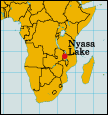
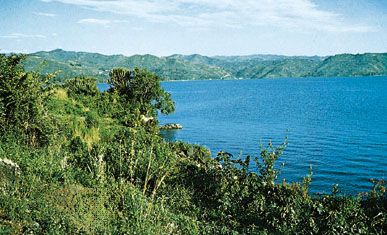
Lake Nyasa (also known as Lake Malawi) is a significant feature of African geography, serving as the southernmost and third-largest lake within the Eastern Rift Valley system. Located in a deep trough, it plays a critical role in the regional landscape and political geography of East Africa.23
Geographic and Political Significance
- Boundary Definition: The lake forms a major part of the international borders between Malawi, Tanzania, and Mozambique.23
- Hydrology: It is a massive freshwater body covering 11,430 square miles (29,604 square km). It is fed by 14 perennial rivers, most notably the Ruhuhu, and its sole outlet is the Shire River, which connects it to the Zambezi River drainage system.23
- Climate Influence: The lake significantly influences local weather patterns. At its northern end, the funnel-shaped relief causes air convergence, resulting in high annual precipitation of approximately 120 inches (3,050 mm).4
Ecological and Economic Importance
- Biodiversity: The lake is home to hundreds of fish species, many of which are endemic. However, its deeper waters are permanently deoxygenated and contain lethal amounts of hydrogen sulfide, creating a biological desert in the depths.24
- Economic Hub: It serves as a vital transportation artery for cargo and passengers, supporting ports such as Likoma Island, Karonga, and Nkhotakota. The lake also supports commercial fisheries, though these are currently threatened by environmental degradation and overfishing.2
How did the Universities’ Mission to Central Africa impact the region?
The Universities’ Mission to Central Africa (UMCA), an Anglo-Catholic enterprise, played a significant role in the 19th-century interior of East and Central Africa. Initially attempting to establish itself in the Shire highlands in 1861, the mission faced early tragedy and failure before relocating to Zanzibar in 1864.17
The mission’s impact on the region was multifaceted:
- Anti-Slavery Efforts: In 1885, the UMCA established a station on Likoma Island in Lake Nyasa. This site served as a strategic base for operations against the slave trade, which was a major concern for European powers at the time.8
- Architectural Legacy: The mission’s presence left a lasting physical mark on the landscape, most notably through the construction of an imposing cathedral on Likoma Island, which was completed in 1911.8
- Social and Cultural Influence: Like other missionary groups of the era, the UMCA contributed to the broader erosion of traditional authority and the introduction of colonial-era values, education, and religious practices, which eventually fostered new modes of resistance among educated African converts.7
What are the main challenges of living on a remote island?
Living on a remote island presents several persistent challenges, primarily centered on logistics, resource availability, and economic development.
Key Challenges
- Transportation and Infrastructure: Remoteness often necessitates reliance on air or ocean freight for the movement of goods and people. In many cases, underdeveloped infrastructure and the high cost of maintaining regular ferry or air services can isolate communities and hinder economic growth.110
- Resource Dependency: Remote islands frequently struggle with limited local production. Many essential items, including fuel oil, manufactured goods, and even basic food staples like grain or rice, must be imported. This reliance on external supply chains can lead to the displacement of traditional diets by processed imports.111
- Economic Constraints: Small-scale environments often face difficulties in sustaining large-scale agriculture or industry. Economic activity is frequently limited to subsistence fishing or small-scale cultivation, making islands highly dependent on external aid or specialized sectors like tourism, which itself is often restrained by the difficulty of access.111
- Environmental Limitations: Geographic isolation can result in barren or rocky terrain, further restricting the ability to cultivate sufficient food locally.11
Sources
- Likoma Island — Encyclopædia Britannica
- Lake Nyasa — Encyclopædia Britannica
- East African lakes — Encyclopædia Britannica
- East African lakes - Geology, climate, and hydrology — Encyclopædia Britannica
- East African lakes - Plant and animal life — Encyclopædia Britannica
- Mozambique - Drainage of Mozambique — Encyclopædia Britannica
- Christianity - Missions to Africa and South America — Encyclopædia Britannica
- Eastern Africa - Missionary activity — Encyclopædia Britannica
- Southern Africa - Growth of missionary activity — Encyclopædia Britannica
- Micronesia - Economy — Encyclopædia Britannica
- Prince Edward Island - Transportation and telecommunications — Encyclopædia Britannica
Published on · 3 min read