Little Belt
The term "Little Belt" typically refers to the Little Belt, a strait located between mainland Denmark and the islands of Funen and Ærø. This waterway, which…
What is Little Belt?
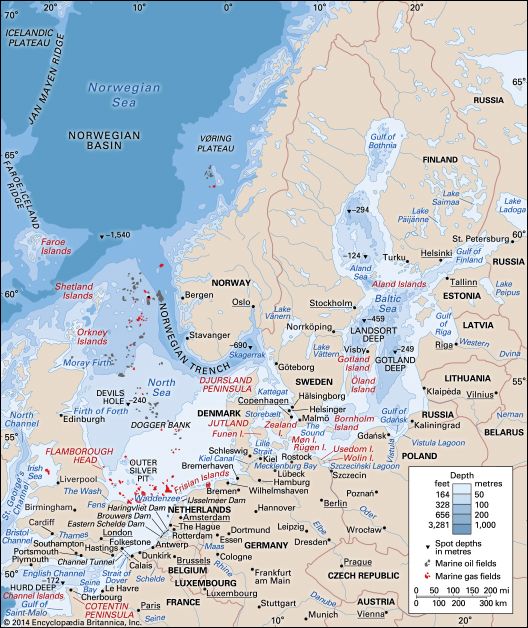
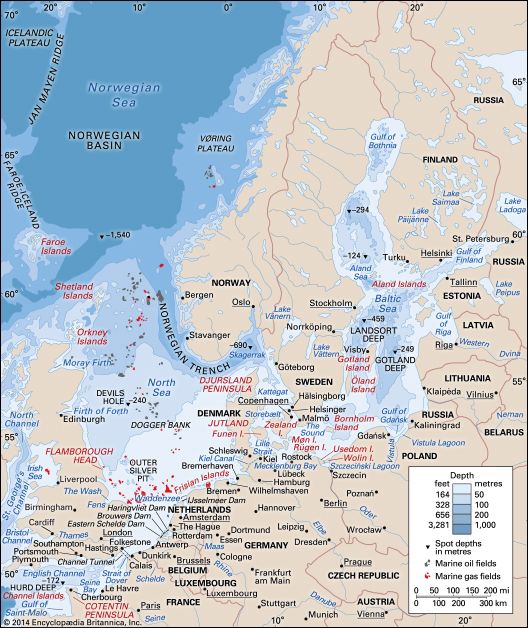
The term “Little Belt” typically refers to the Little Belt, a strait located between mainland Denmark and the islands of Funen and Ærø. This waterway, which stretches approximately 30 miles in length, serves as a vital connection between the Kattegat and the Baltic Sea. While deep, the strait is known for being challenging for large vessels to navigate and is spanned by both a railway bridge and a suspension bridge.1
It is important to note that the name is also shared by the Little Belt Mountains, a segment of the northern Rocky Mountains in central Montana, U.S. These mountains are distinct from the Danish strait and are characterized by their timber forests, mineral deposits, and status as a popular recreation area.2
How does the Great Belt differ from the Little Belt?
The Great Belt and the Little Belt are both vital straits in Denmark that connect the Kattegat to the Baltic Sea, but they differ in location, size, and infrastructure.143
Geographical Differences
- Little Belt: Located between the Danish mainland (Jutland) to the west and the islands of Funen and Ærø to the east. It is approximately 30 miles (48 km) long and about 0.5 miles (0.8 km) wide.1
- Great Belt: Situated further east, separating the islands of Funen and Langeland (west) from Zealand and Lolland (east). It is longer than the Little Belt, measuring about 40 miles (64 km) in length.3
Infrastructure
While both are spanned by bridges, the Great Belt Fixed Link is significantly more extensive. Completed in the late 1990s, it is the largest engineering project in Danish history, featuring a complex system of a suspension bridge, a railway tunnel, and a road bridge connecting Zealand and Funen via the island of Sprogø. The Little Belt is crossed by a railway bridge and a separate suspension bridge.31
What are the Rocky Mountains and how were they formed?
The Rocky Mountains are a vast mountain system forming the cordilleran backbone of western North America, stretching approximately 3,000 miles from northern Alberta and British Columbia down to New Mexico. This extensive system comprises over 100 separate ranges, generally categorized into the Canadian, Northern, Middle, and Southern Rockies, along with the Colorado Plateau.6
Formation
The primary mountain-building event responsible for the Rockies was the Laramide orogeny, a series of pulses occurring between 65 and 35 million years ago. The formation processes varied by region:78
- Canadian and Northern Rockies: These ranges were created when thick sheets of Paleozoic limestone were thrust eastward over younger Mesozoic rocks.8
- Middle and Southern Rockies: Mountain building here resulted primarily from compressional folding and high-angle faulting. In the Southern Rockies, Mesozoic sedimentary rocks were arched upward over massive crystalline batholiths.8
- Colorado Plateau: Unlike the folded and faulted ranges, this region experienced less intense uplift, resulting in a series of plateaus dissected by river erosion into deep canyons.8
Why are straits like the Little Belt important for shipping?
Straits like the Little Belt are essential to maritime logistics because they serve as critical connectors between major bodies of water, specifically linking the Kattegat to the Baltic Sea. By providing a passage between the North Sea and the Baltic, these straits function as vital commercial navigation routes for regional and international trade.149
Historically, control over such passages has been of immense strategic and economic importance. For instance, The Sound—another key strait in the region—was once the shortest route between the Kattegat and the Baltic, allowing Denmark to exert significant influence by levying tolls on all passing shipping for centuries. While the Little Belt is deep enough for some vessels, its narrow width makes it more difficult to navigate for large ships compared to other routes. Consequently, these straits remain fundamental to the maritime infrastructure of Northern Europe, facilitating the movement of goods between major ports like Gothenburg, Århus, and Copenhagen4.91
Sources
- Little Belt — Encyclopædia Britannica
- Little Belt Mountains — Encyclopædia Britannica
- Great Belt — Encyclopædia Britannica
- Kattegat — Encyclopædia Britannica
- Denmark Strait — Encyclopædia Britannica
- Laramide orogeny — Encyclopædia Britannica
- Rocky Mountains — Encyclopædia Britannica
- Rocky Mountains - Physiography — Encyclopædia Britannica
- The Sound — Encyclopædia Britannica
Published on · 3 min read