Loach
Loaches are hardy, primarily nocturnal freshwater fishes found in diverse habitats, ranging from still, stagnant ponds to flowing waters and torrential…
In which habitats are loaches typically found, and how have they adapted to these environments?
Loaches are hardy, primarily nocturnal freshwater fishes found in diverse habitats, ranging from still, stagnant ponds to flowing waters and torrential mountain streams.12
To thrive in these environments, they have developed several specialized adaptations:
- Respiration: In low-oxygen or stagnant water, loaches can swallow air at the surface, using their intestines to absorb oxygen to aid respiration.1
- Body Shape: Many species have evolved an elongated, eel-like form, which allows them to navigate and live effectively on soft, muddy, or sandy bottoms and within rock crevices.2
- Foraging: They possess three to six pairs of whiskerlike barbels around their mouths, which they use to comb the bottom for food such as worms and insect larvae.1
- Adhesion: Species inhabiting rapid mountain streams, such as hill stream loaches, have developed a large ventral suction disk formed by expanded pectoral and pelvic fins to anchor themselves to rocks.2
What are the main characteristics that distinguish loaches from other fish?
Loaches, primarily belonging to the family Cobitidae, are distinguished from other fish by several unique morphological and physiological characteristics:
- Physical Appearance: Loaches typically possess a small, elongated, and often wormlike or eel-like body shape, which is well-suited for life on soft, muddy, or sandy bottoms and within rock crevices. Their scales are generally very small or entirely absent.134
- Sensory Barbels: A defining feature of loaches is the presence of three to six pairs of whiskerlike barbels around the mouth. These fleshy, touch-sensitive projections are equipped with numerous taste buds, allowing the fish to effectively locate food, such as worms and insect larvae, along the bottom of their habitat.15
- Specialized Respiration: To survive in low-oxygen or stagnant water, many loaches have evolved the ability to swallow air at the surface. They utilize a reservoir-like bulge in their intestine to absorb oxygen from the air, subsequently voiding the remaining gases through the anus.164
- Defensive Spines: Certain species, such as the spined loach (Cobitis taenia), feature a short, movable spine located near each eye, which serves as a defensive mechanism.1
What are some of the most common species of loaches, and how do they differ from each other?
Several species of loaches are popular for their distinct appearances and behaviors. While they share the family trait of having small scales and sensory barbels, they differ significantly in size, coloration, and habits:
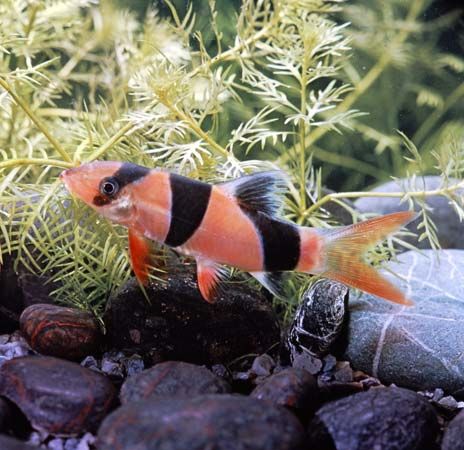
- Clown Loach (Botia macracanthus): A vibrant, orange-colored fish reaching 13–30 cm in length. It is easily identified by its three prominent vertical black bands.1
- Kuhli Loach (Pangio kuhlii): A small, slender, eel-like species growing to about 8 cm. It features a pinkish body marked with numerous vertical black bands.1
- Spined Loach (Cobitis taenia): A mottled, yellow-and-brown fish reaching approximately 13 cm. It is distinguished by a short, movable spine located near each eye, used for defense.1
- Stone Loach (Nemachilus barbatula): Similar in size and coloration to the spined loach, this mottled yellow-and-brown species is found throughout Europe and northern Asia.1
- Weatherfish (Misgurnus fossilis and M. anguillicaudatus): These yellowish, brown-speckled fish grow to about 25 cm. They are famously named for their increased activity levels during shifts in barometric pressure, often occurring before storms.1
How do different species of loaches vary in size and appearance?
Loach species exhibit significant variation in size and physical appearance, ranging from small, eel-like forms to larger, more robust bodies. While they generally share features like small scales and sensory barbels, their specific traits differ as follows:
Species
Typical Size
Appearance
Clown Loach
13–30 cm
Orange body with three vertical black bands
Weatherfish
~25 cm
Yellowish body, speckled and banded with brown
Spined Loach
~13 cm
Mottled yellow and brown; features a movable spine near each eye
Stone Loach
~13 cm
Mottled yellow and brown
Kuhli Loach
~8 cm
Pinkish, slender, and eel-like with many vertical black bands
These variations reflect the diverse adaptations of the Cobitidae family to different freshwater environments across Asia, Europe, and Africa. Their physical traits, such as the defensive spines in the spined loach or the elongated shape of the kuhli loach, are specialized for their specific ecological niches.1
Sources
- loach — Encyclopædia Britannica
- ostariophysan - Swimming — Encyclopædia Britannica
- ostariophysan - Barbels — Encyclopædia Britannica
- ostariophysan - Air breathing — Encyclopædia Britannica
- Circulatory system - Fishes — Encyclopædia Britannica
- Cobitidae — Merriam-Webster
- ostariophysan - Annotated classification — Encyclopædia Britannica
Published on · 3 min read