Lone Star Tick
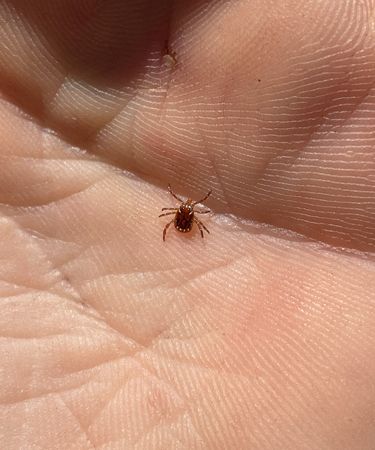
The lone star tick (Amblyomma americanum) is a species of North American hard tick commonly found in wooded areas across the eastern, southeastern, and…
What is lone star tick?
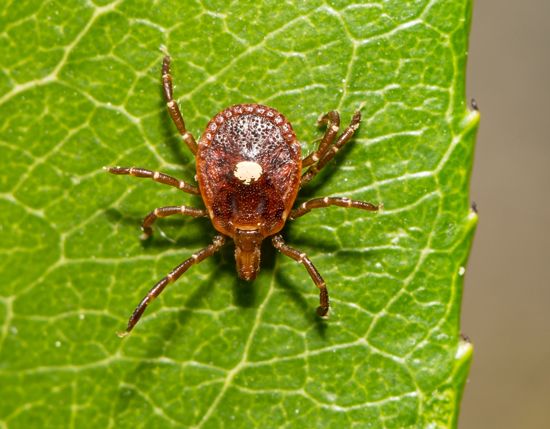
The lone star tick (Amblyomma americanum) is a species of North American hard tick commonly found in wooded areas across the eastern, southeastern, and midwestern United States. These arachnids are named for the characteristic white spot found on the dorsal shield of adult females.12
As parasites, they feed on the blood of various hosts, including humans, birds, and white-tailed deer. They are significant vectors for several diseases and conditions, including:12
- Alpha-gal syndrome: A food allergy to mammalian products (such as beef, pork, and lamb) triggered by a sugar molecule in the tick’s saliva.2
- Ehrlichiosis: A bacterial infection that can range from mild to life-threatening.2
- Tularemia: A potentially fatal illness caused by the bacterium Francisella tularensis.2
- Southern tick-associated rash illness (STARI): A condition characterized by a rash that may resemble the bull’s-eye appearance associated with Lyme disease, though the tick does not transmit Lyme disease itself.12
How do ticks find their hosts in the wild?
Ticks find their hosts in the wild through a behavior known as “questing.” During this process, a tick climbs onto an object, such as a blade of grass or a shrub, and waits for a suitable host to pass by.24
Ticks rely on specific sensory cues to detect and attach to a passing host:
- Chemical Sensing: Ticks are highly sensitive to the odor of butyric acid, which is emanated by all mammals. They also detect carbon dioxide exhaled by potential hosts.24
- Physical Sensing: Adult ticks, in particular, actively seek hosts by sensing movement vibrations.4
- Sensory Organs: Ticks possess a specialized sensory pit called Haller’s organ, located on the end segment of their first pair of legs, which helps them detect these environmental stimuli. Additionally, some species, such as the castor bean tick, use their front legs as primary sites for thermal sensitivity to detect the warmth of a victim’s body.243
Once a host brushes against the tick, it quickly attaches and begins to feed.24
What are the differences between ticks and mites?
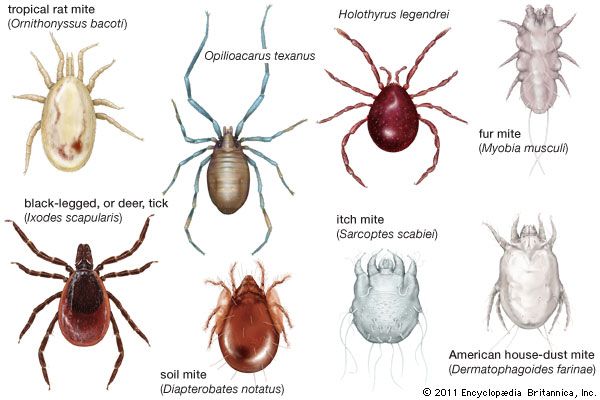
While both ticks and mites belong to the subclass Acari within the class Arachnida, they exhibit distinct morphological and behavioral differences.78
Key Differences
- Sensory Organs: The most notable physical distinction is that ticks possess a specialized sensory pit called Haller’s organ on the end segment of their first pair of legs, which is absent in mites.9
- Size: Ticks are generally larger than mites. Mites can be as small as 0.1 mm, whereas the largest ticks can exceed 30 mm in length when engorged.108
- Body Structure: Ticks have a single body region, whereas many other arachnids have segmented bodies. While some mites are soft-bodied, ticks are often strongly sclerotized with hardened plates.910
- Feeding Habits: All ticks in the order Ixodida are obligate, blood-feeding parasites of vertebrates. In contrast, mites exhibit a vast diversity of lifestyles; they may be free-living in soil or water, predatory, or parasitic on plants, animals, or humans.9118
- Life Cycle: Many hard ticks remain attached to a host for several days to feed, whereas many soft ticks and various mite species feed intermittently or spend much of their time off the host.119
How can you safely remove a tick if you find one attached?
The provided search results do not contain specific instructions on the physical technique for removing an attached tick. While the article details the biology, disease transmission, and prevention methods for ticks, it does not outline the clinical or recommended steps for extraction.
Because improper removal can increase the risk of pathogen transmission, it is essential to consult reliable medical resources or public health guidelines, such as those provided by the Centers for Disease Control and Prevention (CDC) or local health authorities, for safe removal procedures.
Sources
- lone star tick — Merriam-Webster
- lone star tick: Top Questions — Encyclopædia Britannica
- lone star tick — Encyclopædia Britannica
- tick — Encyclopædia Britannica
- Mechanoreception - The sense of touch — Encyclopædia Britannica
- Thermoreception - Thermoreception in invertebrates — Encyclopædia Britannica
- acarid - Size range and diversity of structure — Encyclopædia Britannica
- arachnid — Encyclopædia Britannica
- acarid - Importance — Encyclopædia Britannica
- acarid - Ecology — Encyclopædia Britannica
- acarid - Annotated classification — Encyclopædia Britannica
Published on · 3 min read