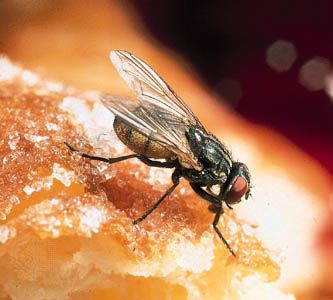
Maggot
A maggot is the soft-bodied, legless larva of many dipterous flies. Approximately half of all fly species produce larvae categorized as maggots, which are…
What is a maggot?
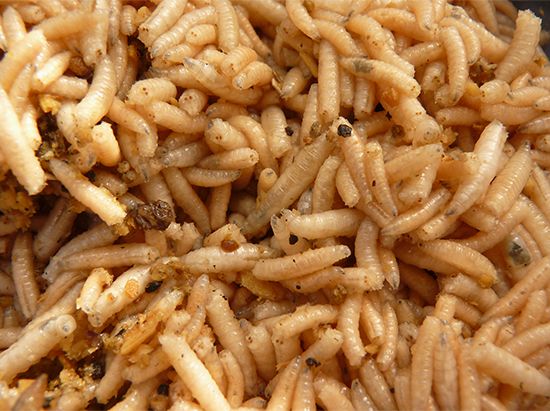
A maggot is the soft-bodied, legless larva of many dipterous flies. Approximately half of all fly species produce larvae categorized as maggots, which are characterized by a tapered, pale yellow body that lacks wings, wing buds, or legs.123
Structurally, maggots have evolved toward simplification, having lost the complex head capsule found in more primitive fly larvae. Instead, they possess mouth hooks used to scoop decaying food and oversized salivary glands to aid in digestion. They breathe through openings called spiracles located at their posterior end.32
While many maggots function as essential decomposers in ecosystems, their roles vary widely:
- Medical and Forensic Use: They are used in maggot debridement therapy to clean wounds and by forensic entomologists to estimate time of death.2
- Health Risks: Some species can cause myiasis, an infection of human or animal tissue.2
- Nutrition: They serve as a sustainable protein source for animal feed and are consumed as food in some cultures.2
Which insects have maggots as their larvae?
Maggots are the larvae of insects belonging to the order Diptera (true flies). Approximately half of all known fly species produce larvae that are classified as maggots.43
While the term “maggot” is specific to these dipterous larvae, it is important to note that not all fly larvae are maggots; some flies produce more specialized or structurally distinct larvae. Examples of insects that produce maggots include:3
- Blow flies: Including the common green bottle fly (Lucilia sericata), which are frequently studied in forensic entomology and used in medical debridement therapy.43
- Houseflies: The common Musca domestica produces maggots that can be associated with human health risks.3
- Flesh flies: Such as the spotted flesh fly (Wohlfahrtia magnifica), which can infest human or animal tissue.3
- Cheese skipper flies: The species Piophila casei produces maggots that are famously associated with the traditional Sardinian cheese casu marzu.3
- Plant-feeding flies: Certain species within the family Chloropidae, such as the frit fly and the gout fly, produce maggots that feed on grains like barley and oats.43
- Screwworms: Such as the New World screwworm (Cochliomyia hominivorax), which are known to infect open wounds.3
What do maggots look like?
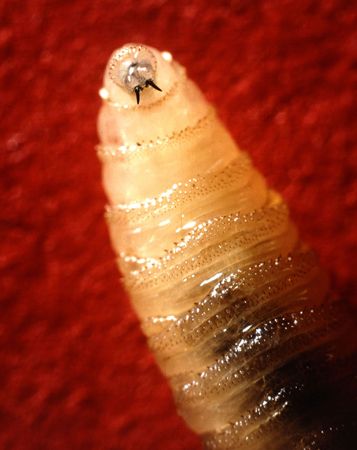
Maggots are the soft-bodied, legless larvae of many dipterous flies. They typically exhibit a tapered, pale yellow body that lacks wings, wing buds, or legs.43
Their physical appearance is defined by several key features:
- Body Shape: They have a pointed anterior (front) end and a blunt posterior (back) end.43
- Mouthparts: Lacking a complex head capsule, they possess one or a pair of mouth hooks at the pointed end, which function like forks to scoop food.43
- Respiration: They breathe through openings called spiracles. On the blunt posterior end, these appear to the naked eye as two small black spots.43
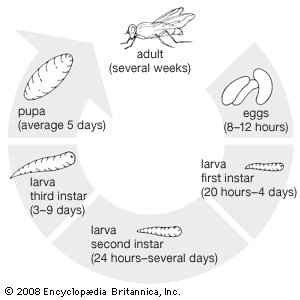
- Size: Upon emerging from eggs, they are typically about 2 mm (0.08 inch) long, though they increase in size as they progress through multiple developmental stages known as instars.3
While they show structural uniformity, their internal anatomy includes oversized salivary glands to assist in digesting decaying organic matter.43
Where do maggots live and grow?
Maggots are highly adaptable and can be found in a wide variety of environments, as they are primarily scavengers that thrive in decaying organic matter. Their habitats are as diverse as their food sources, ranging from terrestrial to aquatic settings.438
Common Habitats
- Decaying Matter: Maggots are most frequently found in decomposing plant and animal material, including garbage, carrion, and animal feces.438
- Plant Tissue: Many species live entirely within plant tissues, such as the frit fly and gout fly, which infest grains like barley and oats, or the apple maggot, which tunnels through fruit. Some larvae cause the formation of galls on leaves or stems.439
- Soil and Surfaces: They are often found in soil, beneath bark, or under stones. Some species, such as certain blow fly larvae, are found in soil near urban buildings.84
- Water: While many maggots are terrestrial, they can also inhabit various aquatic environments, including pools of water and even pools of crude petroleum.8
- Living Tissue: In cases of myiasis, some maggots live and feed within the tissues of living animals or humans, often entering through wounds or body orifices.43
Sources
- Diptera - General features — Encyclopædia Britannica
- maggot — Merriam-Webster
- maggot — Encyclopædia Britannica
- Diptera - Larvae — Encyclopædia Britannica
- Lepidoptera - The larva, or caterpillar — Encyclopædia Britannica
- Apple maggot: Top Questions — Encyclopædia Britannica
- head maggot — Merriam-Webster
- Apple maggot — Encyclopædia Britannica
- Diptera — Encyclopædia Britannica
Published on · 4 min read