Mantispid
It is a common misconception that mantispids possess the same specialized prey-catching adaptations as the praying mantis. While mantispids (family…
What adaptations do mantispids have for catching prey?
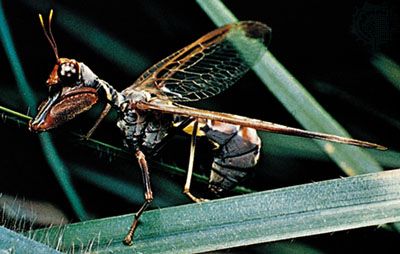
It is a common misconception that mantispids possess the same specialized prey-catching adaptations as the praying mantis. While mantispids (family Mantispidae) bear a superficial resemblance to the praying mantid, the provided information does not describe specific physical adaptations for catching prey in adult mantispids.1
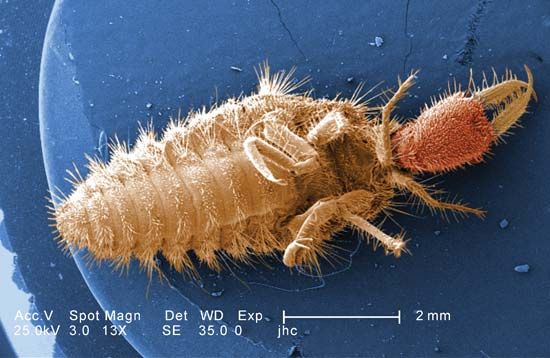
The specialized, spined front legs used by mantises to seize prey in a viselike grip are characteristic of the order Mantodea, not the order Neuroptera, to which mantispids belong. Instead of hunting like mantids, the life cycle of most mantispids is defined by their larval stage, during which they act as parasites, locating and entering the egg cases of spiders to consume the eggs and spiderlings within.12
How are mantispids related to mantises and lacewings?
Mantispids (family Mantispidae) are classified within the order Neuroptera, which is the same order that includes lacewings and antlions. Their relationship to these insects is defined by shared evolutionary lineage and developmental characteristics, such as the spinning of a double cocoon and a complex life cycle involving distinct larval stages.132
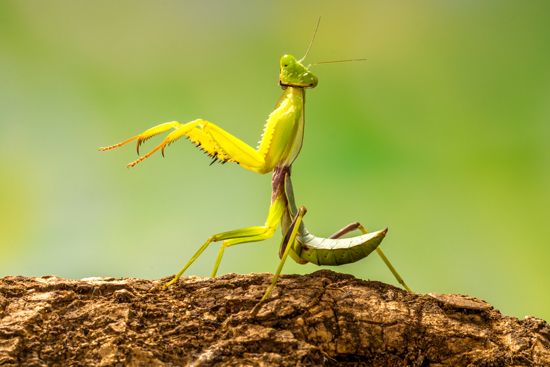
In contrast, mantispids are not closely related to mantises (order Mantodea). The resemblance between the two is purely superficial, a phenomenon known as convergent evolution. While both groups possess predatory forelegs, they belong to entirely different insect orders.143
The key distinctions are:
- Taxonomy: Mantispids are neuropterans, while mantises belong to the order Mantodea.143
- Development: Mantispid larvae are typically parasitic, often targeting spider egg cases, whereas mantises are free-living ambush predators throughout their life cycle.143
- Morphology: Mantispids exhibit the characteristic wing venation and life cycle traits of the order Neuroptera, whereas mantises possess the specialized, spined front legs and triangular, highly mobile heads unique to their own order.43
How do mantispids contribute to pest control in ecosystems?
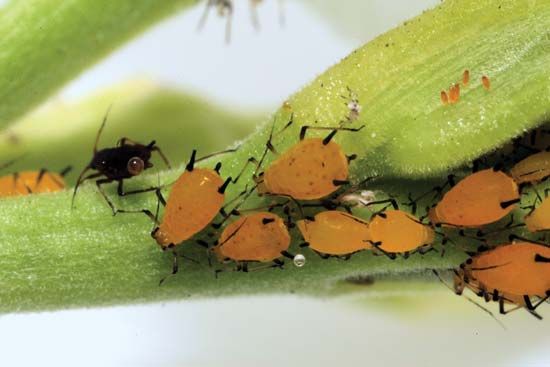
Mantispids (family Mantispidae) do not typically function as generalist pest control agents in the same way that many other members of the order Neuroptera—such as lacewings—do. While many neuropterans are highly effective predators that consume large numbers of aphids, mites, and other garden pests, the life cycle of most mantispids is specialized toward parasitism rather than broad-spectrum predation.12
In most mantispid species, the larvae are specialized parasites that locate and enter the egg cases of spiders, where they consume the spider eggs and developing spiderlings. Some species, such as the Brazilian mantispid (Symphasis varia), are instead parasitic on wasps, pupating within the host’s nest. Because their ecological role is focused on these specific host-parasite relationships, they are not generally categorized as beneficial insects for the control of agricultural or garden pests in the manner of predatory mantises or other neuropterans.172
How do mantispids differ from praying mantises in terms of behavior and appearance?
While mantispids and praying mantises share a superficial resemblance, they are distinct insects belonging to different orders. Mantispids are members of the order Neuroptera, whereas mantises belong to the order Mantodea.12
Appearance and Morphology
- Mantispids: These insects are generally smaller, with the European mantispid measuring 12 to 20 mm in length. Their appearance is a result of convergent evolution, mimicking the form of a mantis.1
- Mantises: These are typically larger, often ranging from 7 to 10 cm. They are characterized by a highly mobile, triangular head with large compound eyes and specialized front legs featuring enlarged femurs lined with spines for seizing prey.2
Behavioral Differences
- Feeding and Lifestyle: Mantises are active or ambush predators that feed exclusively on living insects. In contrast, most mantispid larvae are specialized parasites that locate and enter spider egg cases to consume eggs and spiderlings, though some species parasitize wasps.12
- Reproduction: Mantises lay eggs in protective, often tough capsules called oothecae. Mantispids typically fasten their eggs to long, slender stalks.12
Sources
- mantispid — Encyclopædia Britannica
- mantis — Encyclopædia Britannica
- neuropteran - Life cycle of Neuroptera — Encyclopædia Britannica
- neuropteran - Annotated classification — Encyclopædia Britannica
- List of insects - order Mantophasmatodea — Encyclopædia Britannica
- neuropteran - Evolution and paleontology — Encyclopædia Britannica
- neuropteran - Ecology — Encyclopædia Britannica
Published on · 3 min read