Marion Island
Marion Island, located in the southern Indian Ocean, was discovered in January 1772 by the French explorer Marion du Fresne. The island group was later…
What is the history of human discovery and exploration of Marion Island?
Marion Island, located in the southern Indian Ocean, was discovered in January 1772 by the French explorer Marion du Fresne. The island group was later explored in 1776 by the British navigator James Cook, who bestowed the name Prince Edward Island upon the neighboring island.1
During the 19th and 20th centuries, the islands were frequently visited by seal hunters and whaling ships. In 1947, South Africa formally proclaimed sovereignty over the islands, and in 1948, the nation established a permanent meteorological station on Marion Island. Today, the island remains otherwise uninhabited, serving primarily as a site for biological research.12
How does Marion Island compare to other sub-Antarctic islands in terms of biodiversity and scientific importance?
Marion Island is a significant sub-Antarctic site, distinguished from the Antarctic continent by its location north of the Antarctic Convergence. While the Antarctic continent supports only an impoverished community of cold-tolerant plants due to extreme isolation and harsh conditions, sub-Antarctic islands like Marion are characterized by a greater abundance of vascular plant species, including the Kerguelen cabbage, mosses, and ferns.123
Compared to other sub-Antarctic islands such as South Georgia, Kerguelen, and Macquarie Island, Marion Island shares a similar botanical profile dominated by seed plants rather than the spore-reproducing plants that predominate in the Antarctic zone. Scientifically, Marion Island is highly valued as an uninhabited natural laboratory. Since the establishment of a meteorological station in 1948, it has served as a critical site for biological research. Unlike some other sub-Antarctic regions where introduced herbivores like sheep and rabbits have severely decimated native plant communities, Marion Island remains a focus for monitoring and preserving its fragile sub-Antarctic ecosystem.312
What is the climate like on Marion Island, and how does it affect the local ecosystem?
Marion Island experiences a cool, stormy sub-Antarctic climate, with a mean annual temperature of 40 °F (4.4 °C). The region is characterized by prevailing westerly winds that result in frequent, heavy precipitation, including both rain and snow, with rainfall averaging 100 inches (2,500 mm) annually. Cloudless days are rare, and the environment is consistently damp and exposed.12
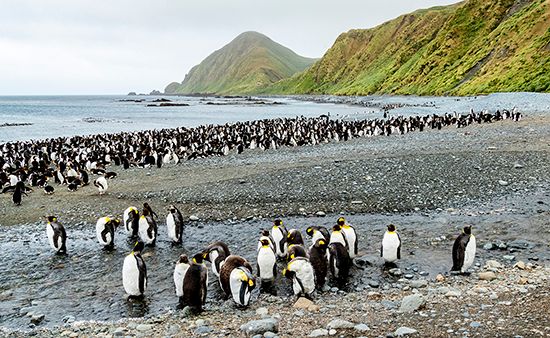
This harsh, wet, and windy climate directly shapes the island’s ecosystem. The persistent moisture and cool temperatures support a specialized flora, including mosses, ferns, and the Kerguelen cabbage, which are adapted to the rugged, volcanic terrain. The extreme weather conditions also influence the island’s extensive birdlife, which relies on the surrounding Indian Ocean and the island’s sheltered coastal areas to survive in such a challenging environment.12
We could dive deeper into how these specific climatic conditions influence the breeding cycles of the seabirds found on the island.
Where is Marion Island located, and what are its main geographical features?
Location and Geography of Marion Island
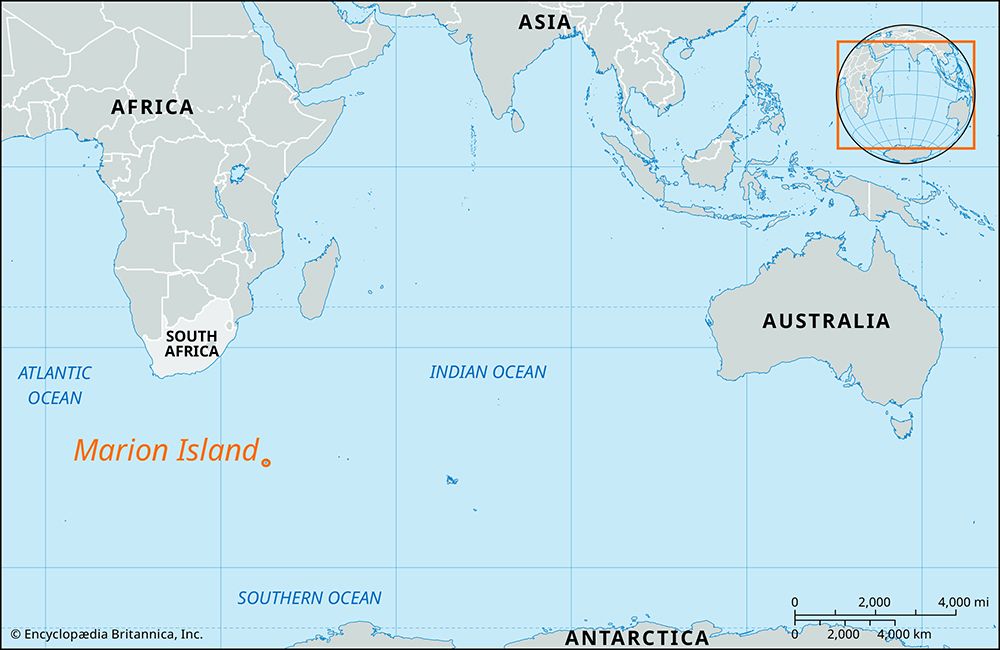
Marion Island is located in the southern Indian Ocean, situated approximately 1,190 miles (1,920 km) southeast of Cape Town, South Africa. It is one of two islands that make up the Prince Edward Islands, with its sister island, Prince Edward Island, lying 12 miles (19 km) to the northeast.1
The island is of volcanic origin and covers an area of 115 square miles (298 square km). Its primary geographical features include:
- Topography: The island features a low, domelike shape that rises to a high point at President Swart Peak, which reaches an elevation of 3,890 feet (1,186 meters).1
- Coastline: The coast is notably rugged and exposed, characterized by steep cliffs that can rise as high as 500 feet (150 meters).1
- Climate: The environment is cool and stormy, with a mean annual temperature of 40 °F (4.4 °C). Prevailing westerly winds contribute to heavy annual precipitation of 100 inches (2,500 mm), making clear, cloudless days rare.1
Sources
- Marion Island — Encyclopædia Britannica
- Prince Edward Island — Encyclopædia Britannica
- Antarctica - Plant life — Encyclopædia Britannica
- Polar ecosystem - The Antarctic region — Encyclopædia Britannica
Published on · 3 min read