Macquarie Island
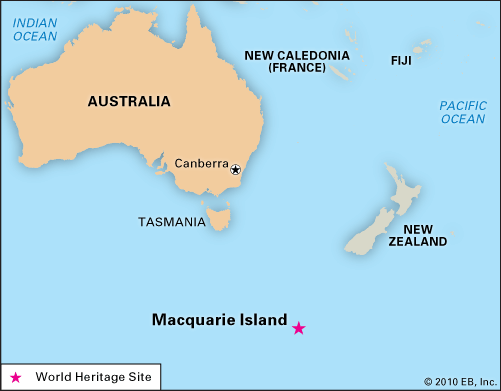
Macquarie Island has no permanent human population, though it has a long history of visitation and scientific activity. While the island was officially…
What is the history of human presence and activities on Macquarie Island?
Macquarie Island has no permanent human population, though it has a long history of visitation and scientific activity. While the island was officially sighted in 1810 by Australian sealer Frederick Hasselborough, he discovered a shipwreck of ancient design, suggesting earlier, likely Polynesian, presence.1
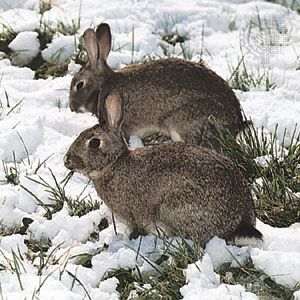
Following its discovery, the island became a hub for seal hunting until 1919, an industry that nearly led to the extermination of local fur seals by the 1830s. Human activity has significantly impacted the island’s ecosystem through the introduction of nonnative species. In the 1870s, rabbits were introduced as a food source, eventually causing severe damage to native vegetation. Subsequent attempts to manage these populations—including the introduction of the Myxoma virus and the eradication of feral cats—led to complex ecological imbalances that required further government intervention.1
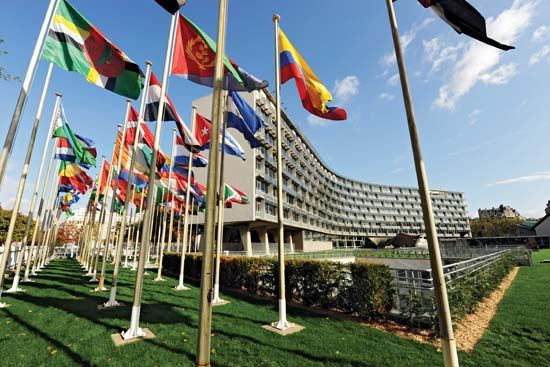
Since 1948, the island has hosted a meteorological and geologic research station, and it remains a site for ongoing biological and botanical study. Designated a nature reserve in 1933, it was named a UNESCO World Heritage site in 1997.1
What scientific research is conducted on Macquarie Island?
Scientific research on Macquarie Island has been conducted consistently since the establishment of a research station in 1948. The island serves as a unique site for several fields of study:
- Geology: The island is the only place on Earth where rocks from the mantle are actively exposed above sea level. Researchers study this area as an exposed portion of the Macquarie Ridge, where the Pacific and Indian-Australian plates meet, providing insights into tectonic activity and earthquakes.1
- Meteorology: The research station maintains long-term meteorological observations, which are critical for understanding the climate of the subantarctic region.1
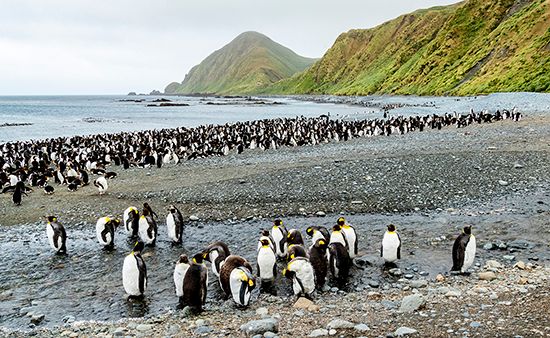
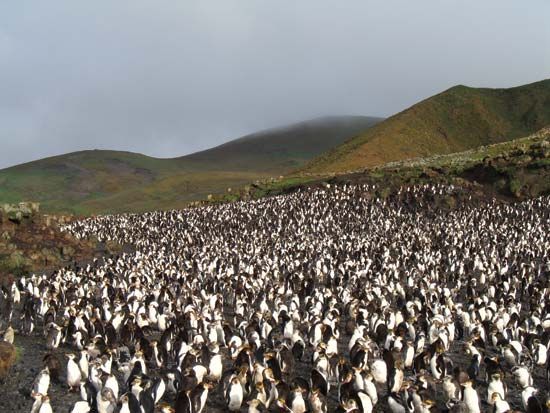
- Biology and Botany: Scientists conduct extensive research on the island’s unique flora and fauna. This includes studies on the royal penguin—for which the island is the only known breeding ground—as well as albatross, petrels, and native mosses and orchids.1
- Ecology: Research is also focused on the management and eradication of nonnative species, such as rabbits, to protect the island’s fragile ecosystem.1
How does Macquarie Island’s isolation impact its ecosystem?
Macquarie Island’s isolation has historically protected a unique, fragile ecosystem characterized by native grasses, mosses, and specialized fauna like the royal penguin and various albatross and petrel species. However, this same isolation made the environment highly vulnerable once human visitation began.1
The introduction of nonnative species has had severe, cascading consequences for the island’s biodiversity. When rabbits were introduced in the 1870s, they proliferated and decimated native vegetation. Subsequent attempts to manage this through the introduction of the Myxoma virus inadvertently impacted feral cats, which then shifted their predation toward native seabirds. The later eradication of these cats led to a further explosion in the rabbit population, which continued to destroy the island’s plant life.1
These events highlight the ethical necessity of responsible stewardship in isolated environments, as human interference can rapidly destabilize delicate ecological balances. Consequently, government authorities have shifted toward holistic, integrated strategies to manage and eradicate multiple interdependent invasive species simultaneously.12
How did Macquarie Island become a UNESCO World Heritage Site?
Macquarie Island was designated a UNESCO World Heritage site in 1997 due to its exceptional geological and biological significance.
The island is recognized globally as the only place on Earth where rocks from the mantle are actively exposed above sea level. This unique feature is a result of intense geologic activity along the Macquarie Ridge, where the Pacific and Indian-Australian plates collide. Beyond its geological value, the island serves as a critical habitat for diverse subantarctic wildlife, including being the only known breeding ground for the royal penguin. Its status as a protected area dates back to 1933, when it was first established as a nature reserve, providing the foundation for its later international recognition.1
Sources
- Macquarie Island — Encyclopædia Britannica
- Antarctica - Plant life — Encyclopædia Britannica
Published on · 3 min read