Meteorite Crater
Studying meteorite craters provides vital insights into the history of the solar system and Earth’s own evolution. Because craters cover most solid-surface…
What can we learn about Earth’s history and the solar system from studying meteorite craters?
Studying meteorite craters provides vital insights into the history of the solar system and Earth’s own evolution. Because craters cover most solid-surface bodies, they serve as a record of the debris left over from the solar system’s formation 4.6 billion years ago.1
Key takeaways include:
- Geologic History: By counting craters per unit area, scientists determine the relative ages of planetary surfaces. A high density of craters indicates an ancient, unaltered surface, while a lack of craters—as seen on Earth—reveals active geologic processes like erosion, volcanism, or plate tectonics that have resurfaced the planet.21
- Early Bombardment: The Late Heavy Bombardment period, visible on the Moon and other bodies, tracks the intense collision phase as planet formation concluded.3
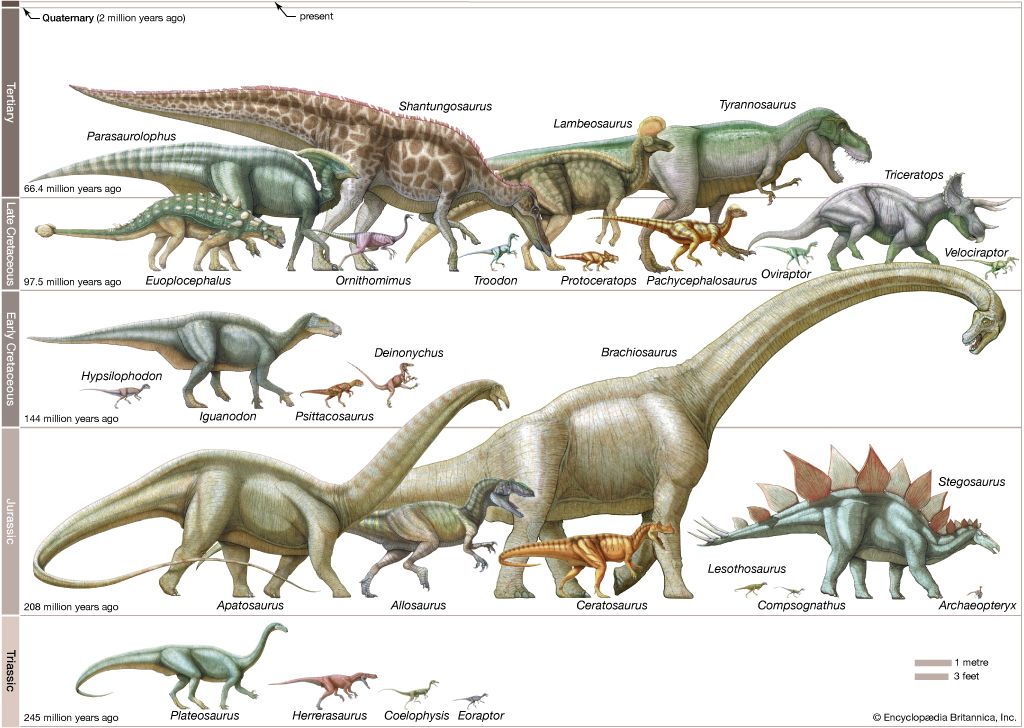
- Biological Impact: Large impacts have shaped life on Earth, potentially influencing its origin and driving mass extinctions, such as the event that led to the demise of the dinosaurs.3
What role do meteorite craters play in the study of planetary geology?
Meteorite craters are fundamental to the study of planetary geology, serving as primary indicators of a body’s history and surface activity. Because cratering is a near-universal process across solid-surface bodies, these depressions provide a record of the debris remaining from the solar system’s formation 4.6 billion years ago.13
Measuring Geologic Activity
The density of craters on a surface is a key metric for determining relative age. A high concentration of craters suggests an ancient, stable surface, whereas a lack of craters indicates that more recent geologic processes—such as volcanism, plate tectonics, or erosion—have resurfaced the area. While Earth is often thought to be shielded by its atmosphere, its relative lack of craters is primarily due to these active geologic processes, which degrade or eliminate impact sites over time.213
Insights into Planetary Evolution
- Surface History: By counting craters per unit area, scientists can estimate the relative ages of different regions on a planet or moon.2
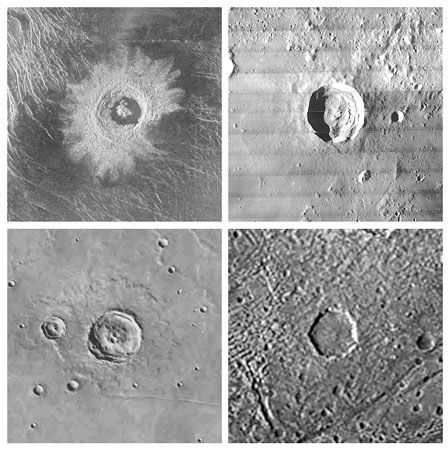
- Crater Morphology: Variations in crater appearance provide data on a body’s physical properties. Factors such as surface gravity and the strength of near-surface materials influence how craters collapse and form complex structures like central peaks or pits.4
- Atmospheric Effects: Comparing craters on airless bodies to those on planets with atmospheres reveals how gas envelopes influence the distribution of ejecta, often creating fluid-like flow patterns rather than simple ballistic deposits.4
What are some of the most famous meteorite craters on Earth?
Several significant meteorite craters on Earth have provided scientists with crucial evidence regarding planetary impacts and their effects on biological and geological history.
- Vredefort Dome: Located in South Africa, this is the largest known impact structure on Earth. Formed approximately 2.023 billion years ago by a meteorite 20–25 km in diameter, the original crater may have spanned up to 280 km. It is recognized as a UNESCO World Heritage site.2
- Chicxulub crater: Buried beneath sediments off the Yucatán Peninsula in Mexico, this 180-km-wide crater was created about 66 million years ago. The impact is widely believed to have triggered the K–T extinction event, leading to the mass extinction of the dinosaurs.67
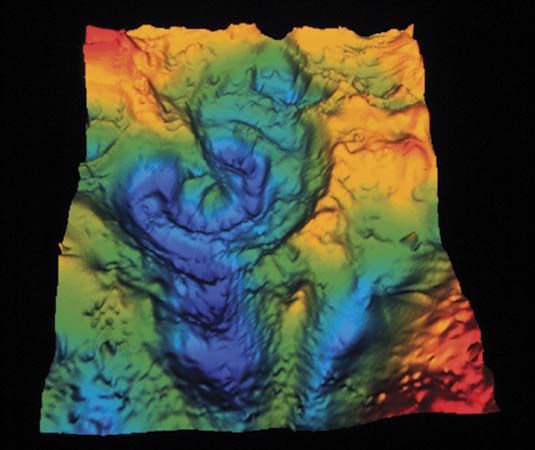
- Meteor Crater: Situated in Arizona, U.S., this is one of the best-preserved terrestrial impact craters. It is roughly 1.2 km in diameter and 200 meters deep, formed approximately 50,000 years ago by an iron meteoroid.68
How does the size of a meteorite affect the size and shape of the resulting crater?
The size and shape of a meteorite crater are primarily determined by the kinetic energy released during a hypervelocity impact. When a large object strikes a planetary surface, it is typically vaporized, and the resulting explosion creates a depression that is generally about 10 times the diameter of the original meteorite.92
The resulting landform depends on the scale of the impact:
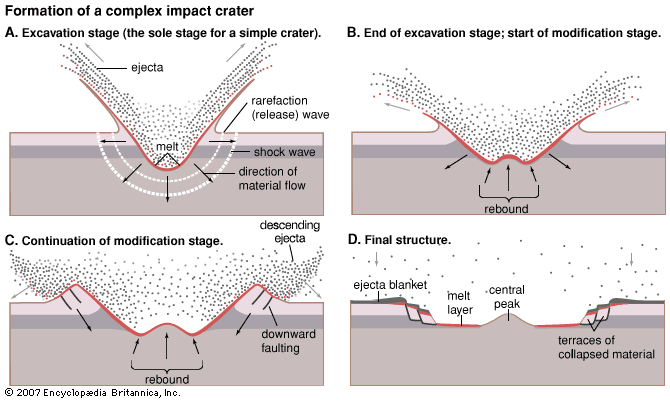
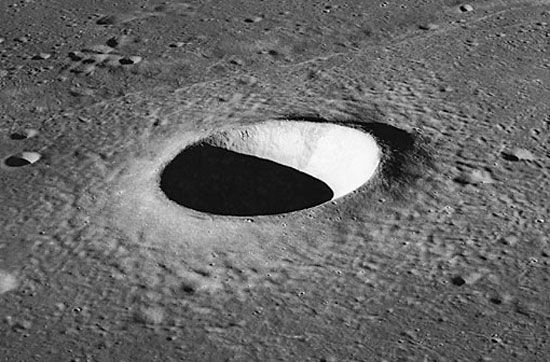
- Simple Craters: Smaller impacts produce a simple, upward-facing parabolic bowl. These craters are stable and do not undergo significant structural changes after the initial excavation.9
- Complex Craters: As the size of the impact increases, the initial parabolic hole becomes too large to support itself. During a “modification stage,” the crater collapses, creating more complex features. These may include a flat floor caused by material rebound, a central peak, or even raised circular rings in the case of very large impacts. Additionally, downward faulting can create terraces along the inner rim.9
In all cases, the crater rim is elevated above the surrounding terrain, and the surrounding area is covered by an ejecta blanket of excavated material.9
Sources
- Meteorite crater - Meteorite craters as measures of geologic activity — Encyclopædia Britannica
- Meteor and meteoroid - Meteorites —meteoroids that survive atmospheric entry — Encyclopædia Britannica
- Meteorite crater — Encyclopædia Britannica
- Meteorite crater - Variations in craters across the solar system — Encyclopædia Britannica
- Crater — Encyclopædia Britannica
- Chicxulub crater — Encyclopædia Britannica
- Vredefort Dome — Encyclopædia Britannica
- Meteor Crater — Encyclopædia Britannica
- Meteorite crater - The impact-cratering process — Encyclopædia Britannica
Published on · 4 min read