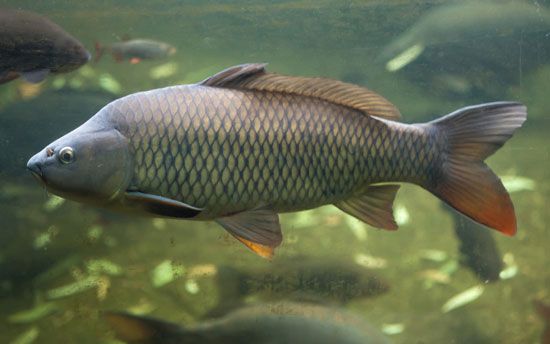
Minnow
In North America, the term "minnow" refers to various small freshwater fishes, primarily those belonging to the carp family, Cyprinidae. While the name is…
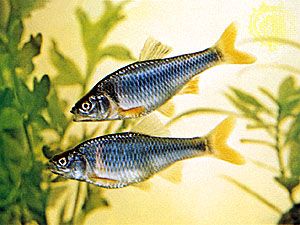
What are some common species of minnows found in North America?
In North America, the term “minnow” refers to various small freshwater fishes, primarily those belonging to the carp family, Cyprinidae. While the name is sometimes applied to other groups like mud minnows or killifishes, the following are common North American cyprinid species:1
- Bluntnose minnow (Pimephales notatus): An olive-colored fish that typically reaches lengths of up to 10 cm and is frequently used as live bait.1
- Fathead minnow (Pimephales promelas): A widely distributed species found from southern Canada to Mexico, often reaching about 6 cm in length.12
- Common shiner (Notropis cornutus): A blue and silver fish that can grow up to 20 cm long.1
- Golden shiner (Notemigonus cryseleucas): Also known as the American roach, this is a larger, greenish-gold species that can reach 30 cm and weigh up to 0.7 kg.1
These species are ecologically significant as a food source for other animals and are often valued for their role in the bait industry.1
What role do minnows play in recreational fishing and as bait fish?
In North America, minnows play a vital role in recreational fishing primarily as a highly valued source of live bait. Many species, such as the bluntnose minnow (Pimephales notatus), the fathead minnow (Pimephales promelas), and the common shiner (Notropis cornutus), are abundant and frequently utilized by anglers to attract larger predatory fish.1
Because of their popularity, certain minnow species are specifically cultured to meet the demand for bait. The golden shiner (Notemigonus cryseleucas) is particularly notable in this regard; it is widely used as bait and is also considered an edible species. Beyond their direct use on hooks, minnows serve as a fundamental food source for various aquatic animals, supporting the broader health of freshwater ecosystems. While commercial fishing operations employ diverse methods like traps and nets to capture fish, the consistent availability of minnows remains a key logistical requirement for successful line fishing.14
How do minnows communicate and interact with each other?
Minnows, which belong to the family Cyprinidae, interact and communicate with each other primarily through chemical signals and specialized sensory systems.
Chemical Communication
Minnows utilize pheromones—specific chemical substances released into the water—to convey information to other individuals. These chemical signals are essential for regulating social behaviors, including:56
- Species Recognition: Minnows possess a high degree of chemosensory acuity, allowing them to discriminate between the odors of numerous different fish species.6
- Individual Identification: Research indicates that certain minnows can identify and remember specific individuals of their own species for several weeks.6
- Social Organization: Chemical cues play a significant role in influencing territorial and communal behaviors within their populations.6
Sensory Perception and Interaction
Beyond chemical signaling, minnows interact with their environment and each other using a sophisticated acoustico-lateralis system.7
- Lateral-line Organs: These organs, located along the head and body, function as “touch at a distance” receptors. They detect minute water displacements caused by the movement of other fish.7
- Social and Protective Behavior: This sensory system allows minnows to perceive and localize members of their own species, which is vital for schooling behavior. Schooling serves as a protective mechanism to avoid predators, while also facilitating breeding and feeding activities.57
How do minnows differ from other small fish species?
Minnows are primarily defined as members of the carp family, Cyprinidae, though the term is often used colloquially to describe various small freshwater fishes. Distinguishing them from other small species involves looking at their unique anatomical and biological traits:1
- Pharyngeal Teeth: Unlike many other fish that possess teeth in their jaws, minnows are characterized by a toothless mouth. Instead, they possess specialized pharyngeal teeth located in their throat, which bite against a horny pad in the roof of the mouth to process food.9
- Taxonomic Diversity: While “minnow” specifically refers to the Cyprinidae family, the name is frequently applied to unrelated small fishes, such as mudminnows (family Umbridae) and various killifishes (Cyprinodontidae).1
- Adaptations: True cyprinid minnows are highly diverse, ranging from small bait species like the bluntnose minnow to larger, edible varieties like the golden shiner. In contrast, other small fish like mudminnows have evolved specific survival strategies, such as the ability to bury themselves in mud and thrive in low-oxygen environments where other species might perish.110
Sources
- minnow — Encyclopædia Britannica
- shiner — Encyclopædia Britannica
- fathead minnow — Merriam-Webster
- commercial fishing - Methods — Encyclopædia Britannica
- fish - Behaviour — Encyclopædia Britannica
- Animal communication - Signal production — Encyclopædia Britannica
- Mechanoreception - Mechanoreceptor function — Encyclopædia Britannica
- ostariophysan - Taste and smell — Encyclopædia Britannica
- atheriniform - Annotated classification — Encyclopædia Britannica
- ostariophysan - Teeth — Encyclopædia Britannica
- mudminnow — Encyclopædia Britannica
Published on · 3 min read