Moldoveanu
Moldoveanu is the highest peak in Romania, reaching an elevation of 8,346 feet (2,544 metres). It is located within the Făgăraș Mountains, which are part of…
What is Moldoveanu?
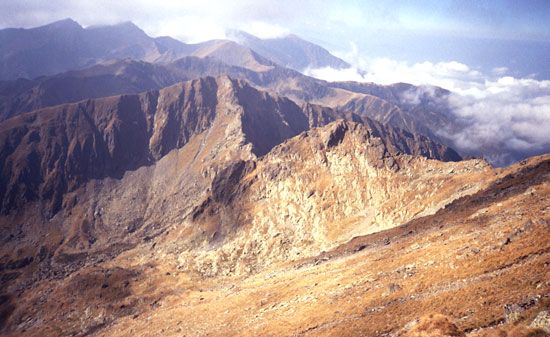
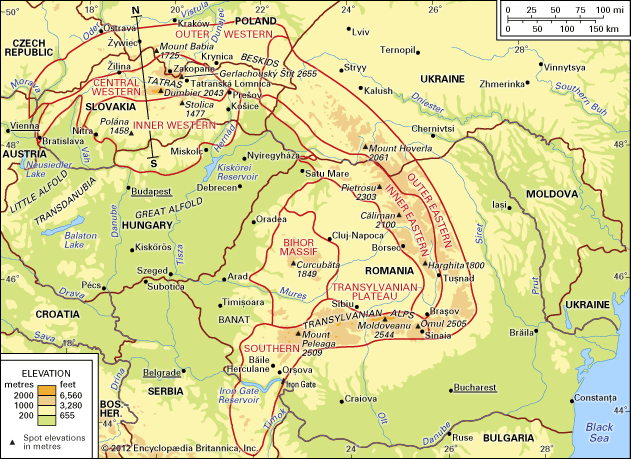
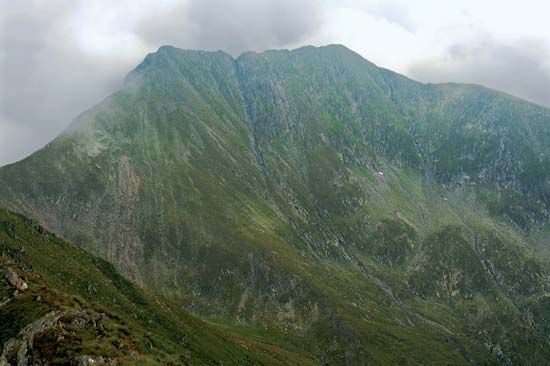
Moldoveanu is the highest peak in Romania, reaching an elevation of 8,346 feet (2,544 metres). It is located within the Făgăraș Mountains, which are part of the Transylvanian Alps in the Southern Carpathians.1
What are the Făgăraș Mountains known for?
The Făgăraș Mountains are primarily known as the highest section of the Transylvanian Alps in south-central Romania.2
Key characteristics of the range include:
- Topography: The mountains feature a steep northern face that rises above 8,000 feet (2,450 m) and overlooks the Făgăraș Depression. The landscape is heavily glaciated, characterized by numerous lakes, fretted peaks, and morainic deposits.2
- Highest Peaks: The range contains the two highest peaks in Romania: Moldoveanu (8,346 feet/2,544 m) and Negoiu (8,317 feet/2,535 m).2
- Hydrology: The northern face is defined by short, precipitous streams flowing into the Olt River, while the southern face is the source of several rivers, most notably the Argeș.2
- Accessibility: Spanning approximately 30 miles (48 km), the range is noted for being relatively isolated and inaccessible compared to other parts of the Transylvanian Alps.2
How do the Southern Carpathians differ from other mountain ranges?
The Southern Carpathians, also known as the Transylvanian Alps, are distinguished from other segments of the Carpathian Mountains by several key geological and physical characteristics:
- Composition: Unlike the Eastern Carpathians, which include significant bands of flysch and volcanic rocks, the Southern Carpathians consist primarily of hard crystalline and metamorphic rocks. This composition gives the region a massive, rugged character that differentiates it from the other divisions of the range.45
- Continuity and Accessibility: The Southern Carpathians form a higher, more continuous, and more impassable barrier than the eastern or western segments. While other parts of the Carpathians are frequently broken by numerous structural depressions, the Southern Carpathians are interrupted by only four major passes.6
- Elevation: This region contains the highest peaks in Romania, including Moldoveanu (8,346 feet) and Negoiu (8,317 feet), both located in the Făgăraș Mountains.56
- Relief: The area is noted for its Alpine-type relief forms and ancient erosion platforms, which have historically been used as high-altitude pastures.45
What is the climate like at high altitudes in Romania?
The climate at high altitudes in Romania, particularly within the Carpathian Mountains, is significantly modified by elevation, creating distinct climatic zones that differ from the surrounding plains.8
Key characteristics of the high-altitude climate include:
- Temperature and Inversion: While mean annual temperatures vary by altitude, a notable phenomenon in the mountains is temperature inversion. During winter, cold air settles into low-lying depressions, while the higher mountain peaks experience relatively warmer temperatures.9
- Precipitation: Precipitation increases substantially with elevation. While the average annual rainfall for Romania is about 25 inches (640 mm), it reaches approximately 55 inches (1,400 mm) in the Carpathians. On the highest massifs, annual precipitation can reach between 65 and 70 inches.89
- Continental Influence: The region experiences a continental climate, governed in winter by polar-continental air masses from the east and northeast, and in other seasons by oceanic air masses from the west.9
Sources
- Moldoveanu — Encyclopædia Britannica
- Făgăraş Mountains — Encyclopædia Britannica
- Bucegi Massif — Encyclopædia Britannica
- Carpathian Mountains - Physiography of the Carpathian Mountains — Encyclopædia Britannica
- Romania - Relief — Encyclopædia Britannica
- Carpathian Mountains — Encyclopædia Britannica
- Transylvanian Alps — Encyclopædia Britannica
- Romania - Climate — Encyclopædia Britannica
- Carpathian Mountains - Climate — Encyclopædia Britannica
- Romania - Land of Romania — Encyclopædia Britannica
Published on · 2 min read