Someş River
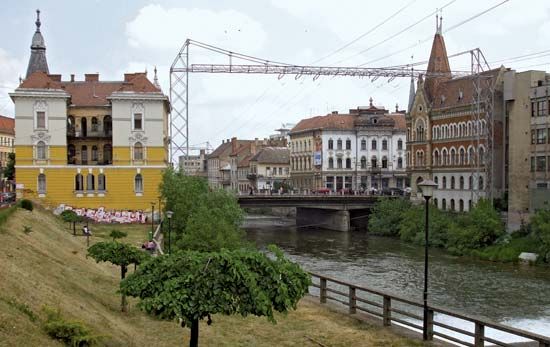
The Someș River is a significant waterway located in northwestern Romania, serving as one of the most important rivers in the Transylvania region.
What is Someş River?
The Someș River is a significant waterway located in northwestern Romania, serving as one of the most important rivers in the Transylvania region.1
It is formed by the confluence of two headstreams at the town of Dej:
- The Great Someș: Rises in the Rodnei Mountains and flows southwest.1
- The Little Someș: Rises in the Apuseni Mountains (as the Someșu Cald and Someșu Rece) and flows northeast.1
From Dej, the river travels approximately 250 miles (400 km) in a zigzag course toward the northwest, eventually entering the Tisza River in Hungary. The city of Satu Mare is situated along its banks. Beyond its geographical importance, the river is a key resource for Romania, contributing to the country’s hydroelectric potential, which has been a focus of development efforts since the 1940s.12
What are the main mountain ranges in Transylvania?
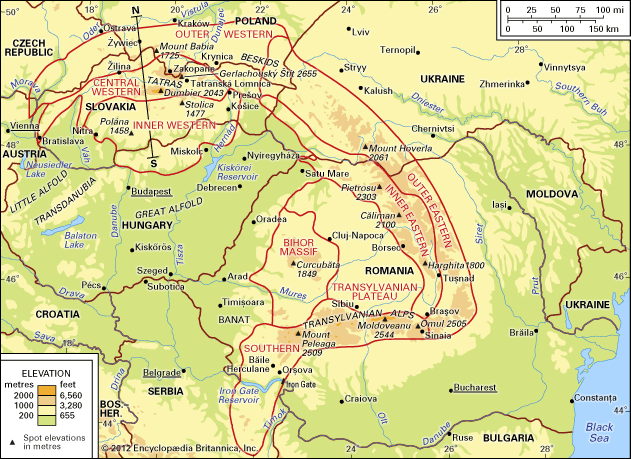
Transylvania is defined by the arc of the Carpathian Mountains, which surround the central Transylvanian Plateau. The region’s mountainous relief is primarily categorized into three major divisions:
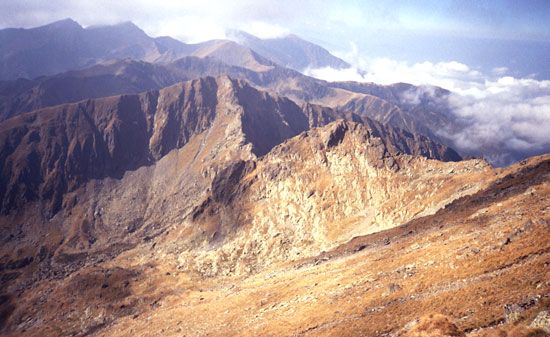
- Southern Carpathians (Transylvanian Alps): Stretching between the Prahova River valley and the Timiș and Cerna rivers, this is the highest and most massive section of the range. It includes the Făgăraș Mountains—home to Romania’s highest peaks, Mount Moldoveanu and Negoiu—as well as the Bucegi, Parâng, and Retezat-Godeanu massifs.345
- Eastern Carpathians: Extending from the Ukrainian border to the Prahova River, these mountains feature a mix of crystalline, volcanic, and flysch rocks. Notable ranges include the Rodna Mountains and the volcanic Călimani and Harghita ranges.46
- Western Carpathians: Located between the Danube and Someș River, this area consists of a cluster of massifs rather than a continuous range. It includes the Apuseni Mountains, centered on the Bihor Massif, as well as the Banat and Poiana Ruscăi mountains](https://www.britannica.com/place/Banat-Mountains) and Poiana Ruscăi mountains.456
How does the Tisza River connect to the Danube?
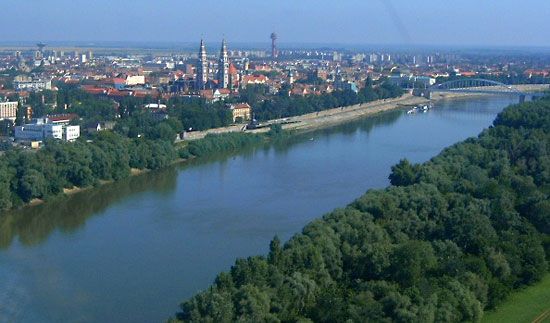
The Tisza River serves as a major tributary of the middle Danube River. After traveling a meandering, largely canalized course of approximately 600 miles (966 km), the Tisza joins the Danube 28 miles (45 km) north of Belgrade, Serbia.9
In addition to this natural confluence, the two rivers are connected by a canal in Serbia that provides a man-made link between them. The relationship between these waterways is significant for regional hydrology; when high water levels coincide in both rivers, the Tisza can experience backflow, which has historically caused severe flooding in areas such as Szeged, Hungary.9
What is the importance of hydroelectric power in Romania?
Romania possesses significant hydroelectric potential due to its dense network of rivers and the Danube River, which serves as a primary source for energy production. While the country’s theoretical hydroelectric capacity is vast, technical and economic factors limit the amount that can be developed.210
Key aspects of Romania’s hydroelectric importance include:
- Strategic Infrastructure: Since the 1940s, major projects have been developed on rivers such as the Argeș, Bistrița, Lotru, Olt, Sebeș, and Someș.2
- The Iron Gate: The Iron Gate hydroelectric project, a joint venture between Romania and the former Yugoslavia completed in 1972, is a cornerstone of the nation’s energy sector. It provides equal energy shares to both countries and generates at least three-fifths of Romania’s electricity.1110
- Energy Balance: Hydroelectric power has been essential in diversifying Romania’s energy mix, which also relies on thermal power stations fueled by lignite and nuclear reactors at Cernavodă.10
Sources
- Someş River — Encyclopædia Britannica
- Romania - Drainage of Romania — Encyclopædia Britannica
- Transylvanian Alps — Encyclopædia Britannica
- Apuseni Mountains — Encyclopædia Britannica
- Romania - Relief — Encyclopædia Britannica
- Carpathian Mountains - Physiography of the Carpathian Mountains — Encyclopædia Britannica
- Făgăraş Mountains — Encyclopædia Britannica
- Carpathian Mountains - The people — Encyclopædia Britannica
- Tisza River — Encyclopædia Britannica
- Iron Gate — Encyclopædia Britannica
- Romania - Resources and power — Encyclopædia Britannica
Published on · 3 min read