Moloch
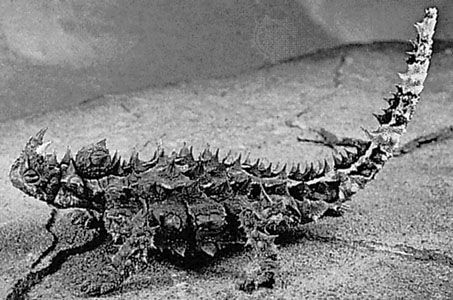
The moloch (also known as the thorny devil) is a small, squat lizard belonging to the family Agamidae, native to the sandy deserts of Australia.
What are the key characteristics that define the Moloch lizard species?
The moloch (also known as the thorny devil) is a small, squat lizard belonging to the family Agamidae, native to the sandy deserts of Australia.1
Key characteristics include:
- Appearance: It measures approximately 20 centimeters (8 inches) in length and is covered in thornlike spines, with prominent spikes projecting from its snout and above each eye.1
- Camouflage: Its cryptic coloration and morphology make it difficult to spot in its natural environment, a trait enhanced by its tendency to remain perfectly still when approached.1
- Diet and Behavior: The moloch is a specialized ant-eater, feeding primarily on black ants. Despite being a slow-moving reptile, it can travel 200–300 meters daily.1
- Convergent Evolution: It shares many physical and behavioral traits with the horned lizards of North America, including a flattened body, short tail, and a sedentary nature, despite belonging to a different family.1
Where is the natural habitat of the Moloch lizard, and how is it adapted to its environment?
The moloch, or thorny devil, is native to the sandy deserts of Australia. This lizard is highly specialized for its arid environment, utilizing several key adaptations to survive:
- Cryptic Morphology: The moloch is covered in thornlike spines, which, combined with its orange and brown coloration, provide effective camouflage against the desert floor. It further enhances this protection by remaining perfectly still when approached, making it extremely difficult to detect in its natural habitat.1
- Dietary Specialization: It is a specialized ant-eater, feeding primarily on black ants. Despite its sedentary nature, it is capable of traveling 200–300 meters daily to forage.1
- Water Conservation: Like many reptiles, the moloch excretes uric acid, which minimizes the amount of liquid required to expel nitrogenous wastes. Its low metabolic rate also reduces its overall water requirements, a common trait that allows lizards to thrive in extreme desert conditions.2
What is the scientific name of the Moloch lizard, and why was it given this name?
The scientific name of the moloch lizard is Moloch horridus.
The name reflects the lizard’s distinctive and intimidating appearance:
- Moloch: This name is derived from the ancient Canaanite deity, often associated with fire and sacrifice in biblical texts. The lizard was likely named for this figure due to its fierce, spiked appearance, which may have evoked a sense of “monstrous” or “horrid” imagery to early naturalists.145
- Horridus: This is the Latin term for “bristly” or “rough.” In its archaic sense, it refers to something that is stiffly erect or covered in spines, perfectly describing the thorny devil’s body, which is entirely covered in thornlike spines that project from its snout and over its eyes.16
Together, the name Moloch horridus captures the lizard’s unique, spiny morphology that serves as its primary defense in the Australian desert.1
How does the Moloch lizard’s body structure differ from other lizard species?
The body structure of the moloch is defined by its squat, flattened shape and a dense covering of thornlike spines, with the most prominent spikes located on its snout and above each eye.1
While the moloch belongs to the Agamidae family, its physical form and behavioral patterns are remarkably similar to the horned lizards of North America, which belong to the family Iguanidae. Both species share several structural characteristics that distinguish them from many other lizard species:1
- Flattened Body: Both have a low-profile, flattened build that aids in camouflage and stability on the desert floor.1
- Spiny Morphology: Both are covered in protective spines, which serve as a primary defense mechanism.1
- Short Tails: Unlike many lizard species that possess long, whip-like tails, the moloch and horned lizards have notably short tails.1
These structural similarities are a classic example of convergent evolution, where unrelated species develop similar traits to adapt to comparable environmental pressures.1
Sources
- moloch — Encyclopædia Britannica
- lizard - Water loss and other variables — Encyclopædia Britannica
- Thorn forest — Encyclopædia Britannica
- Moloch — Encyclopædia Britannica
- Moloch — Merriam-Webster
- horrid — Merriam-Webster
- thorny devil — Merriam-Webster
Published on · 3 min read