Monoplacophoran
Monoplacophorans (class Tryblidia) are primitive marine mollusks defined by a unique combination of characteristics that reflect their evolutionary history.…
What are the key characteristics that define monoplacophorans?
Monoplacophorans (class Tryblidia) are primitive marine mollusks defined by a unique combination of characteristics that reflect their evolutionary history. Key defining features include:1
- Shell Structure: They possess a single, cap-shaped shell.12
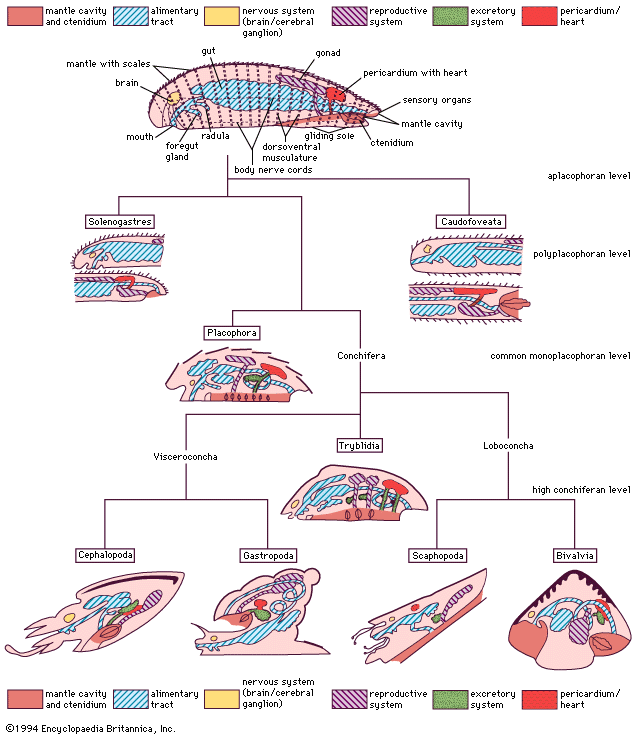
- Symmetry and Segmentation: They exhibit bilateral symmetry and possess paired, multiple organs, which indicate a degree of internal segmentation (metamerism).1
- Anatomical Complexity: Their internal anatomy includes 5–6 pairs of modified gills (ctenidia), 5–6 pairs of excretory organs, and two pairs of heart auricles and gonads.2
- Head Appendages: The head region is equipped with two pairs of appendages.2
- Habitat: These organisms are deep-sea dwellers, typically found at depths ranging from 175 to 6,500 meters, where they function as detritus feeders.12
The presence of metamerism and specific gill structures in monoplacophorans has led researchers to suggest a closer evolutionary affinity between mollusks and annelid worms or arthropods than was previously understood.1
Where are monoplacophorans typically found in the ocean, and what is their habitat like?
Monoplacophorans are exclusively marine mollusks that inhabit deep-sea environments. Contrary to the idea that they might be found in shallow or coastal waters, extant members of the class Monoplacophora are typically found at depths ranging from 175 to 6,500 meters.15
Their habitat is characterized by secondary hard bottoms, where they function as detritus feeders. They capture organic material using specialized head appendages, known as a velum, located around the mouth. While they were once thought to be extinct, living specimens have been discovered in various deep-sea locations, including off the coasts of Central and South America, at depths reaching approximately 5,800 meters.51
When were monoplacophorans first discovered, and how did this discovery impact the field of malacology?
Living monoplacophorans were first discovered in 1952, when several specimens were dredged from a depth of 3,570 meters off the coast of Costa Rica. Prior to this discovery, it was widely believed that the group had become extinct approximately 400 million years ago.1
This discovery had a profound impact on the field of malacology and evolutionary biology. Because monoplacophorans possess a unique combination of primitive characteristics—specifically their paired, multiple organs and gill structures—they provide critical evidence of metamerism (segmentation). These anatomical features suggest that mollusks share a much closer evolutionary affinity with annelid worms and potentially arthropods than was previously believed.1 By offering a window into the ancestral organization of mollusks, the discovery of these “living fossils” has been instrumental in refining our understanding of how the various molluscan classes differentiated over time.16
How do monoplacophorans feed and what is their diet?
Monoplacophorans are detritivores that inhabit secondary hard bottoms in the deep sea. They nourish themselves by capturing loose organic material, known as detritus, from their environment.1
To feed, these mollusks utilize specialized head appendages called a velum, which are positioned around the mouth to collect food particles. This method of gathering organic matter allows them to thrive in deep-sea habitats ranging from 175 to 6,500 meters in depth.1
Sources
- monoplacophoran — Encyclopædia Britannica
- mollusk - Evolution and paleontology — Encyclopædia Britannica
- list of mollusks — Encyclopædia Britannica
- mollusk - Annotated classification — Encyclopædia Britannica
- mollusk - Habitats, feeding habits, and associations — Encyclopædia Britannica
- bivalve - Evolution and paleontology — Encyclopædia Britannica
- bivalve - Food and feeding — Encyclopædia Britannica
Published on · 2 min read