Opisthobranch
An opisthobranch is any marine gastropod belonging to the subclass Opisthobranchia, a group comprising approximately 2,000 species. Often referred to as sea…
What is opisthobranch?
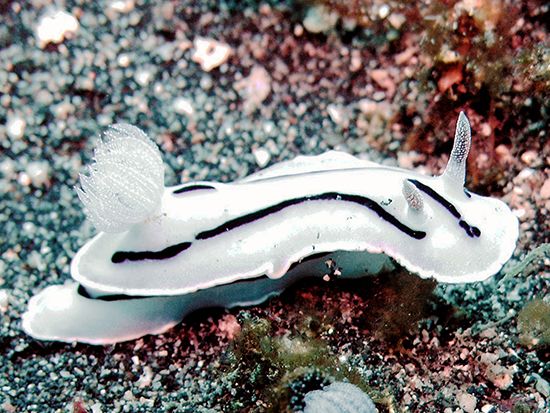
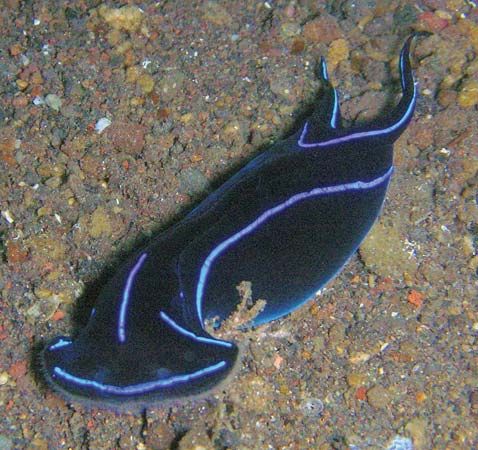
An opisthobranch is any marine gastropod belonging to the subclass Opisthobranchia, a group comprising approximately 2,000 species. Often referred to as sea slugs or sea hares, these animals are characterized by having gills located behind the heart, or by breathing directly through their body surface.12
In most species, the shell and mantle cavity are either reduced or entirely absent. While gastropod development typically involves a twisting of the body known as torsion, opisthobranchs often undergo a process called “detorsion” during metamorphosis, which typically positions the mantle cavity at the side or rear of the animal. Additionally, every opisthobranch is a simultaneous hermaphrodite, meaning each individual possesses both male and female reproductive organs.1
Major groups within this subclass include nudibranchs, sea hares, bubble shells, and pteropods.13
How do nudibranchs use their cerata for defense?
Nudibranchs utilize their cerata—the bizarre, finger-like outgrowths on their backs—as a sophisticated defensive mechanism. When these marine gastropods feed on cnidarians, such as sea anemones, they ingest the prey’s stinging cells, known as nematocysts.
Through specialized glandular secretions, the nudibranch prevents these capsules from discharging while they are being consumed. The animal then stores the intact, functional nematocysts within its cerata. When a predator attacks, the nudibranch discharges these stolen stinging cells from the cerata to deter the aggressor, effectively turning the prey’s own weapon against the predator. In addition to this defensive role, the cerata also serve the vital function of gas exchange for the animal.25
What does it mean for an animal to be a simultaneous hermaphrodite?
A simultaneous hermaphrodite is an animal that possesses both functional male and female reproductive organs at the same time, allowing a single individual to produce both sperm and eggs concurrently.78
While these animals are biologically equipped for both roles, they typically engage in cross-fertilization rather than self-fertilization. In many species, this involves mutual copulation, where each member of a mating pair introduces sperm into the body of the other. This strategy is common among various invertebrates, including earthworms, slugs, land snails, flatworms, and barnacles.7
It is important to distinguish this from other reproductive patterns, such as sequential hermaphroditism, where an animal changes sex over its life cycle (e.g., starting as a male and becoming a female as it grows larger). In simultaneous hermaphrodites, the presence of both sets of organs is a permanent, mature state.798
What is the process of torsion in gastropod development?
Torsion is a unique developmental process occurring in gastropods during their larval stage, known as the veliger. During this process, the animal undergoes a 180° twisting of its body, which effectively shifts the posterior portion of the body to an anterior position located behind the head.1
This anatomical reorganization is a defining characteristic of gastropod development. However, the extent of this process varies among different groups. For instance, in opisthobranchs, torsion is often limited, or the individuals may undergo a process called “detorsion” during metamorphosis. Consequently, in many opisthobranchs, the mantle cavity is positioned at the side or rear of the animal rather than at the front.12
Sources
- opisthobranch — Encyclopædia Britannica
- nudibranch — Encyclopædia Britannica
- list of mollusks — Encyclopædia Britannica
- Opisthobranchia — Merriam-Webster
- mollusk - Features of defense — Encyclopædia Britannica
- Chemoreception - Defensive tastes — Encyclopædia Britannica
- Sex - Sex patterns — Encyclopædia Britannica
- hermaphrodite — Merriam-Webster
- hermaphroditism — Merriam-Webster
- Animal reproductive system - Gonads, associated structures, and products — Encyclopædia Britannica
- Reproductive behaviour - Fishes — Encyclopædia Britannica
- gastropod - Reproduction and life cycles — Encyclopædia Britannica
Published on · 2 min read